Synopsis
- In the same way that a smartphone is a device that can still be used physically but loses usefulness, protection, and compatibility with software updates over time, a fifth-generation fighter runs the risk of becoming substantially less relevant in terms of how it is applied in the current combat context unless it is kept in constant contact with the stream of upgrades with it.
Source : IgMp Bulletin
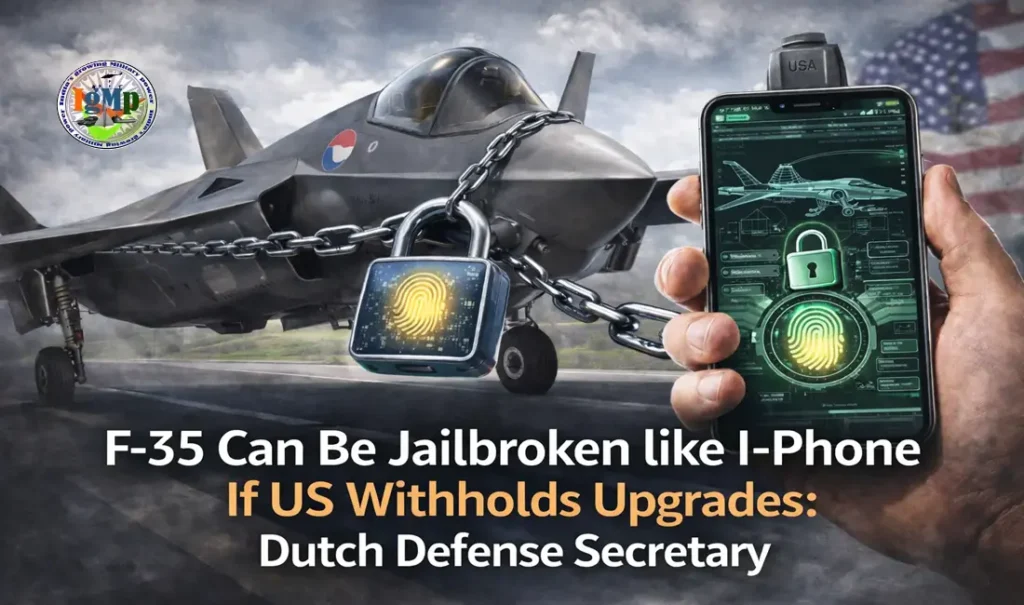
Concerns over sovereign control of advanced combat aircraft have returned to the spotlight after the statement made by Christophe van der Maat, who serves as a Dutch state secretary for defence, suggested that the F-35’s software architecture could theoretically be “jailbroken” if the United States were to withhold critical updates. The comments, made by Christophe van der Maat, have reignited a long-speculated debate in European defence circles over dependence on US-controlled software ecosystems in fifth-generation fighter jets.
It has not been a new discussion, but has found a new surge of traction with the F-35 Lightning II taking a back seat in the combat aviation inventories of more European air services. The Netherlands, as with a number of other NATO allies, has invested in the aircraft as a fundamental component of its air power to the point of making it a part of national defence planning, alliance obligations, and long-term force organization. It is against this background that any hint of the idea that access to software or software upgrades may be limited poses uncomfortable questions about freedom of choice in the current warfare.
Background of the remark made by Dutch Defence Secretary: The ‘Kill Switch’ discussion in the European Defence circles
These statements by Van der Maat were made in the background of discussions about an alleged kill switch in the F-35, a statement that both the US government and the manufacturing company have vigorously refuted. He was keen to mention that the aircraft cannot be merely flipped off by Washington. But his analogy to an iPhone was informative. In the same way that a smartphone is a device that can still be used physically but loses usefulness, protection, and compatibility with software updates over time, a fifth-generation fighter runs the risk of becoming substantially less relevant in terms of how it is applied in the current combat context unless it is kept in constant contact with the stream of upgrades with it.
The main issue is that the F-35 is a software-defined weapons system. The F-35 can be improved by adding new functionality via periodic blocks of software that enable additional capabilities, enhanced sensor fusion, enhanced electronic warfare tasks, and add new weapons, unlike its predecessors, whose performance was mainly determined at the time of delivery. The updates are not just optional additions; they are the main core of the relevance of the aircraft to the fast-changing threats. Their absence means that a jet that is projected to rule disputed airspace would operate with limited awareness, survivability, and interoperability with the allied forces.
The F-35 program structure itself is a source of European apprehensions. The plane is designed, maintained, and also improved within a US-dominated framework whereby important aspects like mission data files, threat, libraries, and even some parts of logistics and diagnostics are highly restricted. Although partner countries make contributions in the financial and industrial sectors, the final decision-making on the software roadmap and the issue of updates is carried out by the United States. During periods of congruency, this structure provides effectiveness, standardisation, and commonness of force. During political pressure, though, it may seem that it is a strategic weakness.
Increasing Discomfort among European F-35 operators
When the defence secretary of the Netherlands mentions jailbreaking, it reflects a theoretical possibility rather than a practical policy option. Hacking or avoiding proprietary military software would be much more complicated than any hack on a consumer smartphone, and would probably have breached security agreements, export controls, and contractual liability. It might also pose some severe threats, including a weakened cybersecurity to weapons and sensors certification. However, the fact that such analogies are being debated in the open is an indication of increased discomfort over dependence on digitally controlled ecosystems.
This is a discomfort that is felt throughout Europe. Italy, Norway, Denmark, Belgium, Poland, and Finland, among others, are building or considering building F-35 fleets and basing their future air power on the same platform. In the case of NATO, this similarity presents titanic protection benefits, which allow the free exchange of data, common missions, and combined deterrence. However, to individual states, it also implies that the national freedom of action is becoming dependent more and more on software control and less on the actual aircraft ownership.
The so-called kill switch debate tends to look at the matter simplistically. The intellectual community of defence analysts is in a thorough consensus that the more realistic variant of leverage is not the incapacitation of the aircraft itself but the administrative control of access to upgrades, spares, encryption keys, and mission data. An F-35 without recent threat libraries will be able to fly, but its performance in terms of detecting, classifying, and acting against more modern air defence will be beyond the capability of an older aircraft. This may have a long-term impact on the level of training, preparedness to combat, and confidence in combat planning.
The US officials are trying their best to assure European partners, but is it a bit too late a response?
The US officials have repeatedly tried to assure partners that this is merely hypothetical and it is something that cannot possibly occur according to the rules of alliances. They insist that the F-35 project is established on the basis of mutual trust and mutual security interests, specifically in NATO. In the thinking of Washington, refusing upgrades to close allies will hamper collective defence and destroy long-formed alliances. Nevertheless, history has demonstrated that whatever happens in the relationship between supplying arms can also get mired up by political wrangles; as such, the European governments are cautious not to make the permanent alignment assumption.
The new debate is also overlapped with the larger European ambitions for defence autonomy. Efforts to build native or collective-governed fighting airplanes, detectors, and electronic structures are also influenced in part by the experience of depending on systems managed by a different nation. Other programs like future European fighter projects are meant to provide those countries involved with more control over software, data, and upgrade cycles, even when working in conjunction with other countries.
For the Netherlands, the discussion is particularly sensitive. The country has not only purchased the F-35 but is also deeply attached to its industrial and operational ecosystem. The Dutch firms also contribute to the global supply chain, and the Royal Netherlands Air Force is one of the most active European users of the airplanes. The remarks made by Van der Maat are therefore not an indicator of a disregard of the F-35, but are actually a very frank acknowledgement of the strategic trade-offs that come along with the management of one of the most sophisticated weapons systems in the world.
No doubts on F-35’s capabilities, but Europe has already decided to secure its future on its own
Operationally, the F-35 is unsurpassed in several ways. The sensor fusion, low observability, and capability to be considered a force multiplier of other assets have radically altered the manner in which air forces plan and execute missions. In intelligence collection, electronic warfare, and networked operations, European pilots and commanders are always pointing to the aircraft as valuable assets. It is these strengths that make there not being a European F-35 operator actually thinking about leaving the programme despite the frequent discussions on the matter.
The debate surrounding the issue of software sovereignty is, however, influencing future thought. Military procurement departments are putting more focus on scrutiny of contracts, access privileges, and data management. It has become increasingly popular to make sure that national authorities retain the necessary level of perception and control over the development of their platforms. Parallel capabilities that are being invested in by some countries include sovereign data centres, alternative mission planning tools, and increased domestic knowledge on software integration.
The comparison with the iPhone, though far-fetched, has resonated as it has embodied a kernel of reality about the modern war machine technology. Nowadays, only metal, engines, and weapons are not the most significant sources of power; code, updates, and algorithms are. The management of such factors is what will define performance, but it will also define autonomy. In the case of fifth-generation fighters, such as the F-35, this fact obliterates the separation between possession and access.
These questions are not likely to subside as geopolitical competition between nations grows stronger and technological cycles become much faster. On the contrary, they will lie at the heart of the state’s perception of defence relationships and purchasing decisions. The words of the Dutch defence secretary have not betrayed some not-so-secret weakness but have exposed an unpleasant reality: in the age of software-defined war, sovereignty exists in the same way that it does on the flag by means of paint-on-tail aircraft: digitally.
To the F-35 operators in Europe, the issue is whether the undoubted advantages of being members of an integrated, powerful alliance system can be offset by the need to have more national agency. The controversy after the statements of van der Maat indicates that such a balance will continue being one of the character statements of air power policy in the coming years, which will not only influence the management of the current fleets, but also shape the way the combat aircraft of the future are thought and guided.