Synopsis
- The development of a credible and indigenous ballistic missile shield is approaching a decisive phase as India, in its Ballistic Missile Defence (BMD) Phase-II program, is progressively getting closer to the developmental test firing of the much-anticipated AD-2 interceptor.
Source : IgMp Bulletin
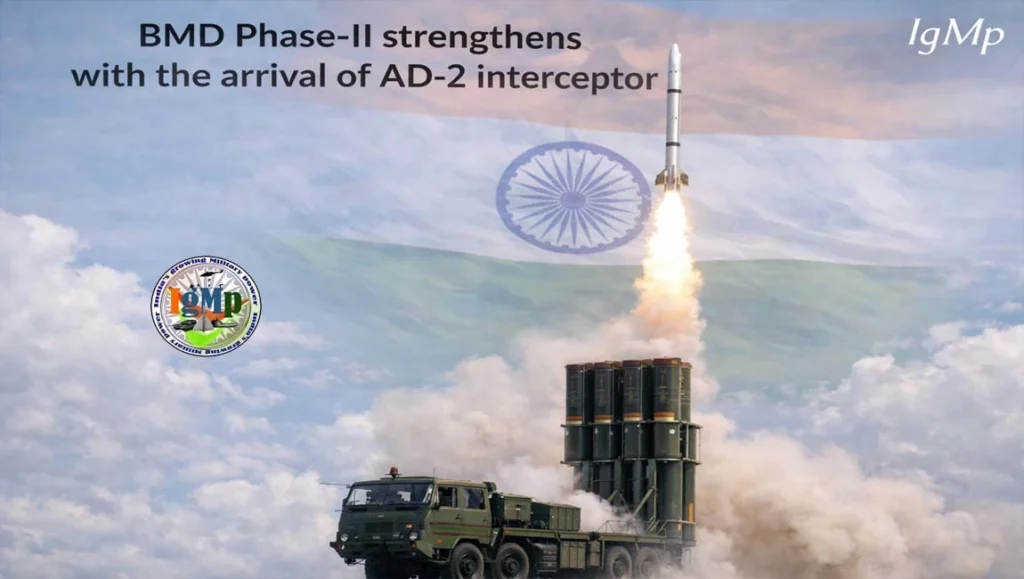
The development of a credible and indigenous ballistic missile shield is approaching a decisive phase as India, in its Ballistic Missile Defence (BMD) Phase-II program, is progressively getting closer to the developmental test firing of the much-anticipated AD-2 interceptor. The AD-2 is an advanced interceptor missile that will be able to perform at Mach 7+ speeds and intercept high altitude threats, as well as mark a significant move forward in India’s quest to defend against long-range ballistic missiles and emerging multiple warheads.
BMD Phase-II architecture is a development that has taken years to take on an unobtrusive manner, through laboratory studies, simulations, subsystem tests, and full flight developments. Central to this initiative is the Defence Research and Development Organisation (DRDO), which has been at the forefront of the missile and air defence programs in India over the decades. As the AD-2 interceptor is entering its test window, India is planning to build up the upper layer of its missile defense cover in a manner that will substantially increase the coverage.
The AD-2 is meant to be an exo-atmospheric interceptor. It is designed to intercept incoming ballistic missiles beyond the atmosphere of the Earth and at very high altitudes, before the latter starts to fall towards the ground. This is especially relevant when it comes to Intermediate Range Ballistic Missiles (IRBMs) and Intercontinental Ballistic Missiles (ICBMs), which travel long distances and, upon returning into the atmosphere, do so at very high speeds. By engaging the target in its first phase or during midcourse, the defender obtains additional time and chances of engagement with the threat in its early stages.
The Indian BMD Phase-II is a layered concept. The AD-1 interceptor, which has gone through flight validation, can intercept both exo-atmospheric and endo-atmospheric targets. It has flexibility in the altitude of engagements. The AD- 2, in turn, is designed to fit high-altitude exo-atmospheric missions. Together, the two interceptors are supposed to create a multi-layered shield, and this is more likely to create a successful intercept against high-tech ballistic threats.
An important milestone in this process was reached when the Defence Research and Development Organisation, on July 24, 2024, conducted the maiden flight test of the AD-1 interceptor as part of the Phase-II system. The test was a validation that the interceptor itself, along with the larger network-centric architecture on which the missile shield is based, was valid. The long-range radar, tracking equipment, secure communications links, and battle management software were combined so that it was able to counter the target of the 5,000 km category. The accomplishment thereof highlighted the increasing Indian capability to deal with high-speed and long-range ballistic threats.
This is expected to be pushed further by the AD-2. The interceptor should work on very tight deadlines with a speed listed to be more than Mach 7. Blasting missiles, particularly those in the IRBM and ICBM categories, have the capability of attaining hypersonic speeds during re-entry. The dilemma in all missile defense systems is to detect, track, discriminate, and engage such targets within a few seconds. High-speed profile of the AD-2, along with advanced guidance and seeker systems are meant to comply with such a challenging requirement.
Among the new threats posed by sophisticated long-range missiles to missile defense systems around the world is the menace of MiRV, or Multi Independently Launchable Re-entry Vehicles. This enables one ballistic missile to carry several warheads, all programmed to hit various targets. It is much more complicated than simple warhead interception to defend against MiRVs. An effective penetrative interceptor, such as the AD-2, improves the capability of the defender to intercept a number of objects in space before they scatter out completely and fall into the atmosphere. Although it is a secretive matter of technicalities, the emphasis on exo-atmospheric interception implies that India is building their shield, considering such highly problematic threats.
The development of infrastructure is also proceeding in the same direction. New test ranges are being created at Machilipatnam on the eastern coast and at Rutland Island in the Andaman and Nicobar Islands chain. These sites provide tactical richness and a variety of paths to probe long-range intercept conditions. Besides that, a 10,000-ton displacement vessel is being prepared to be a floating test range. The platform, which is based at sea, enables experimentation in different azimuths and flight paths, which are flexible and cannot always be offered on fixed land ranges. It is an intentional attempt to test the system in realistic and complex conditions to prove it.
Another compelling aspect of the AD-2 program is the intended maritime integration. Phase-II interceptors such as the AD-2 are also being discussed to be deployed on Indian Navy destroyers and other large warships. This would create a beam of protection for the missiles over the sea beyond land-based batteries. The introduction of naval deployment would permit a military area extensive to the coastal areas, important sea routes, and forward operations bases. It would equally make the posture of India’s missile defense consistent with the changing naval effectiveness theories of layered air and missile defense of carrier groups and task forces.
The broader significance of BMD Phase-II goes beyond hardware. It shows how India has been progressing slowly but surely towards being self-reliant in technologically critical defense systems. To develop an indigenous ballistic missile defense system, there is a need to have a mastery of technology in the area of propulsion systems, high-precision guidance, cutting-edge materials, radar engineering, data fusion of information, and secure communications. Every successful trial makes a country less dependent on the outside environment and increases the domestic industrial forces. Long term, these programs can be targeted at a broader high-technology manufacturing and research ecosystem.
When operational, the AD-1 and AD-2 together will create a set of layers of protection that can handle a range of ballistic missile threats. There are very few nations that have successfully deployed comprehensive, indigenous missile defense systems in both the lower and long ranges. India is one of those countries that will be joining the few that are doing so by progressing through Phase-II. The resilience of the architecture is further increased by land-based and possibly sea-based systems.
There will be rigorous testing ahead. Guidance accuracy, the ability of the guidance accuracy, hit-to-kill performance, sensor coordination, and system reliability under varied conditions should be validated in developmental trials as part of multiple conditions. The data provided by each test will be used as feedback that will be fed into refinements of software, hardware, and operational processes. Missile defense systems are not evaluated by what is said, but by the recurring, consistent successes in challenging situations.
With the AD-2 interceptor moving into the preliminary major testing stage, the missile defense shield of India is on the verge of a fundamental enhancement. BMD Phase-II takes the form of a smooth defense architecture with high-altitude interception capability, increased speed, and an increased support infrastructure. The upcoming trials will determine how effectively the AD-2 can translate design ambition into operational reality, strengthening India’s ability to deter and defend against the most advanced ballistic missile threats in the region and beyond.