Synopsis
- Inducted in Chennai in the presence of Chief of Naval Staff Dinesh K Tripathi, the new warship marks another step in the Navy’s sustained push to expand indigenous maritime capabilities amid evolving regional security challenges.
Source : IgMp Bulletin
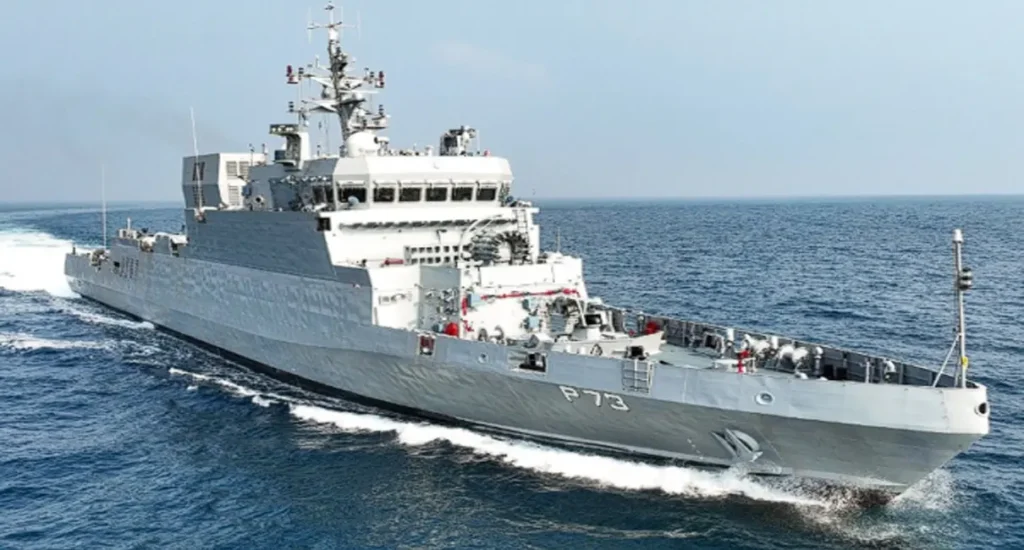
The Indian Navy has commissioned INS Anjadip, a purpose-built anti-submarine warfare platform designed to sharpen India’s edge in coastal defence and undersea surveillance. Inducted in Chennai in the presence of Chief of Naval Staff Dinesh K Tripathi, the new warship marks another step in the Navy’s sustained push to expand indigenous maritime capabilities amid evolving regional security challenges.
INS Anjadip is part of the Anti-Submarine Warfare Shallow Water Craft (ASW-SWC) programme, a project aimed at plugging a long-recognised gap in littoral warfare. While larger destroyers and frigates patrol the high seas, shallow coastal waters demand specialised vessels that can detect and neutralise hostile submarines attempting to operate close to shore. At 77 metres in length and powered by water-jet propulsion, the ship can reach speeds of around 25 knots, enabling rapid response across India’s busy eastern and western seaboards.
Often described as a “Dolphin Hunter,” INS Anjadip carries a comprehensive indigenous sensor and weapons suite tailored for undersea combat. The hull-mounted sonar system provides real-time detection and tracking of submarines in complex shallow-water conditions, where acoustic signals can be distorted. Complementing this are lightweight torpedoes and anti-submarine rockets, giving the vessel credible offensive capability against underwater threats. An integrated combat management system helps fuse data from multiple sensors, allowing quicker decision-making during high-pressure operations.
The vessel has been built by Garden Reach Shipbuilders & Engineers (GRSE), reflecting India’s broader drive toward defence self-reliance. Over the past decade, the Navy has increasingly relied on domestic shipyards for frontline platforms, ranging from aircraft carriers to missile corvettes. The ASW-SWC programme itself is a key pillar of that effort, with multiple ships under construction to ensure sustained force levels in the coming years.
Beyond its primary anti-submarine role, INS Anjadip is also equipped for coastal surveillance, low-intensity maritime operations, and search-and-rescue missions. These secondary roles are critical in a region where fishing traffic, commercial shipping, and naval patrols often intersect. The ship’s agility and shallow draft allow it to operate in waters where larger combatants may face constraints.
The strategic timing of the induction is significant. Maritime security dynamics in the Indian Ocean Region have become more complex, with increasing submarine deployments by regional and extra-regional navies. Coastal waters, once considered relatively secure, are now viewed as potential zones of covert activity. Strengthening shallow-water anti-submarine capability ensures that India can monitor and respond to undersea movements close to vital ports, naval bases, and energy corridors.
The ship’s name carries historical resonance. Anjadip Island, located off the Karnataka coast, witnessed naval action during operations linked to the liberation of Goa. By adopting this name, the Navy underscores continuity between past maritime resolve and present-day preparedness.
Recent global disruptions, from tensions around critical chokepoints to attacks on merchant shipping, have reinforced the importance of layered maritime defence. Since late 2023, Indian naval deployments have played a visible role in ensuring safe passage for commercial vessels in sensitive waters. Platforms like INS Anjadip add another layer to that security architecture, particularly in safeguarding approaches to the mainland.
For defence analysts, the commissioning reflects a broader doctrinal shift. Undersea warfare is no longer confined to deep-ocean cat-and-mouse games between nuclear submarines. It increasingly involves protecting coastal infrastructure, monitoring grey-zone activity, and maintaining credible deterrence in contested littoral zones. By inducting specialised shallow-water ASW vessels at scale, the Indian Navy is signalling that it intends to stay ahead of emerging threats rather than react to them.
As more ships from the ASW-SWC programme join the fleet, India’s coastal anti-submarine grid will become denser and more responsive. INS Anjadip’s entry into service is not just another addition to the order of battle; it represents a focused investment in undersea vigilance at a time when maritime security is central to national strategy.