Synopsis
- Defence observers note that the aircraft is intended to fill the gap between lightweight fighters and heavier multirole platforms, offering a balance of agility and firepower tailored to the Indian Air Force’s evolving operational needs.
Source : IgMp Bulletin
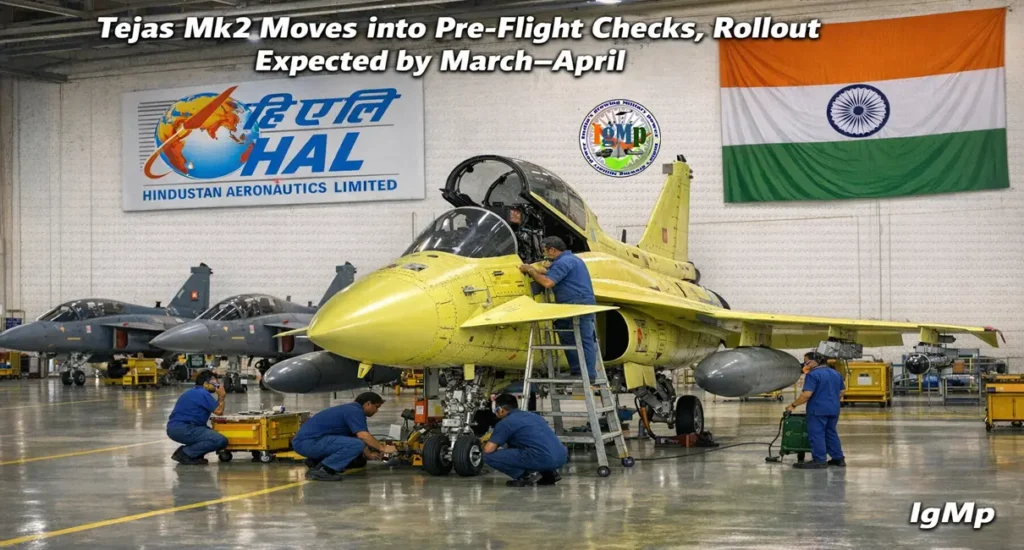
India’s next-generation fighter program has taken a crucial step forward, with the Tejas Mk2 entering the pre-flight calibration phase ahead of its anticipated rollout in March or April. For a project closely watched by defence analysts and the aerospace industry alike, this milestone signals that the aircraft is moving steadily from assembly toward ground validation and eventual flight testing.
The Tejas Mk2, being developed by Aeronautical Development Agency in partnership with Hindustan Aeronautics Limited, is designed as a more powerful and capable evolution of the earlier Tejas variants. With roughly 70 percent of the prototype already assembled, engineers are now focused on ensuring that the aircraft’s complex systems function precisely as intended before it ever leaves the ground.
Pre-flight calibration is not a ceremonial checkpoint; it is one of the most technically demanding stages in fighter development. At this stage, flight control laws are validated to confirm that the digital fly-by-wire system responds accurately across different simulated conditions. Structural stress assessments are conducted to ensure that the airframe can withstand aerodynamic loads during high-speed manoeuvres. Fuel system checks are also critical, as imbalances or flow inconsistencies can have serious safety implications. Only after these parameters are cleared can the aircraft move toward high-energy ground trials such as taxi tests.
The Tejas Mk2 represents a significant leap over the earlier HAL Tejas variants. It is expected to feature a more powerful engine, increased payload capacity, extended range and an upgraded avionics suite. Defence observers note that the aircraft is intended to fill the gap between lightweight fighters and heavier multirole platforms, offering a balance of agility and firepower tailored to the Indian Air Force’s evolving operational needs.
The timeline suggests that once the aircraft rolls out, the maiden flight could take place approximately six to eight months later, provided all safety parameters are cleared. Current projections point toward a first flight window in late 2026 or early 2027. While delays are not uncommon in aerospace programs, steady progress through calibration indicates disciplined project management and maturing design stability.
From a strategic standpoint, the Tejas Mk2 program is central to India’s broader push for defence self-reliance. Indigenous fighter development reduces long-term dependence on imports and strengthens domestic aerospace capabilities. Over the past decade, India has invested heavily in building supply chains for avionics, composite materials and precision manufacturing. The Mk2 integrates lessons learned from earlier Tejas production runs, including maintainability improvements and streamlined assembly processes.
For the Indian Air Force, the aircraft is expected to replace ageing fleets while complementing heavier platforms already in service. Modern air combat increasingly demands multi-role flexibility, network-centric capability and the ability to integrate advanced weapons and sensors. The Tejas Mk2’s expanded internal fuel capacity and improved radar systems are intended to meet those benchmarks.
Industry experts often point out that fighter programs are as much about ecosystem development as about a single aircraft. The calibration phase reflects the cumulative effort of engineers, test pilots, structural analysts and quality control teams. Each validated system builds confidence not only in this platform but in future projects as well.
As India’s aerospace ambitions grow, progress on the Tejas Mk2 underscores a larger narrative of technological advancement and industrial depth. Moving into pre-flight calibration brings the aircraft closer to its long-awaited rollout and eventual first flight, marking another measured step in the country’s journey toward advanced fighter design and production.