Synopsis
Source : IgMp Bulletin
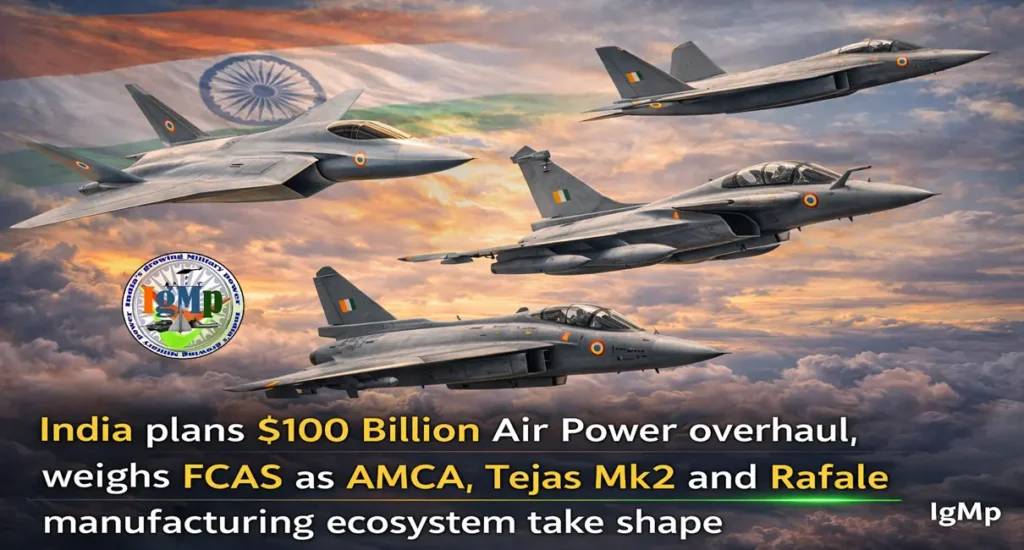
India’s air power roadmap is entering a decisive phase as New Delhi weighs a sweeping modernization effort that could approach $100 billion over the next decade and beyond. The objective is clear: rebuild the Indian Air Force to a credible 50-squadron force by around 2040, while reducing long-term dependence on fragmented imports. What makes the current push different from earlier cycles is the balance India is attempting to strike between selective foreign collaboration and an increasingly confident indigenous fighter ecosystem.
At the heart of this strategy is a layered fleet structure. Rather than betting on a single platform, the IAF is aligning multiple programs across different technology levels and timelines. The indigenous fifth-generation AMCA is positioned as the long-term centerpiece, designed to anchor network-centric, multi-domain air warfare. Alongside it, the Tejas Mk2 is expected to fill the critical medium-weight category, replacing ageing MiG-29 and Mirage-era fleets while providing numerical strength at sustainable cost.
Yet planners are realistic about timelines. AMCA remains a complex developmental effort, and while progress has been steady, the aircraft will take time to mature into a fully operational combat system. This gap is where India’s interest in the Future Combat Air System enters the picture. Unlike earlier sixth-generation concepts explored globally, FCAS is being examined less as an off-the-shelf purchase and more as a potential collaborative pathway that aligns with India’s operational doctrine and industrial ambitions.
France’s approach has found traction in Indian assessments for several reasons. One is continuity. The IAF already operates the Rafale, and the growing domestic manufacturing and maintenance ecosystem around the jet has reshaped how India views long-term fighter sustainment. The possibility of extending that ecosystem—covering avionics, structures, engines and mission systems—into future platforms reduces risk and improves life-cycle control. For a force that has struggled with fragmented supply chains across diverse fleets, this industrial coherence matters as much as performance.
There is also an operational logic at play. FCAS is being designed with carrier compatibility, nuclear mission flexibility and deep integration of sensors, unmanned systems and data fusion. These attributes resonate with India’s evolving threat environment, where air power must seamlessly connect with space, cyber, naval and ground domains. For the IAF, a future successor to the Sukhoi Su-30MKI cannot simply be a faster or stealthier aircraft; it must act as a command node in a distributed combat network.
Importantly, India’s interest in FCAS does not signal a retreat from indigenous ambition. On the contrary, policymakers increasingly see external collaboration as a force multiplier for domestic programs. Technologies, design philosophies and manufacturing practices absorbed through such partnerships could directly inform AMCA’s later blocks and upgrades. This two-track approach—developing at home while selectively engaging abroad—reflects lessons learned from past all-or-nothing strategies.
The scale of investment under consideration underscores how seriously India views the challenge. Restoring squadron strength while preparing for next-generation warfare requires not just aircraft, but simulators, weapons, sensors, digital backbones and skilled manpower. By aligning Tejas Mk2 for numbers, AMCA for strategic edge, Rafale for immediate capability and FCAS for the post-2040 horizon, India is attempting to build an air force that is resilient, adaptable and industrially sustainable.
If executed as envisioned, this modernization drive could redefine India’s air power not just in terms of platforms, but in how those platforms are designed, built, upgraded and fought as part of a unified combat system.