Synopsis
- Videos of several Iranian Shahed low cost long range suicide drones hitting high rise prestigious buildings in UAE like the Burj Khalifa, raises the never ending debate of using high value air defence interceptors against low cost drones, with most of the middle east countries relying heavily on American air defenses, it is high time that they start thinking on other alternative low cost systems to match the low cost attacking option of drones especially.
Source : IgMp Bulletin
The rapidly expanding conflict involving Iran, Israel and the United States has pushed the Middle East into a new phase of warfare, one where the balance between cost, scale and technology is being tested in real time. Over the past few days, Iranian drone and missile strikes across the Gulf have done more than signal retaliation; they have highlighted how low-cost unmanned systems can strain even the most sophisticated air defence networks deployed by some of the world’s best-equipped militaries.
Iran’s use of massed Shahed-series drones has become the most visible symbol of this shift. Developed as relatively simple, long-range loitering munitions, Shahed drones are not designed to defeat air defences through stealth or speed. Their strength lies in numbers, persistence and economics. Each drone costs a fraction of the price of the interceptor missiles used to stop it, yet when launched in large swarms, they force defenders into difficult choices about prioritisation and expenditure. This dynamic has played out across the Gulf, where US and allied air defence systems have been working continuously to counter waves of incoming threats.
Facilities linked to the United States and its partners across Bahrain, Qatar, the United Arab Emirates, Kuwait and Saudi Arabia have faced sustained pressure. While the majority of Iranian missiles were intercepted, drones proved harder to manage. Their slow speed and low-altitude flight profiles allowed many to slip beneath radar horizons until late in their approach, compressing reaction times. In several cases, drones penetrated defended airspace and caused damage despite high interception rates, underscoring how saturation can exploit even small gaps in layered defences.
Videos of the US Patriot air defense system launching several interceptor missiles to intercept a single Iranian ballistic missile, yet failing to intercept it, went viral on social media, raising questions about the efficiency of the long-marketed Patriot PAC-III air defense system of the United States, which is used by several American partners and allies.
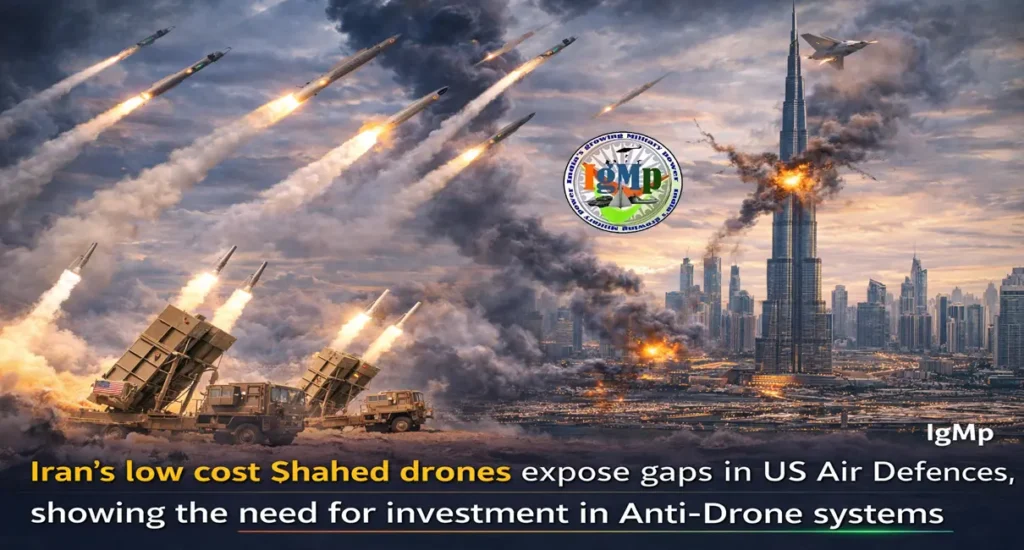
Videos of several Iranian Shahed low cost long range suicide drones hitting high rise prestigious buildings in UAE like the Burj Khalifa, raises the never ending debate of using high value air defence interceptors against low cost drones, with most of the middle east countries relying heavily on American air defenses, it is high time that they start thinking on other alternative low cost systems to match the low cost attacking option of drones especially.
What makes this episode particularly instructive is how it reflects broader trends in modern warfare. Iran’s approach blends traditional ballistic missiles with drones that act as both decoys and strike weapons. The missiles draw attention and trigger high-end interceptors, while drones arriving in parallel or shortly afterward test the endurance and coverage of defensive networks. This hybrid model does not require technological parity with adversaries; instead, it leverages asymmetry, forcing defenders to spend disproportionately more to maintain protection.
The geopolitical context adds another layer of complexity. Countries such as the United Arab Emirates and Qatar host critical US facilities and sit astride global aviation and energy routes. Disruptions near airports, ports and urban centres carry economic and psychological impact beyond the immediate military effect. Even limited damage can ripple through markets and logistics, magnifying the strategic value of relatively modest attacks.
For the United States and its regional partners, the current crisis is prompting hard questions about future air defence architecture. High-end systems remain indispensable against ballistic and cruise missile threats, but they are increasingly being supplemented by discussions around lower-cost counter-drone measures. Electronic warfare, directed-energy weapons, cheaper interceptor missiles and integrated sensor networks are gaining renewed attention as ways to address the drone problem without exhausting premium assets.
Iran, for its part, appears to have internalised lessons from conflicts elsewhere, including Ukraine and earlier Middle Eastern engagements. The emphasis on volume, persistence and psychological pressure reflects an understanding that modern conflict is as much about endurance as precision. Shahed drones, once dismissed as crude, have now proven their relevance by forcing advanced militaries into defensive postures that are expensive and difficult to sustain over time.
As the conflict continues to evolve, the broader lesson extends far beyond the Middle East. The era when air superiority and missile defence could be assured purely through technological sophistication is giving way to a more complex reality. Low-cost systems, when used creatively and at scale, can challenge high-end defences and reshape operational planning. The Gulf skies over the past few days have offered a stark preview of how future wars may be fought—not just with the most advanced weapons, but with the smartest use of affordable ones.