Synopsis
- According to United Aircraft Corporation, the aircraft is expected to achieve its first flight in the first half of 2026, placing it on a realistic development trajectory at a time when India needs decisions rather than distant promises.
Source : IgMp Bulletin
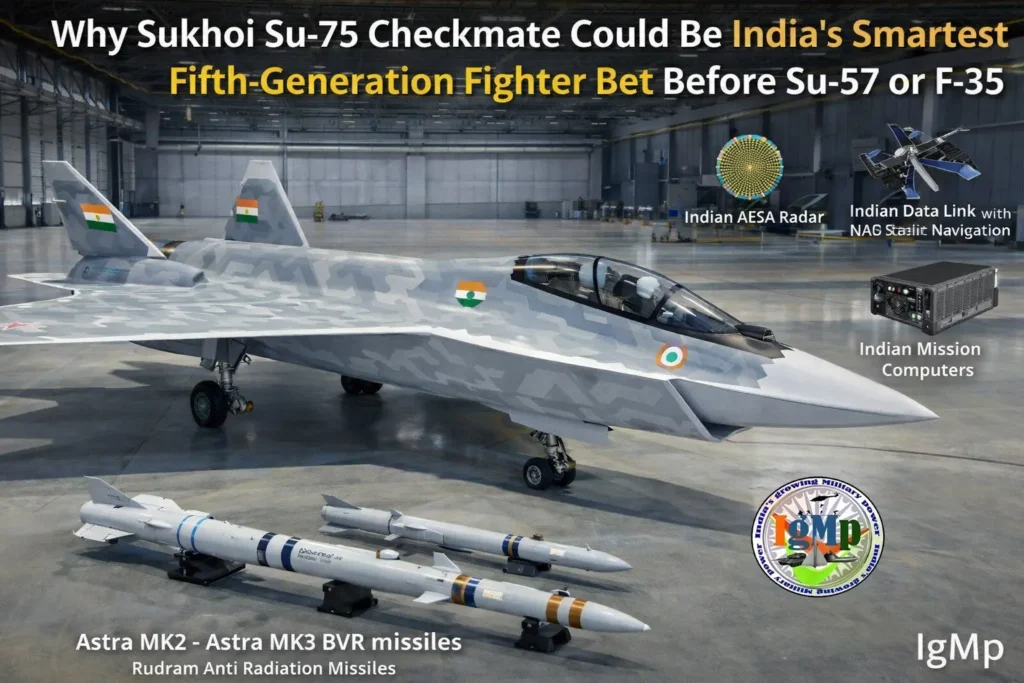
India’s search for a practical fifth-generation fighter is increasingly shaped by timelines, affordability, and strategic autonomy rather than prestige alone. As the Indian Air Force balances near-term capability gaps with long-term self-reliance, the Russian Su-75 “Checkmate” is quietly emerging as an option that deserves closer scrutiny, especially when compared with the heavier Su-57 or the far more expensive American F-35.
The Su-75 was conceived as a lighter, single-engine stealth fighter optimized for cost efficiency and export flexibility. According to United Aircraft Corporation, the aircraft is expected to achieve its first flight in the first half of 2026, placing it on a realistic development trajectory at a time when India needs decisions rather than distant promises. Since its first public appearance in 2021, the design has undergone visible refinement, particularly in its airframe shaping, intake geometry, and overall signature management, all of which point to a stronger focus on low observability than earlier Russian fighters.
One of the key reasons the Su-75 merits consideration over the Su-57 is philosophy. The Su-57 is a large, twin-engine platform optimized for multi-role dominance, but that size comes with higher costs and a radar signature that has often been debated. The Su-75, by contrast, is built around a sleeker planform, internal weapons carriage, and extensive use of radar-absorbent materials. For India, which faces dense air defence environments on both western and northern fronts, penetrating contested airspace with a smaller, stealth-optimized aircraft could offer greater operational flexibility.
Cost is another decisive factor. The F-35, while technologically mature, remains one of the most expensive fighters to acquire and operate, with lifecycle costs that can strain even well-funded air forces. For India, committing large sums to such a platform could limit squadron numbers and divert resources from indigenous programmes. The Su-75 is being positioned as a far more affordable fifth-generation option, allowing India to induct meaningful numbers without undermining parallel investments in domestic aerospace.
Crucially, the Su-75 also opens the door to deep customization. India has consistently emphasized control over mission software, electronic warfare logic, and sensor fusion. A platform that allows integration of indigenous systems would align far better with this doctrine. India could potentially fit the Su-75 with its own AESA radar, mission computers, and electronic warfare suites developed by organisations like Defence Research and Development Organisation. This would not only enhance survivability but also ensure that upgrades and threat library updates remain under Indian control.
Weapon integration is another area where India could add decisive value. Indigenous munitions such as the Astra beyond-visual-range missile family, Rudram anti-radiation missiles, and precision glide weapons could be tailored for internal carriage, preserving the aircraft’s stealth profile. This approach would allow the Su-75 to evolve into a uniquely Indian configuration, optimized for regional threat scenarios rather than generic export requirements.
From Russia’s perspective, Indian participation could significantly accelerate the programme. India brings experience in large-scale aerospace manufacturing, systems integration, and flight testing under demanding operational conditions. Joint development, localized production, and shared testing infrastructure could help fast-track maturity while giving India leverage over configuration choices and timelines. This kind of partnership would be difficult to replicate with Western platforms that operate under tighter export controls.
Importantly, choosing the Su-75 does not mean compromising India’s indigenous ambitions. Its lower acquisition and operating costs would make it easier to continue steady funding of the AMCA programme. Instead of being a competitor, the Su-75 could act as a bridge, helping the IAF gain fifth-generation operational experience while AMCA progresses toward induction.
Timing, however, is critical. With regional air forces rapidly expanding their stealth fleets, delaying decisions risks widening capability gaps. Taking a call this year would give India clarity, bargaining power, and time to shape outcomes rather than react to them. In that sense, the Su-75 represents not just another fighter option, but a strategic lever that could balance capability, cost, and autonomy in a way few alternatives currently offer.