Synopsis
- India’s push toward an indigenous combat drone ecosystem received a significant boost after the Defence Procurement Board (DPB) cleared the design and development of a new unmanned combat aerial vehicle (UCAV) by the Defence Research and Development Organisation (DRDO).
IgMp Bulletin
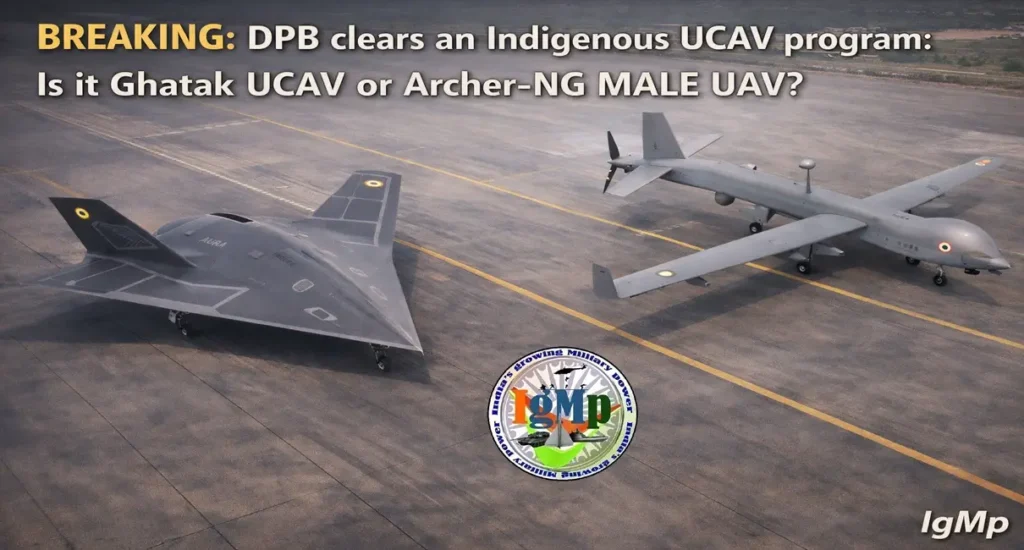
Evaluating the Candidates: Which Indigenous UCAV Has the DPB Cleared?
India’s push toward an indigenous combat drone ecosystem received a significant boost after the Defence Procurement Board (DPB) cleared the design and development of a new unmanned combat aerial vehicle (UCAV) by the Defence Research and Development Organisation (DRDO). However, the exact platform approved in the meeting has not been publicly disclosed [Source: Times Now].
This has sparked discussion across defence circles because several Indian drone programs currently fit the description of an “indigenous combat drone.” Based on available information from ongoing trials, development timelines, and capability requirements of the armed forces, three programs appear to be the most likely candidates: the Archer-NG armed drone, the stealth-focused Ghatak UCAV project, and the weaponised Tapas platform.
Each of these systems represents a different stage of India’s drone development journey and addresses a distinct operational requirement.
The first strong contender is the Archer-NG, an armed Medium-Altitude Long-Endurance platform derived from India’s earlier Rustom drone program. Archer-NG is designed to perform both surveillance and strike missions and is currently undergoing weapon integration trials. The platform is expected to carry precision-guided munitions and anti-tank weapons, allowing it to perform roles similar to Western MALE drones. Because it is already in an advanced stage of development, analysts believe Archer-NG could be the most realistic candidate for a production clearance aimed at rapid induction.
Another possibility is the stealth-focused Ghatak program, India’s long-term effort to build a low-observable combat drone capable of penetrating heavily defended airspace. The project gained attention after the successful flight testing of the Stealth Wing Flying Testbed (SWiFT) technology demonstrator, which validated key aerodynamic and autonomous flight technologies required for a stealth UCAV. While the full-scale operational platform is still several years away, the recent clearance may relate to funding for the next stage of detailed design and systems development.
The third candidate is the weaponised variant of the Tapas drone, formally known as Tapas-BH-201. Originally developed as a surveillance platform comparable to foreign MALE drones, Tapas has recently undergone trials involving anti-tank guided missile integration. If approved for weaponisation and production, this platform could provide a relatively quick indigenous alternative for intelligence, surveillance, reconnaissance, and strike missions.
Comparison of Potential Candidates for Today’s DPB Clearance
| Potential Project | Current Development Status | Role / Capability | Probability of Clearance |
|---|---|---|---|
| Archer-NG | Weapon integration trials ongoing | Armed reconnaissance and precision strike | High |
| Ghatak UCAV | SWiFT technology demonstrator tested | Stealth deep-strike drone | Medium |
| Tapas-BH-201 (Weaponised) | User trials largely completed | MALE surveillance and strike | High |
This comparison reflects current public information about India’s drone development pipeline and highlights how each program aligns with the description of a “combat drone” approved for development.
Why the DPB Clearance Matters in India’s Defence Procurement System
Understanding the significance of this clearance requires a closer look at India’s defence acquisition process. The Defence Procurement Board acts as a crucial technical filter within the Ministry of Defence procurement chain. Projects that pass through the DPB typically move closer to receiving the Acceptance of Necessity (AoN) from the Defence Acquisition Council, which formally authorizes a program to move toward procurement and production.
In practical terms, DPB clearance indicates that a project has met preliminary operational and technological criteria and is considered viable enough to proceed toward the next stage of development.
Another key factor is the procurement category likely attached to the project. Defence analysts expect the program to fall under the “Buy and Make (Indian)” category, a framework designed to encourage domestic manufacturing while involving private sector partners in production. Major Indian defence companies such as Tata Advanced Systems, Adani Defence & Aerospace, and Mahindra Defence Systems could potentially participate in manufacturing or subsystem development depending on the platform selected.
This approach aligns with India’s broader strategy to strengthen indigenous defence manufacturing and reduce reliance on imports in high-technology military sectors.
Transparency Note: What We Know and What Remains Unconfirmed
While the Defence Procurement Board has cleared the development of an indigenous combat drone, the exact platform name has not been officially disclosed.
Industry discussions and defence observers suggest that the approved project likely involves a Medium-Altitude Long-Endurance platform capable of carrying indigenous precision-guided weapons. Such a capability would complement India’s recently approved acquisition of the MQ‑9B SkyGuardian and MQ‑9B SeaGuardian drones manufactured by General Atomics.
India’s MQ-9B deal, valued at roughly $4 billion, will provide immediate high-altitude surveillance and strike capability for all three armed services. However, the long-term objective remains clear: building a fully indigenous ecosystem capable of designing, producing, and operating advanced unmanned combat systems.
Developing domestic UCAVs is not only about military capability but also about technological sovereignty. From artificial intelligence-enabled mission control to advanced propulsion systems and stealth materials, these projects are expected to drive innovation across India’s aerospace sector.