Synopsis
- The Indian Army is preparing to place a fresh order for 300 Dhanush 155mm/45-calibre howitzers, a move that could raise 15 new regiments and significantly expand indigenous firepower across sensitive northern and western borders.
IgMp Bulletin
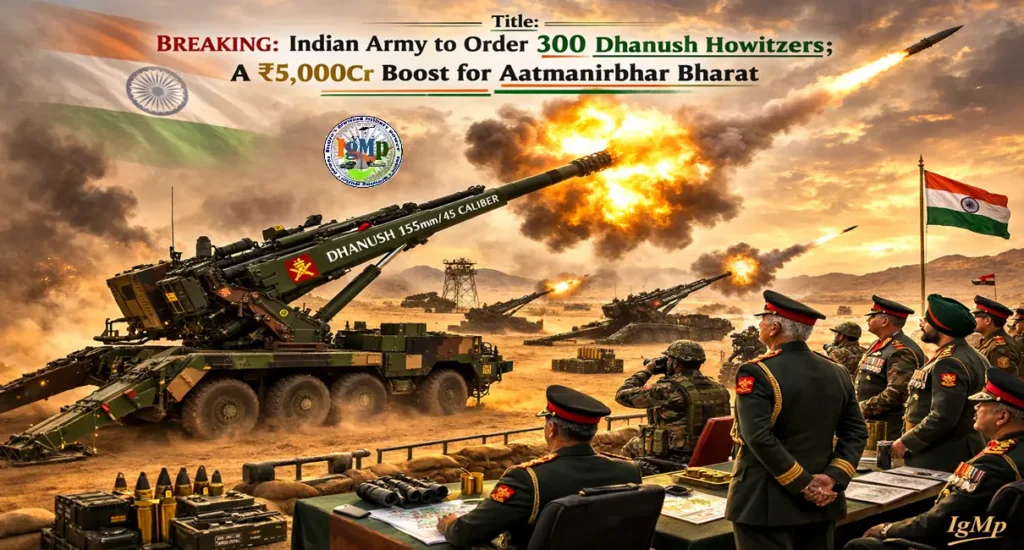
India’s long-delayed artillery modernisation is entering a decisive phase. The Indian Army is preparing to place a fresh order for 300 Dhanush 155mm/45-calibre howitzers, a move that could raise 15 new regiments and significantly expand indigenous firepower across sensitive northern and western borders. Beyond the numbers, this procurement signals something deeper: the steady consolidation of India’s transition toward a standardised, digitally enabled, and largely indigenous 155mm artillery ecosystem [Source: ANI].
The Dhanush program, now executed under Advanced Weapons and Equipment India Limited (AWEIL) after the restructuring of the Ordnance Factory Board, represents a full-circle moment in Indian defence manufacturing. What began as technology absorption from the Bofors AB FH-77B guns inducted in the 1980s has matured into a system with over 80% indigenous content and a clear roadmap for further evolution.
Technical Leap: How the 45-Calibre Dhanush Outperforms Legacy Bofors
To understand why this order matters, one must first grasp what “45-calibre” actually means. In artillery terminology, calibre is not just the diameter of the shell; it also denotes barrel length relative to bore diameter. A 45-calibre barrel is 45 times the diameter of the 155mm bore. This makes it longer than the 39-calibre barrel of the original Bofors FH-77B.
The physics is straightforward but decisive. A longer barrel allows expanding propellant gases to act on the projectile for a longer duration, increasing muzzle velocity. Higher muzzle velocity translates into flatter trajectories and extended range. In operational terms, the shift from 39-calibre to 45-calibre gives the Dhanush roughly 30% more reach compared to legacy Bofors systems, pushing its maximum range close to 38 km with advanced ammunition.
That additional 8–10 kilometres is not incremental; it is transformational. In modern artillery warfare, range equals survivability. Guns that can fire from deeper inside friendly territory reduce exposure to counter-battery strikes and drone-assisted targeting.
Evolution of Indian 155mm Towed Artillery
| Feature | Bofors FH-77B (Baseline) | Dhanush (Current Order) | ATAGS (Future Standard) |
|---|---|---|---|
| Calibre | 155 mm / 39 Calibre | 155 mm / 45 Calibre | 155 mm / 52 Calibre |
| Max Range | ~27–30 km | ~38 km | ~45–48 km |
| Indigenization | ~20% (Mainly Spares) | ~81%–90% | >95% |
| Navigation | Optical / Manual | Inertial / GPS (SIGMA) | Fully Digital / Auto-Laying |
| Firing Rate | 3 rounds in 13 sec | Burst: 3 rds / 15 sec | Rapid: 5 rds / 60 sec |
The table makes clear that Dhanush is not merely a copy of Bofors; it is a mid-generation leap bridging older imports and the next-generation Advanced Towed Artillery Gun System (ATAGS).
Navigation and Fire Control: The Digital Heart of the Dhanush
The most underappreciated upgrade in Dhanush lies in its electronic suite. Unlike the largely optical and manually laid Bofors guns, Dhanush integrates an Enhanced Tactical Computer (ETC) and the SIGMA 30 inertial navigation system. This combination enables automatic gun alignment, onboard ballistic computation, and real-time positional awareness.
In practical terms, this allows the system to execute “Shoot and Scoot” missions in under two minutes. After firing a salvo, the gun can rapidly relocate before enemy counter-battery radars or armed drones can lock onto its firing signature. In an era where UAVs and loitering munitions have become integral to battlefield surveillance, this capability is not optional—it is existential.
The system also supports night operations and adverse weather firing, ensuring round-the-clock readiness across deserts, plains and high-altitude sectors.
Strategic Rationale: 15 New Regiments for the Northern & Western Borders
The proposed induction of 300 additional Dhanush guns would translate into 15 fresh regiments, significantly expanding firepower density along key sectors facing China and Pakistan. Artillery remains the backbone of land warfare; in limited conflicts and border stand-offs, it delivers the bulk of fire support before armour or infantry manoeuvres begin.
This expansion also aligns with a broader doctrine shift under the Field Artillery Rationalisation Plan (FARP), which aims to standardise artillery calibres and modernise legacy systems.
Standardization: Moving Toward an All-155mm Army
For decades, the Indian Army operated a complex mix of 105mm Indian Field Guns, 130mm Russian M-46 guns, and 155mm systems. This diversity created logistical challenges—different ammunition types, separate maintenance chains, and varied training requirements.
The long-term goal is clear: make 155mm the universal calibre across the force. A single standard shell simplifies supply chains, improves interoperability, and reduces logistical friction during high-intensity operations. The 300-gun Dhanush order marks a major step toward this “one calibre” objective, accelerating the retirement or upgrade of older 105mm and 130mm inventories.
Industrial Impact: Sustaining the AWEIL Production Line
Beyond strategy, the industrial implications are substantial. The Dhanush production line under Advanced Weapons and Equipment India Limited is one of the flagship outcomes of India’s ordnance factory restructuring. This fresh order would be its largest test yet.
Industry estimates suggest the deal could be worth ₹4,500–₹5,000 crore, making it a significant pillar of the government’s Aatmanirbhar Bharat initiative. More importantly, the program sustains a supply chain of over 100 local vendors and MSMEs that provide components ranging from barrel forgings to electronic subsystems.
High indigenous content—estimated between 81% and 90%—ensures that capital outflow remains limited while domestic capability deepens. It also reduces long-term dependence on foreign spares and upgrades, a vulnerability that historically complicated defence readiness.
The Dhanush order also complements parallel progress on ATAGS, which, once fully inducted, is expected to become the Army’s primary 52-calibre towed platform. Together, Dhanush and ATAGS represent a layered indigenous artillery family capable of scaling to future operational requirements.
The Roadmap to an All-155mm Artillery Force
The planned procurement of 300 Dhanush howitzers is not just another defence contract; it is a structural milestone in India’s artillery evolution. Technically, it cements the shift from 39-calibre legacy systems to longer-barrel, digitally integrated platforms. Strategically, it expands regimental strength along contested borders while advancing the goal of an all-155mm standardised force. Industrially, it validates AWEIL’s production capability and sustains a broad domestic manufacturing ecosystem.
For a country that once endured a three-decade artillery acquisition freeze, the scale and coherence of this modernisation drive reflect a maturing defence policy—one that blends operational urgency with industrial self-reliance.