Synopsis
- A critical but often misunderstood factor in this story is why a “dry” engine—one without an afterburner—is not a compromise but a strategic choice for a stealth UCAV.
IgMp Bulletin
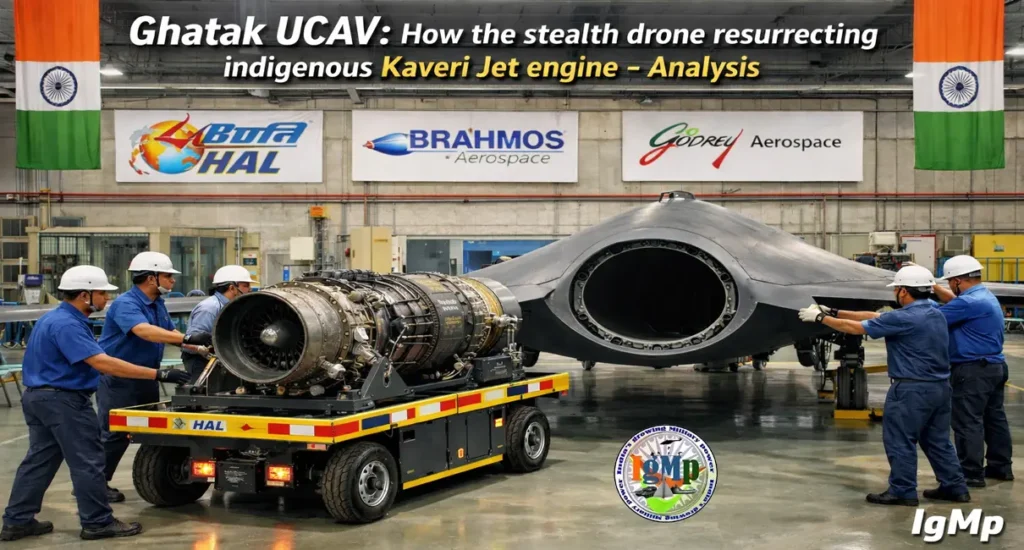
The Defence Procurement Board’s clearance of 60 Ghatak UCAV (Unmanned Combat Aerial Vehicle) is being viewed as a breakthrough for India’s unmanned strike capability. But the deeper strategic shift lies under the skin of the aircraft—inside its engine bay. For the first time in decades, India’s long-troubled Kaveri jet engine programme is positioned not as an abandoned experiment, but as the propulsion backbone of a frontline combat platform.
The Ghatak, developed by the Defence Research and Development Organisation (DRDO), is designed as a stealthy flying-wing unmanned bomber capable of penetrating contested airspace. While its low-observable airframe and internal weapons bay have drawn attention, its adoption of the Kaveri dry variant—producing roughly 48–52 kN of thrust—may prove far more consequential for India’s aerospace independence.
Also Read: GTRE Kaveri Engine Afterburner Test Success: 81-83 kN Thrust Achieved in Presence of Rajnath Singh
To understand why this matters, it helps to view the Kaveri’s journey as a structured propulsion roadmap rather than a single failed attempt.
The Kaveri Engine Evolution: From Tejas Failure to Ghatak Success
| Stage | Engine Variant | Platform | Status | Strategic Goal |
|---|---|---|---|---|
| Stage 1 | Kaveri (Original) | Tejas Mk1 | Delinked | 80 kN-class thrust (Failed) |
| Stage 2 | Kaveri Dry (Current) | Ghatak UCAV | Production-Ready | 48–52 kN Thrust; No Afterburner |
| Stage 3 | Kaveri + Afterburner | Tejas Mk1A / HLFT-42 | Testing | 75–80 kN with BrahMos Afterburner |
| Stage 4 | Next-Gen Kaveri | AMCA / Tejas Mk2 | Research | 90–110 kN Thrust Class |
The original Kaveri programme aimed to power the Tejas fighter with an afterburning engine in the 80 kN class. Technical challenges in thrust, weight and thermal margins led to its delinking, with the aircraft ultimately powered by the F404 engine from General Electric. For years, the programme appeared stalled.
The Ghatak changes the equation because it does not demand the same afterburning thrust profile as a supersonic fighter. Instead of chasing peak power, engineers can optimise for endurance, reliability and stealth compatibility.
The “Dry” Advantage: Why Kaveri is the Perfect Fit for Stealth UCAVs
A critical but often misunderstood factor in this story is why a “dry” engine—one without an afterburner—is not a compromise but a strategic choice for a stealth UCAV.
Stealth over Speed: Managing Infrared Signatures
Afterburners are essentially fuel injectors placed in the exhaust stream to provide a burst of additional thrust. While they dramatically increase power, they also generate extremely high exhaust temperatures. This creates a massive infrared (IR) signature, making the aircraft more visible to heat-seeking missiles and infrared search-and-track systems.
For a stealth UCAV like Ghatak, survivability depends more on remaining undetected than on raw speed. A dry engine produces lower exhaust temperatures, significantly reducing the infrared footprint. Combined with design elements such as serpentine air intakes—which hide the compressor blades from radar reflections—the cooler exhaust flow enhances the aircraft’s “ghost” profile in hostile airspace.
In other words, the Kaveri dry variant is not a scaled-down solution. It is technically aligned with the mission profile of a stealth unmanned bomber that prioritises persistence and low observability over high-speed dogfighting.
From GTRE to BrahMos: A New Era of Inter-Agency Propulsion Success
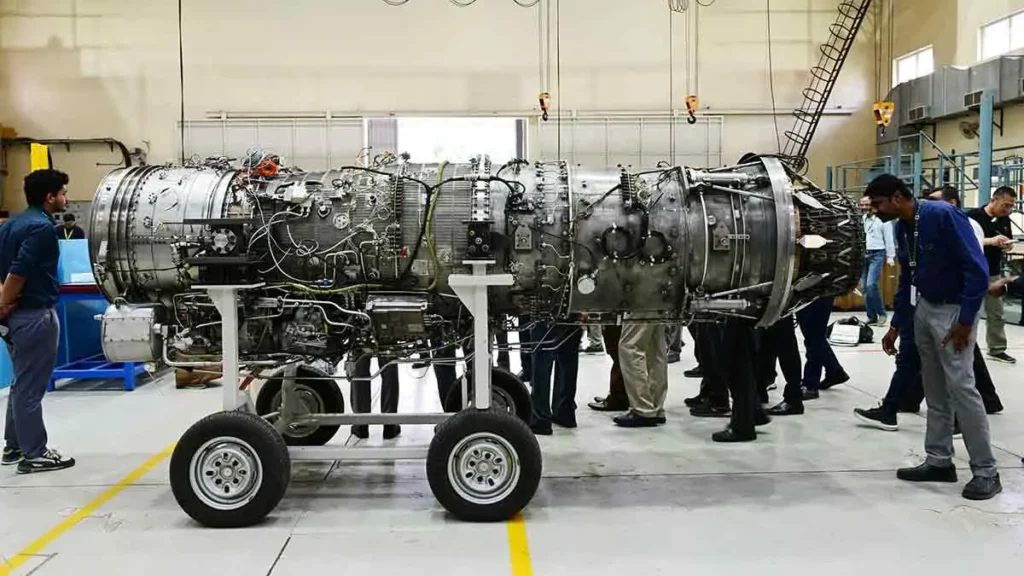
Another underreported dimension is the emergence of inter-agency collaboration. During a recent visit by Defence Minister Rajnath Singh to GTRE, an afterburner module developed with participation from BrahMos Aerospace was demonstrated.
This collaboration is strategically significant. BrahMos Aerospace has decades of experience in high-temperature propulsion systems for supersonic cruise missiles. Translating that expertise into jet engine afterburner design is a rare and pragmatic example of technology cross-pollination within India’s defence ecosystem.
If the dry Kaveri achieves certification through operational deployment on 60 Ghataks, it establishes a validated engine core. From there, integrating a refined afterburner—leveraging BrahMos’ high-temperature materials expertise—could push thrust levels into the 75–80 kN bracket. That would make it relevant for platforms such as advanced trainers or light combat derivatives.
Beyond that lies the more ambitious target: a redesigned next-generation Kaveri in the 90–110 kN class. Achieving this would require new titanium alloy blisk compressor stages, single-crystal turbine blades and advanced cooling techniques. But crucially, these advancements would build upon an already certified indigenous engine architecture rather than starting from scratch.
The Industrial Multiplier: Creating a “Warm Line” for Godrej & MIDHANI
Aerospace manufacturing does not function on sporadic prototype orders. It requires predictable volumes to sustain supplier investments in tooling, metallurgy and precision machining.
The 60-unit Ghatak order effectively creates a “warm production line” for the Kaveri ecosystem. Godrej Aerospace has been involved in manufacturing engine modules, while Mishra Dhatu Nigam (MIDHANI) is likely supplying specialised super-alloys critical for turbine blades and high-temperature components.
Super-alloys are the heart of any modern jet engine. Without reliable domestic sources, propulsion programmes remain vulnerable to export restrictions. By sustaining production volumes above the 50-engine threshold, the programme becomes economically viable for private players. It encourages long-term investment in materials science, casting technologies and advanced machining.
This is where the Ghatak order transcends a single platform. It provides industrial continuity. In aerospace, continuity is capability.
The 60 Ghatak Deal as a Gateway to a 90 kN Indigenous Engine
The approval of 60 Ghatak UCAVs is not merely about adding unmanned strike assets to the Indian Air Force. It is about finally giving the Kaveri engine a credible operational runway. Certification of the dry variant would validate decades of research by GTRE and its partners, transforming the engine from a developmental project into a fielded system.
From there, the path toward an afterburning 75–80 kN variant—and eventually a 90 kN-class indigenous fighter engine—becomes technically and institutionally realistic. In a world where jet engine technology remains tightly controlled by a handful of nations, propulsion sovereignty is strategic sovereignty.
The Ghatak deal, therefore, is not just about a drone. It may well be the bridge India needed to cross the jet engine barrier once and for all.