Synopsis
- According to the current framework of the proposal, as many as 96 of the 114 fighters could eventually be produced in India, making it one of the largest fighter manufacturing programmes ever attempted in the country.
IgMp Bulletin
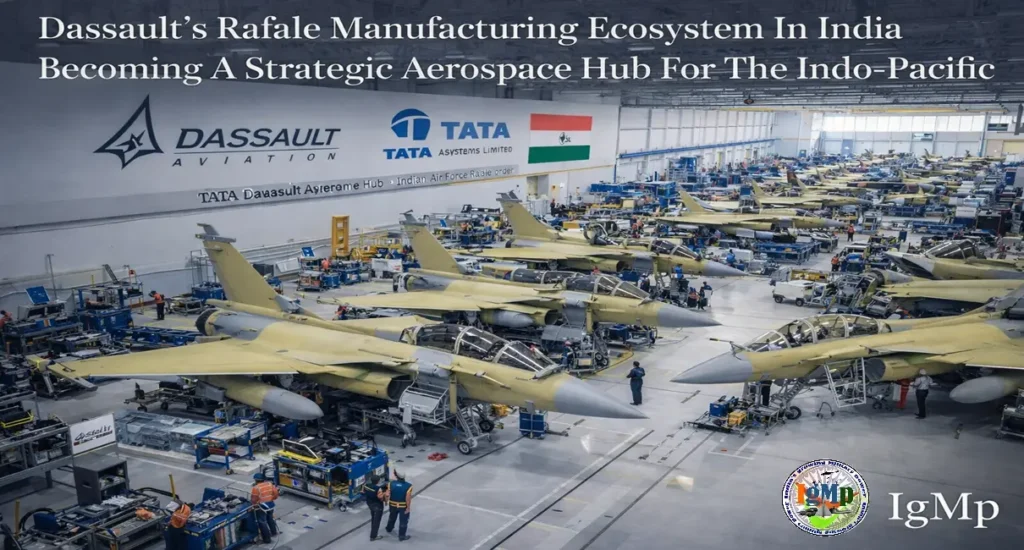
India’s growing industrial ecosystem around the Dassault Rafale fighter jet is beginning to take shape as one of the most significant developments in the country’s aerospace sector in recent years. What started as a fighter acquisition programme has gradually expanded into a complex manufacturing, maintenance and supply chain network that could transform India into a regional hub for Rafale operations across Asia and the Middle East.
Several major developments in late 2025 and early 2026 have accelerated this transformation. The Indian government has formally asked Dassault Aviation to participate in the 114-aircraft Multi-Role Fighter Aircraft (MRFA) competition, a programme widely expected to involve large-scale domestic manufacturing if Rafale is selected. According to the current framework of the proposal, as many as 96 of the 114 fighters could eventually be produced in India, making it one of the largest fighter manufacturing programmes ever attempted in the country.
Alongside the potential production line, India is also building the deeper industrial infrastructure required to support such aircraft throughout their decades-long service life. Modern combat jets require extensive maintenance, repair and overhaul capabilities, particularly for engines, avionics and airframes. Without domestic MRO facilities, fleets must rely heavily on overseas servicing, which increases operational costs and reduces aircraft availability.
A major milestone in this direction came when Safran inaugurated one of its largest global maintenance facilities in Hyderabad. The complex includes specialised infrastructure capable of servicing the M88 turbofan engine that powers the Rafale. This development effectively creates the first major M88 deep-maintenance hub outside France.
For the Indian Air Force, the presence of an engine overhaul facility inside India significantly reduces the time required for heavy maintenance cycles. But the impact goes far beyond India’s own fleet. Several Rafale operators across the Indo-Pacific and Middle East—including Egypt, Indonesia and the United Arab Emirates—could potentially use India as a closer service hub rather than flying aircraft or engines back to Europe. A five-hour ferry flight to India is far more practical than a long transcontinental journey to France for major servicing work.
The broader ecosystem forming around Rafale production and maintenance is spread across multiple industrial centres in India. Manufacturing partnerships with private sector companies have created a distributed supply chain that combines airframe manufacturing, component production and long-term servicing infrastructure.
Rafale Industrial Hub Snapshot
| Ecosystem Pillar | Location | Strategic Impact |
|---|---|---|
| Fuselage & Airframe Manufacturing | Hyderabad (TASL) | Capacity to produce up to 24 fuselages annually for global supply chains |
| M88 Engine MRO | Hyderabad (Safran) | First deep-maintenance hub outside France |
| Final Assembly Possibility | Nagpur (DRAL) | Potential for “Made in India” Rafales if MRFA proceeds |
| Regional Support Network | Global reach | Servicing fleets from Egypt, Indonesia and UAE |
The airframe manufacturing pillar is already being developed through collaboration with Tata Advanced Systems Limited in Hyderabad, where aerospace manufacturing facilities have been built to produce major structural components and fuselage sections. These facilities have the capacity to manufacture aircraft structures not only for India but also for Dassault’s global supply chain.
Another critical node of the ecosystem is the Dassault-Reliance Aerospace Limited facility in Nagpur. Following a restructuring in 2025, the plant became majority owned by Dassault Aviation, strengthening its position as a key industrial base for the Rafale programme. If the MRFA deal moves forward, the Nagpur complex could eventually support final assembly of Rafale fighters built entirely in India.
The industrial model emerging around Rafale marks a clear departure from India’s earlier fighter manufacturing experience with Russian aircraft. In past decades, platforms such as the Sukhoi Su-30MKI or the Mikoyan MiG-21 were produced under licence, with India largely functioning as a manufacturing partner following designs controlled by the original equipment manufacturer.
The Rafale ecosystem follows a more modern supply-chain model in which domestic companies become integrated partners rather than simple licensees. Indian manufacturers are required to meet global aerospace certification standards, particularly AS9100 quality certification, which is considered the gold standard in the aviation industry. Achieving this certification allows Indian small and medium-sized enterprises to supply components not only to Dassault but potentially to global manufacturers such as Airbus or Boeing.
This quiet but important shift is creating a new generation of aerospace suppliers within India. Precision machining companies, composite manufacturers and avionics specialists participating in the Rafale supply chain are gaining exposure to advanced manufacturing practices and international quality systems that can later support other aviation projects.
Those capabilities are directly relevant to India’s future fighter programmes. Aircraft currently under development, such as the HAL Tejas Mk2 and the stealth-focused HAL AMCA project, require sophisticated supply chains capable of producing complex avionics, radar systems and composite airframes.
Maintaining and servicing Rafale systems also builds valuable technical expertise. The aircraft’s RBE2 active electronically scanned array radar and its Spectra electronic warfare suite represent some of the most advanced combat avionics in service today. Engineers trained to maintain such systems develop skills that are directly transferable to future indigenous aircraft technologies.
India is also seeking deeper technological sovereignty through its negotiations for the MRFA programme. One of the key demands reportedly involves greater access to source code and software interfaces that would allow India to integrate indigenous weapons such as the Astra air-to-air missile without external restrictions. Such flexibility is increasingly viewed as essential for long-term operational independence.
The Rafale ecosystem therefore represents more than just a maintenance network. It is gradually evolving into a broader aerospace manufacturing cluster that connects airframe production, engine servicing, avionics maintenance and global supply chains.
This transformation aligns closely with the long-term industrial vision promoted by Narendra Modi, whose government has emphasised building India into a major global centre for defence manufacturing. Initiatives under the “Make in India” framework have encouraged international defence companies to establish local production lines and integrate Indian firms into global aerospace supply chains.
As more infrastructure, certifications and skilled manpower accumulate around programmes like Rafale, India’s aerospace sector is beginning to move beyond simple defence procurement. The emerging network of manufacturing plants, engine overhaul centres and certified suppliers suggests that the country is steadily positioning itself as a long-term aerospace industrial hub capable of supporting both global aircraft programmes and its own future fighter development ambitions.