Synopsis
- According to Maharashtra Chief Minister Devendra Fadnavis, some of the defence robots being developed in Nagpur are designed to operate in extreme environments, including temperatures as low as minus 40°C.
IgMp Bulletin
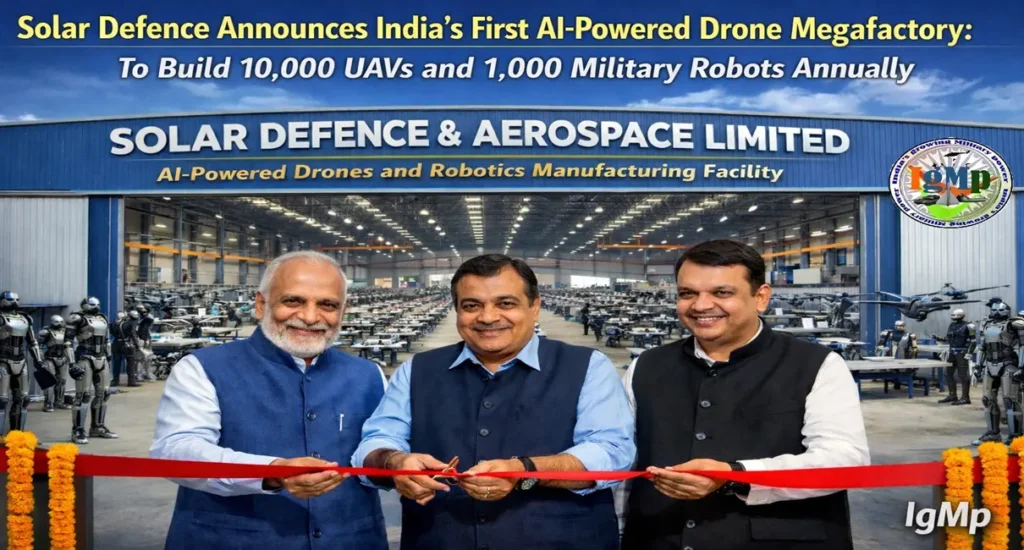
India’s private defence industry marked a significant milestone on March 7, 2026, as Solar Defence & Aerospace Limited (SDAL) announced an investment of a massive ₹12,800 crore in building India’s first AI-Powered Drone Megafactory in Nagpur. The new complex, located at the Multi-modal International Hub and Airport at Nagpur (MIHAN), is being positioned as India’s first AI-powered Industry 5.0 defence manufacturing ecosystem—an advanced model where robotics, artificial intelligence, and human engineering expertise will operate together to produce next-generation combat systems [Source: Nagpur Today].
The project, developed by SDAL’s parent firm Solar Industries India Limited, represents one of the largest private investments in India’s defence technology sector. Instead of functioning as a traditional assembly line, the facility will integrate automated production, AI-assisted quality control, and digital simulation tools to manufacture unmanned aerial vehicles, long-range strike drones and military robotics at scale.
At the centre of the plan is an ambitious annual production target: up to 10,000 drones with ranges varying from tactical 15-kilometre systems to long-range platforms capable of travelling nearly 1,000 kilometres. The facility will also manufacture roughly 1,000 defence robots every year, designed specifically for surveillance, logistics and high-risk operations along India’s challenging borders.
Project at a Glance
| Metric | Specification |
|---|---|
| Total Investment | ₹12,800 Crore (next 3–4 years) |
| Annual UAV Capacity | 10,000 Units (Range: 15 km – 1,000 km) |
| Robotics Output | 1,000 Defence Robots per year |
| Manufacturing Model | AI-Powered Industry 5.0 Ecosystem |
| Job Creation | 6,800+ Direct & Indirect |
For defence planners, the most intriguing capability lies in what Solar Group Chairman Satyanarayan Nuwal described as “long-range missile UAVs.” These platforms sit in a new category between cruise missiles and conventional drones—high-speed unmanned strike systems capable of travelling hundreds of kilometres before engaging targets with precision munitions. If successfully developed, such platforms could significantly expand India’s stand-off strike options without relying on expensive missile inventories.
The Nagpur complex is also designed to address one of the most persistent gaps in India’s drone ecosystem: sensor and chip dependence. While airframes and propulsion technologies have increasingly been indigenised, many advanced UAV sensors, electro-optical payloads and specialised microchips are still sourced from global suppliers. Solar’s new hub aims to gradually localise these technologies through in-house development and partnerships with Indian electronics manufacturers, potentially closing a key vulnerability in the defence supply chain.
A dedicated 1.25-kilometre runway built inside the facility will allow engineers to test Medium Altitude Long Endurance drones under real operational conditions. MALE-class UAVs typically fly at altitudes approaching 30,000 feet and remain airborne for more than 24 hours, making them essential for intelligence, surveillance and reconnaissance missions across long borders and maritime zones.
The robotics programme has drawn particular attention from policymakers. According to Maharashtra Chief Minister Devendra Fadnavis, some of the defence robots being developed in Nagpur are designed to operate in extreme environments, including temperatures as low as minus 40°C. Such systems are expected to assist troops deployed in high-altitude regions along the Himalayan frontier, where autonomous patrol and surveillance technologies are becoming increasingly important.
Solar Group’s expanding drone ecosystem already has operational credibility. Its indigenous loitering munition, the Nagastra-1, gained attention after reportedly demonstrating effective battlefield performance during Operation Sindoor in 2025–26. The new manufacturing hub could allow the company to scale production of similar systems while developing longer-range variants for future missions.
The company expects the core facility to become operational within about a year, with early robotics prototypes likely to emerge the following year. Once fully developed, the project is projected to create more than 6,800 direct and indirect jobs, ranging from avionics engineering and AI software development to precision manufacturing and advanced materials research.
Nagpur itself is steadily evolving into one of India’s most important aerospace clusters. The MIHAN industrial zone already hosts major defence manufacturing facilities, including Dassault Reliance Aerospace Limited and Tata Advanced Systems Limited. With Solar Group joining this ecosystem, analysts increasingly describe the region as forming a strategic aerospace triangle in central India—an industrial network capable of producing everything from aircraft components to advanced unmanned systems.
For India’s defence ecosystem, the significance of the Nagpur project lies not just in scale but in vertical integration. Solar Group already manufactures explosives and propellants; adding drones, robotics and AI-driven manufacturing under the same industrial network creates a rare end-to-end capability. In an era where autonomous systems are redefining warfare, the emergence of such integrated defence technology hubs could shape the next phase of India’s military industrial evolution.