Synopsis
- India’s defence electronics ecosystem is entering a decisive phase as the Defence Research and Development Organisation has developed a next-generation photonic radar prototype that could fundamentally change the air-combat equation for the upcoming Advanced Medium Combat Aircraft, especially the AMCA Mk2.
IgMp Bulletin
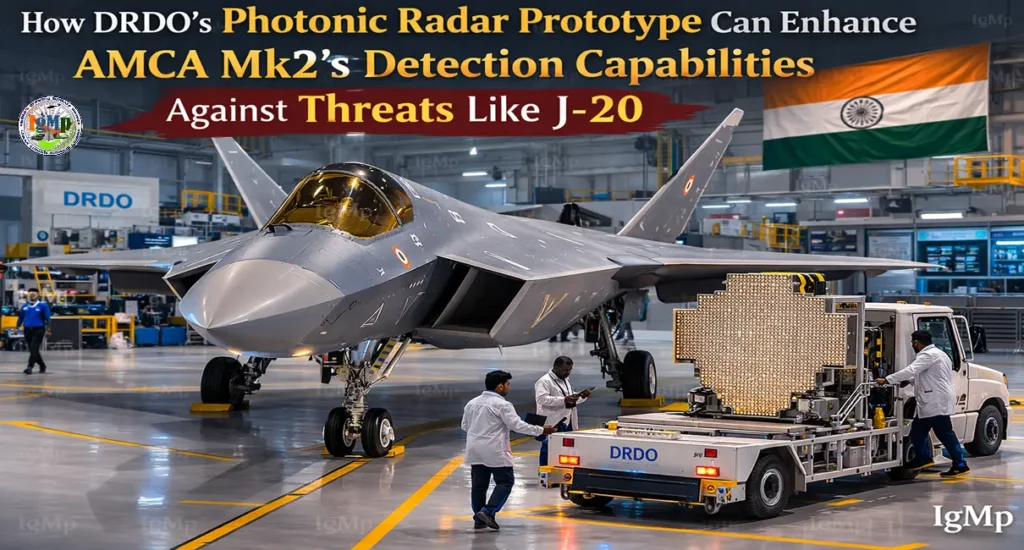
India’s defence electronics ecosystem is entering a decisive phase as the Defence Research and Development Organisation has developed a next-generation photonic radar prototype that could fundamentally change the air-combat equation for the upcoming Advanced Medium Combat Aircraft, especially the AMCA Mk2.
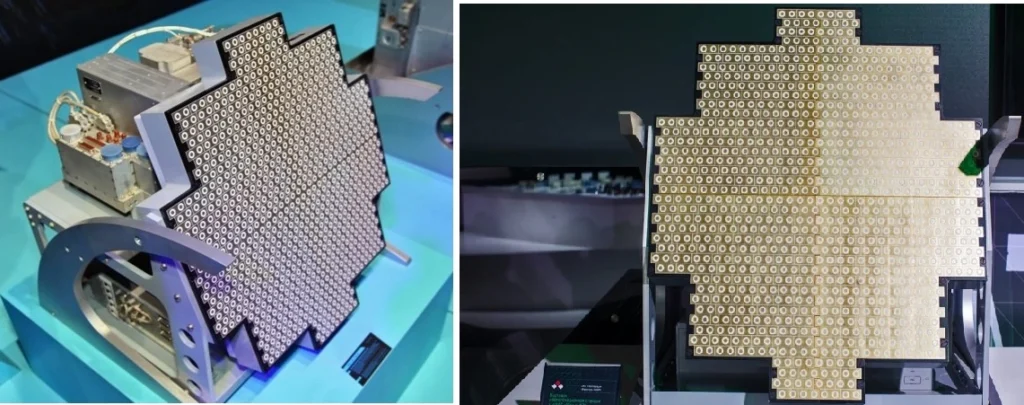
Unlike conventional AESA radars, this system leverages Microwave Photonics (MWP)—using laser-generated radio frequencies instead of traditional electronic signal generation—to achieve unprecedented bandwidth, resolution, and anti-jamming capability.
As of early 2026, the project led by Electronics and Radar Development Establishment has progressed beyond site acceptance testing and entered anechoic chamber integration for a modified HAL Tejas Mk1A testbed.
For India’s fifth-generation fighter ambitions, this radar could become the sensor that neutralizes stealth advantages held by aircraft such as the Chengdu J-20.
Why Photonic Radar Is a Stealth Killer
Most modern stealth aircraft are optimized to defeat X-band radar frequencies, which dominate conventional AESA radars like the indigenous Uttam AESA Radar.
However, photonic radar breaks that paradigm.
By using optical techniques to generate RF signals, the radar can transmit across Ultra-Wideband (UWB) frequencies exceeding 10 GHz of bandwidth. This enables it to:
• Penetrate radar absorbent material (RAM) coatings
• Resolve extremely small radar cross-sections
• Track stealth targets with centimetre-level precision
DRDO engineers claim the breakthrough lies in achieving ultra-low phase noise within the microwave photonic chain.
This improvement allows the radar to detect targets with a radar cross section as small as 0.0001 m²—roughly equivalent to advanced stealth drones—at distances approaching 150 km.
2026 Development Roadmap: From Lab to Flight
The photonic radar program has moved rapidly through several milestones:
2024
• Core microwave photonics signal generation validated
• Ultra-wideband antenna integration trials begin
2025
• Ground-based prototype demonstrated at DRDO radar facilities
• Site acceptance testing completed
2026
• Anechoic chamber integration for airborne platform
• Flight-test instrumentation installed on Tejas Mk1A radar testbed
• AI-based signal processing modules added
The upcoming airborne trials will validate multi-band stealth detection in real operational environments.
The Physics Behind “Seeing” Stealth
Traditional radars generate signals electronically using Gallium Arsenide (GaAs) transmit-receive modules.
Photonic radar instead uses:
Laser sources → Optical modulators → RF signal generation
This architecture delivers three major advantages:
1. Massive Bandwidth
Photonic generation enables Ultra-Wideband radar pulses capable of high-resolution target imaging.
2. Low Phase Noise
Stable optical sources dramatically reduce signal distortion, improving detection of very low observable targets.
3. Spectrum Agility
The radar can rapidly shift across frequency ranges, making it extremely difficult to jam.
Weight and Thermal Advantage for AMCA Mk2
Beyond detection performance, photonic radar offers a major benefit for stealth aircraft integration.
Compared with conventional AESA arrays:
• Photonic components are up to 70% lighter
• Significantly lower heat generation
• Reduced cooling system requirements
For the AMCA Mk2, this directly supports thermal stealth, as excessive heat emissions can compromise infrared signature management.
In essence, the radar itself becomes stealth-optimized.
AI-Driven “De-Ghosting” and Cognitive Electronic Warfare
The 2026 prototype is also being integrated with AI-driven signal processing designed to distinguish real targets from electronic deception.
Modern stealth aircraft increasingly rely on digital radio frequency memory (DRFM) decoys that generate false radar signatures.
The photonic radar’s ultra-fast processing pipeline enables AI-based “de-ghosting” algorithms to filter out these false signals.
Even more significant is the radar’s role in Cognitive Electronic Warfare.
Because photonic signal generation operates at optical speeds, the radar can transition from search mode to electronic attack in nanoseconds.
This allows the system to:
• detect an enemy aircraft
• analyze its emissions
• jam its radar
• and blind its sensors
—all before the target receives a lock-on warning.
In future air combat, radars will no longer be passive sensors—they will function as active electronic weapons.
J-20 vs Photonic Radar: A Technology Comparison
| Feature | Conventional AESA (Uttam) | DRDO Photonic Radar Prototype |
|---|---|---|
| Signal Source | Radio Frequency (RF) electronics | Laser-generated RF (photonics) |
| Bandwidth | 2–4 GHz | Ultra-Wideband (>10 GHz) |
| Stealth Detection | Challenging for VLO targets | Centimetre-level resolution |
| ECCM | Vulnerable to DRFM jamming | Highly resistant to traditional jamming |
This architecture may allow Indian fighters to detect stealth aircraft like the J-20 earlier than previously possible, potentially reshaping aerial engagement timelines.
Beyond 2026: Toward Quantum-Photonic Radar
DRDO researchers are already exploring quantum-enhanced photonic radar concepts for the 2030s.
Such systems would leverage quantum entanglement and photonic signal coherence, theoretically enabling:
• near-perfect detection of stealth objects
• complete immunity to conventional jamming
• unprecedented radar resolution
If realized, quantum-photonic radar could represent the next revolution in military sensing technology.
Strategic Implications for the Indo-Pacific
For India’s air power strategy, photonic radar could become a critical component of the AMCA Mk2 sensor suite, providing a decisive advantage against emerging stealth aircraft.
In an era where stealth technology is proliferating across Asia, the ability to detect and electronically dominate low-observable targets may determine the outcome of future aerial conflicts.
With airborne testing expected in 2026, DRDO’s photonic radar program may soon move from laboratory promise to operational reality—potentially redefining the balance between stealth and detection in modern air warfare.