Synopsis
- New UnitPrimary ResponsibilityStrategic ObjectiveDefence Geo-Spatial Agency (DGSA)Satellite intelligence, digital terrain mappingPrecision targeting and battlefield awarenessDefence Data Force (DDF)AI-driven data analytics and cyber intelligenceReal-time decision support for commandersStrategic Drone CommandCoordination of unmanned systems and drone swarmsLow-cost, high-impact strike and surveillance operationsCognitive Warfare Action Force (CWAF)Information warfare and counter-disinformationProtecting national narrative and countering hybrid threats.
India has outlined an ambitious long-term strategy to reshape its armed forces for the next generation of warfare. On March 10, 2026, Defence Minister Rajnath Singh unveiled the “Defence Forces Vision 2047” during a high-level defence review conference in New Delhi that brought together senior leadership from the Indian Army, Indian Navy and Indian Air Force. The announcement came during a tri-service brainstorming session focused on integrated warfare and future security challenges, marking one of the most comprehensive defence transformation blueprints announced by India in recent decades.
The roadmap is designed to prepare India’s military for the centenary of independence in 2047 by strengthening joint operations, accelerating indigenous defence technologies and building new capabilities in emerging domains such as artificial intelligence, cyber warfare, unmanned systems and information operations. At the core of this transformation is the creation of four specialised tri-service organisations that will act as force multipliers across land, sea, air, cyber and space.
Four New Tri-Service Units Under Defence Forces Vision 2047
Defence Geo-Spatial Agency (DGSA): The first pillar of this transformation is the Defence Geo-Spatial Agency (DGSA), which will become the central hub for satellite intelligence, geospatial mapping and digital battlefield visualization. Modern military operations depend heavily on accurate location data and real-time terrain analysis, especially for long-range strike missions and coordinated multi-domain operations. The DGSA will integrate satellite imagery, drone reconnaissance data and advanced mapping technologies to produce detailed digital battle maps for commanders. A major advantage will be its reliance on India’s indigenous satellite navigation network, NavIC, ensuring secure and independent navigation capability without dependence on foreign satellite systems. This agency is expected to significantly enhance precision targeting, logistics planning and situational awareness during complex military operations.
Defence Data Force (DDF): The second organisation, the Defence Data Force (DDF), will function as the digital brain of India’s future military structure. Modern battlefields generate enormous volumes of data from sensors, surveillance systems, communication networks and unmanned platforms. Managing and analysing this data quickly is essential for gaining an operational advantage. The Defence Data Force will leverage artificial intelligence, big-data analytics and cyber intelligence tools to convert raw information into actionable insights. By providing real-time battlefield analytics and predictive threat assessments, this unit will enable commanders to make faster and more accurate operational decisions, which is increasingly critical in high-tempo conflicts.
Drone Warfare and Cognitive Warfare: The New Combat Domains
Strategic Drone Command: Another major element of the roadmap is the creation of a Strategic Drone Command, often referred to in planning circles as the Defence Drone Force. This unit will oversee the deployment and coordination of unmanned systems across all branches of the military. From small reconnaissance drones used along contested borders to high-altitude long-endurance surveillance platforms and unmanned combat aerial vehicles, the command will integrate all drone operations into a unified framework. Military planners are particularly focused on developing swarm drone capabilities that can overwhelm enemy defences using large numbers of low-cost autonomous platforms. The command may also integrate AI-enabled remote weapon stations such as the Barbarik unmanned remote controlled weapon system to support automated defensive operations against aerial or ground threats.
Cognitive Warfare Action Force (CWAF): The fourth unit proposed under the roadmap is the Cognitive Warfare Action Force (CWAF), which reflects the growing importance of the information domain in modern conflicts. Warfare today increasingly involves psychological operations, influence campaigns and digital propaganda designed to weaken adversaries without direct combat. The Cognitive Warfare Action Force will focus on countering disinformation, protecting national information networks and managing strategic communications during crises. It will also develop capabilities in perception management and hybrid warfare defence, ensuring that India can respond effectively to emerging threats in the digital information ecosystem.
Quick Overview of the New Tri-Service Organisations
| New Unit | Primary Responsibility | Strategic Objective |
|---|---|---|
| Defence Geo-Spatial Agency (DGSA) | Satellite intelligence, digital terrain mapping | Precision targeting and battlefield awareness |
| Defence Data Force (DDF) | AI-driven data analytics and cyber intelligence | Real-time decision support for commanders |
| Strategic Drone Command | Coordination of unmanned systems and drone swarms | Low-cost, high-impact strike and surveillance operations |
| Cognitive Warfare Action Force (CWAF) | Information warfare and counter-disinformation | Protecting national narrative and countering hybrid threats |
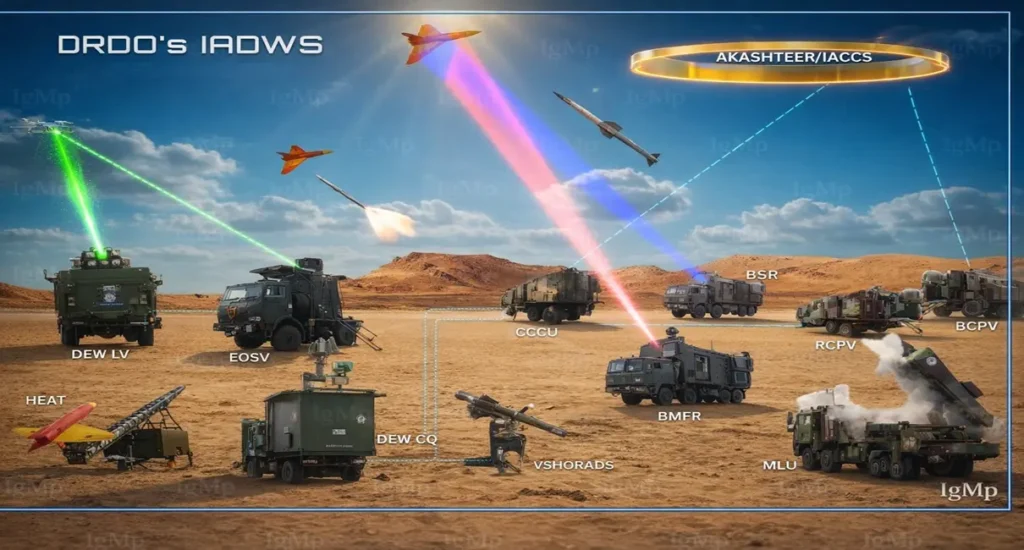
Beyond these structural reforms, the roadmap also introduces Mission Sudarshan Chakra, an indigenous multi-layered air defence network designed to counter modern aerial threats such as cruise missiles, swarm drones and future hypersonic weapons. Defence planners have set 2035 as a major milestone for large-scale deployment of the system around key military installations and strategic infrastructure.
The Defence Forces Vision 2047 roadmap signals a major shift in India’s strategic thinking. Instead of focusing only on expanding traditional military platforms, the plan prioritizes technological dominance, information superiority and seamless coordination between the services. By building specialised capabilities in geospatial intelligence, AI-driven decision systems, unmanned warfare and cognitive operations, India is laying the foundation for a military that is not only larger but smarter, faster and more adaptable. If implemented successfully, these reforms could position the country as one of the most technologically advanced military powers by the time India marks the centenary of its independence in 2047.