Synopsis
- Sources quoted in the report indicate that the Ministry of Defence and the IAF have discussed the necessity of inducting a fifth-generation fighter as a stopgap solution until India’s indigenous Advanced Medium Combat Aircraft (AMCA) program becomes operational.
Source : IgMp Bulletin
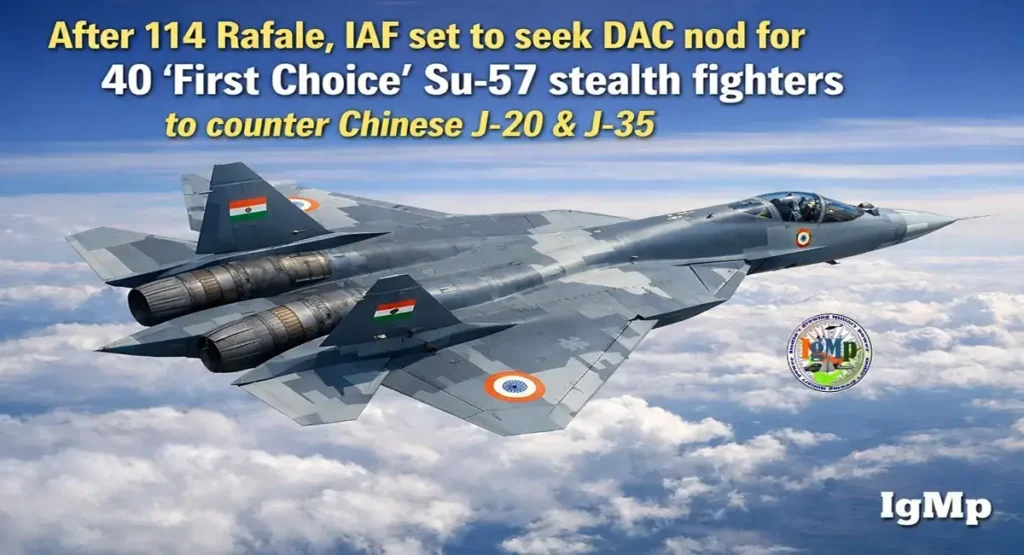
According to a report by The Tribune, the Indian Air Force may soon seek the Defence Acquisition Council (DAC)’s approval for around 40 fifth-generation stealth fighters. As per the report, Russia’s Sukhoi Su-57 has emerged as the IAF’s preferred option to counter China’s rapidly expanding stealth aircraft inventory. While the report cites unnamed government sources and has not been independently confirmed by official channels, it reflects a debate that has been steadily gaining urgency within India’s defence establishment.
The immediate driver behind this reported move is China’s growing operational fleet of fifth-generation fighters, notably the Chengdu J-20 and the newer Shenyang J-35. Beijing has already indicated its willingness to transfer advanced platforms to Pakistan, with promises of fifth-generation aircraft reportedly made to Islamabad following last year’s India–Pakistan tensions. For Indian planners, the prospect of facing stealth aircraft on both the northern and western fronts has sharpened the need for a near-term response.
Sources quoted in the report indicate that the Ministry of Defence and the IAF have discussed the necessity of inducting a fifth-generation fighter as a stopgap solution until India’s indigenous Advanced Medium Combat Aircraft (AMCA) program becomes operational. The indigenous AMCA remains a long-term primary fifth-generation solution, with service entry widely expected only in the mid-to-late 2030s. In this context, the Su-57 is being viewed as an interim solution to bridge the gap with India’s adversaries until the AMCA arrives on the front.
The other fifth-generation option that was also on offer, the American F-35, is reportedly not under consideration due to concerns over operational restrictions. Indian officials have long been wary of limitations on indigenous weapons integration and mission autonomy, particularly the inability to freely integrate indigenous systems. The IAF’s experience with its Sukhoi Su-30MKI fleet, which has successfully integrated the BrahMos cruise missile and was employed during Operation Sindoor, reinforces the importance India places on sovereign control over its combat aircraft. By contrast, restrictions imposed by Washington on Pakistan’s F-16 operations, including monitored sorties and a US personnel presence at air bases, are often cited as cautionary examples.
Ironically, these concerns exist alongside earlier US overtures. In February last year, then US President Donald Trump publicly stated that Washington was paving the way to eventually offer F-35 stealth fighters to India. Despite such statements, Indian decision-makers appear inclined to prioritise flexibility and integration freedom over diplomatic signalling.
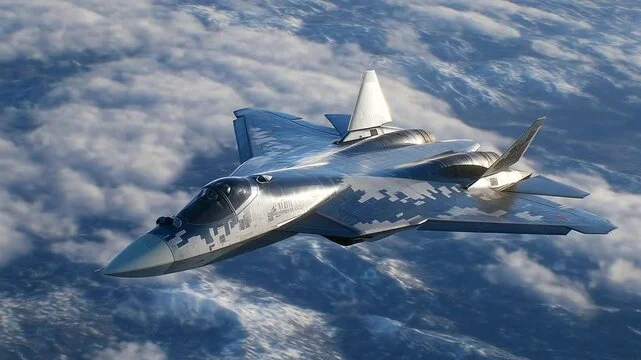
Another factor which is favoring the Russian platform is logistical and maintenance commonality. The Sukhoi Su-57 shares similarities with the Sukhoi Su-30MKI, which forms the backbone of the IAF’s fighter fleet. Russian teams have reportedly assessed facilities at Hindustan Aeronautics Limited (HAL)’s Nashik complex, indicating the possibility of local manufacturing or deeper industrial involvement if negotiations proceed towards a larger order. However, officials quoted in the report stressed that formal talks have not yet begun and would follow only after detailed technical evaluations by IAF teams.
The Su-57 itself is designed as a multi-role fifth-generation fighter, featuring internal weapon bays to preserve stealth during critical mission phases. It can carry a mix of air-to-air and air-to-surface munitions internally, while external hardpoints are available for non-stealth roles. The aircraft is also intended to support future weapons integration, including advanced stand-off and hypersonic systems, reflecting a design philosophy centred on growth potential.
India’s earlier experience with joint fifth-generation development offers an important backdrop. In 2007, New Delhi partnered with Moscow on a collaborative fighter project, called the Sukhoi/HAL-FGFA program, committing billions of dollars before exiting in 2018 over concerns related to cost, work share, and perceived capability gaps. The current discussions, if they materialise, would represent a different approach—focused on acquisition rather than co-development, and aimed squarely at addressing an immediate strategic requirement.
At its core, the reported Su-57 plan reflects a broader reality of modern air combat. Fifth-generation fighters are defined not merely by speed or manoeuvrability, but by stealth, sensor fusion, and software-driven decision superiority. As regional air forces transition into this domain, India faces a narrowing window to ensure it does not fall behind. Whether the Su-57 ultimately secures DAC approval or not, the debate itself underscores the urgency with which India is reassessing its future air power posture in an increasingly contested strategic environment.
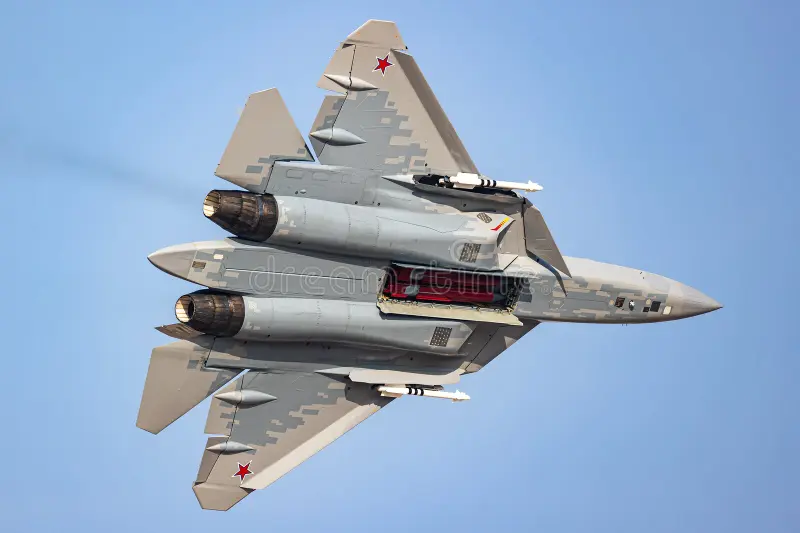
The most unique thing the Su-57, as a fifth-generation stealth fighter, can offer to India is the ability to fire the Kh-47M2 Kinzhal and Zircon (Tsirkon) hypersonic missiles from its standoff ranges. This point itself is a huge one to favour a Su-57 deal as the IAF is shifting its focus towards long-range standoff weapons and the ability to fight the next war at standoff distances with long-range precision strike weapons, and this is the point where the Su-57 with its hypersonic missiles fits the arena perfectly.
Now, it is interesting to see what the United States does in response to this imminent Indo-Russian deal for Su-57, as the US has already warned prospective buyers of this aircraft to back off, otherwise they will impose CAATSA sanctions on them. Now, if they issue a threat of CAATSA to India, then the already strained Indo-US ties will be in more danger, and the US can’t afford that, and on the other hand, it will set a precedent for other potential buyers of Su-57, if the US exempts India from CAATSA despite purchasing Su-57, just like they did duringthe S-400 purchase. It will be a ‘Catch-22’ moment for them.
Nevertheless, the growing number of fifth-generation stealth fighters around India, has forced New Delhi to consider a stopgap purchase of a fifth-generation platform from abroad, and it was obvious that Russian Sukhoi Su-57 with all its operational freedom and weapons package would become the first choice for the Indian Air Force. It was an imminent deal, long anticipated by many defence experts for long.