Synopsis
- A fresh debate is unfolding in global defence circles after American military analyst Wes O’Donnell argued that India could transform Russia’s Su-57 into a far more capable combat aircraft—though not a truly stealthy one.
Source : IgMp Bulletin
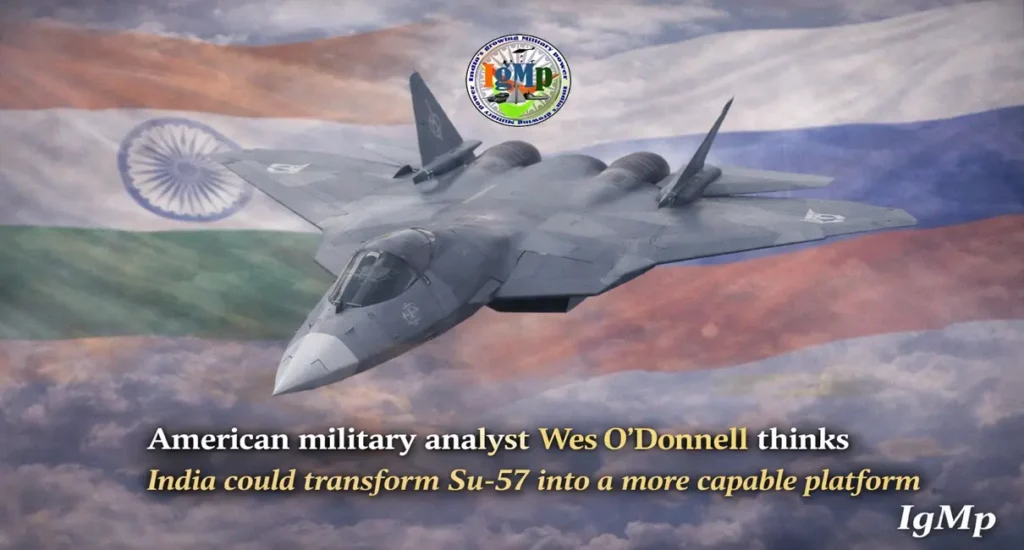
A fresh debate is unfolding in global defence circles after American military analyst Wes O’Donnell argued that India could transform Russia’s Su-57 into a far more capable combat aircraft—though not a truly stealthy one. O’Donnell, a US Army and Air Force veteran known for his sharp breakdowns of airpower trends, recently suggested that while the Su-57 has clear design limitations, India’s technological inputs could significantly enhance its battlefield effectiveness.
The aircraft in question, Russia’s Sukhoi Su-57, has long been marketed as a fifth-generation stealth fighter. Yet it has faced sustained scrutiny over its radar cross-section, engine design and overall survivability in contested airspace. Western analysts frequently point to exposed engine components, infrared signatures and shaping compromises that reduce its low-observable performance compared to platforms like the F-22 Raptor or F-35 Lightning II.
O’Donnell’s central argument is nuanced. He does not claim India can make the Su-57 invisible. Instead, he suggests New Delhi could make it far more dangerous by replacing or upgrading key electronic systems. India has a proven track record of integrating advanced avionics onto Russian-origin aircraft. The Sukhoi Su-30MKI stands as a prime example—a Russian airframe enhanced with Indian, Israeli and Western subsystems to create one of the Indian Air Force’s most potent platforms.
If India were to pursue the export-focused Su-57 variant, analysts believe the real leverage would lie in avionics, radar and mission software. Indigenous developments such as the Uttam AESA Radar demonstrate India’s growing competence in active electronically scanned array technology. Advanced sensor fusion, improved electronic warfare libraries and streamlined cockpit interfaces could significantly reduce pilot workload while boosting situational awareness.
Modern air combat is no longer defined solely by raw stealth metrics. Detection range, electronic countermeasures, data fusion and cooperative engagement capabilities increasingly determine who gains the upper hand. An Su-57 equipped with improved radar processing, robust electronic protection and seamless integration with Indian weapons—such as next-generation beyond-visual-range missiles—could serve as a powerful standoff and air-dominance platform.
However, structural realities remain. The aircraft’s basic airframe geometry and engine nozzle design cannot be rewritten through software alone. Radar cross-section characteristics and infrared visibility are baked into the design. Even with superior electronics, it would not match the ultra-low observable standards of American fifth-generation jets. At best, it would become a sensor-rich, electronically resilient heavy fighter rather than a true stealth penetrator.
Strategically, India’s calculus would extend beyond performance metrics. The country exited its earlier joint fifth-generation programme with Russia in 2018 due to concerns over stealth maturity and workshare arrangements. Today, India is advancing its indigenous HAL AMCA, aimed at delivering a homegrown stealth solution in the mid-2030s. An upgraded Su-57 could act as an interim capability bridge, provided it aligns with long-term force planning and technological autonomy goals.
There are also geopolitical considerations. Russia seeks export traction for the Su-57 amid limited domestic production and evolving battlefield realities. India, on the other hand, seeks sovereign control over upgrades, weapons integration and electronic warfare systems. Any deal would need to balance these incentives carefully.
O’Donnell’s assessment ultimately reframes the discussion. The Su-57’s stealth ceiling may be fixed, but lethality is not determined by stealth alone. If India overlays its own sensors, mission software and electronic warfare expertise, the aircraft could emerge as a far more credible threat in the region. It would not vanish from radar screens—but it might see, decide and strike faster than its adversaries expect.