Synopsis
- A retired battalion commander of the Pakistan Special Service Group (SSG) in a recent podcast mentioned how he was deployed at a location close to the Line of Control that morning and spotted three parachutes floating down into the territory of Kashmir controlled by Pakistan.
Source : IgMp Bulletin
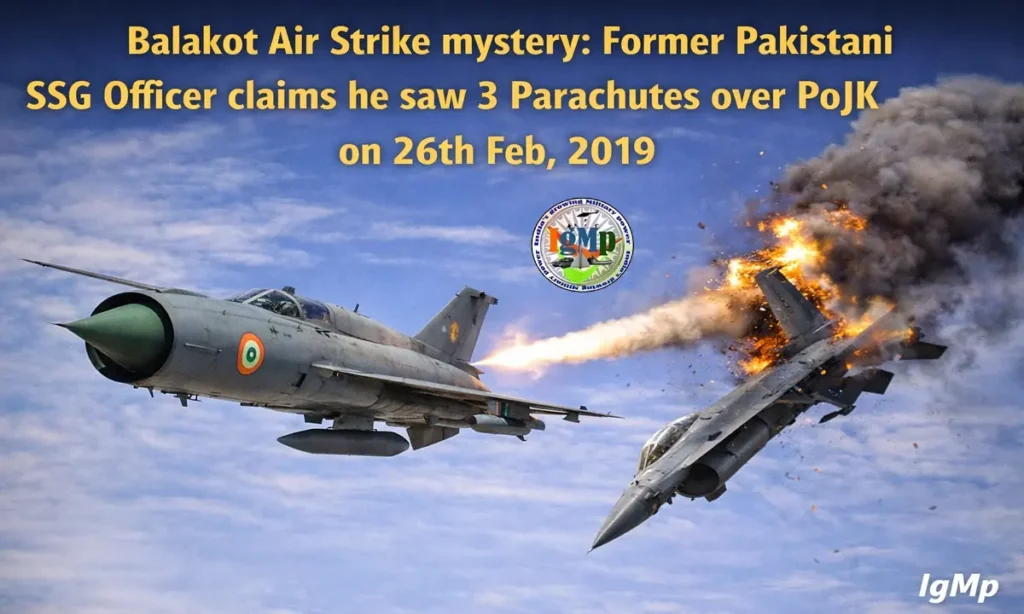
February 27, 2019, is one of the most examined days in South Asian military history in the recent past. The aerial confrontation, which began hours after the Balakot air strike carried out by India, soon became not only a battle in the air, but also in the narratives peddled. Now, several years down the line, a former Special Service Group (SSG) officer of Pakistan has brought another twist to the argument and stated that he witnessed three parachutes falling over Pakistani-occupied Jammu and Kashmir (PoJK) that morning.
However, following the Pulwama terror attack, the Indian Air Force initiated airstrikes against terrorist targets in Balakot on February 26, 2019, which triggered the events. The following day, fighter jets of both parties took part in an intense high-voltage air battle across the Line of Control. India also verified that one of its MiG-21 Bison fighter had been shot down and that the pilot, Wing Commander Abhinandan Varthaman, had been taken captive and later released. Pakistan claimed it had shot down two Indian planes, and there was no loss of its assets.
A retired battalion commander of the Pakistan Special Service Group (SSG) in a recent podcast mentioned how he was deployed at a location close to the Line of Control that morning and spotted three parachutes floating down into the territory of Kashmir controlled by Pakistan. One, he said, dropped full in front of his place, and there were two that could be seen behind that. His explanation was spontaneous and prosaic–a memory of that which he himself saw and not a general strategic assertion.
What is interesting about this assertion is that it seems to echo the bits of what was being reported at that time. Immediately after the dogfight, unconfirmed reports went around among local civilians on both sides of the LoC that there were several parachutists in the air. First reports by the military media wing of the Government of Pakistan, the Inter-Services Public Relations (ISPR), also mentioned more than one ejection before the official version took a U-turn stance within a few hours.
The messaging became more controlled and understandable within hours. The official version was that Pakistan was stating that two Indian planes were shot down and that Pakistan lost no planes. India, for its part, claimed that it had shot down a Pakistani fighter jet, which was widely reported to be an F-16, but this was denied by Islamabad. The United States subsequently tabulated the number of F-16s in the Pakistani fleet, and American officials assured media houses that not a single plane had gone into the air, but still India stood with its own reporting.
The statements made by the former SSG officer lack physical evidence, like radar information and cockpit tape recordings. Instead, they introduce a second layer of eyewitnessing to an already convoluted episode. Confusion is nearly unavoidable in high-speed air combat (especially in mountainous terrain, as is the case of the LoC). The ejections of pilots out of planes that have been struck can be as many as kilometres apart, and the confusion of debris can be posed by the fog of war.
Military historians regularly warn that there is a tendency to change what happened in the initial stage when interpreting stories, with governments editing them and assessing their strategies. There is pride, deterrence signalling, and domestic audience management, which all affect the process of the official description of incidents. This does not necessarily disregard eyewitness testimony, but it highlights the difficulty in balancing individual memory and formal word.
February 27, 2019, air battle was characterized by high-speed aerial combat between Indian MiG-21 Bison and Pakistani fighter where F-16s and JF-17s were reportedly used. When dealing with such encounters, things get resolved within seconds, and not minutes. Several planes may be tracking targets at the same time, and the trails, flares, and specific shots of missiles may all have a common physical location.
To analysts and observers, the former Pakistani SSG commander did not prove with utmost certitude an additional shoot-down. It does, nevertheless, raise issues that never entirely vanished. The fact that three parachutes were seen might mean that there were multiple ejections, and there may have been more than a single aircraft casualty. Alternatively, different perceptions on the ground might have been a result of visual confusion or overlapping debris patterns.
Four years later, on February 27, 2019, the remains were picked apart using official statements, open-source intelligence evaluations, and now personal memories of the alleged victim, who claims to have been there. Even a single eyewitness report can restart a debate in a part of the world (and a condition) where there is not much trust in the enemy and where war without information resembles the modern form of warfare.
It might not be on its own that the words of the former SSG officer can rewrite history, but they provide a dimension to a day that is already characterised by uncertainty. For researchers and defense observers as well as citizens who want to know the truth, they are a reminder that the entire story behind that aerial clash is probably more complex than any single story makes it appear.