Synopsis
- Pune-based Bharat Forge, the flagship of the Kalyani Group led by Baba Kalyani, is quietly working on two separate Future Infantry Combat Vehicle (FICV) platforms—one tracked and one wheeled—under a fully indigenous development programme.
Source : IgMp Bulletin
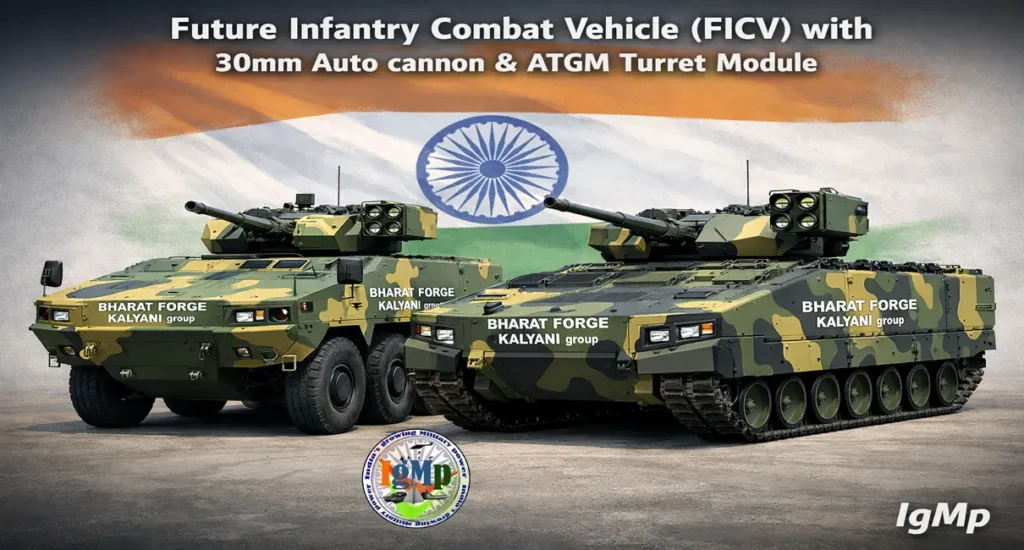
India’s push to modernise its mechanised infantry may soon get a major boost from the private sector. Pune-based Bharat Forge, the flagship of the Kalyani Group led by Baba Kalyani, is quietly working on two separate Future Infantry Combat Vehicle (FICV) platforms—one tracked and one wheeled—under a fully indigenous development programme.
The Indian Army’s need for a next-generation infantry combat vehicle has been clear for years. Its ageing BMP-2 fleet, inducted in the 1980s, is due for phased replacement with a platform that offers better protection, mobility, digital networking, and firepower. The Future Infantry Combat Vehicle, or FICV, is expected to be a backbone asset for mechanised units operating across deserts, plains, riverine belts, and high-altitude regions. By developing both tracked and wheeled variants simultaneously, Bharat Forge appears to be positioning itself with flexible solutions for diverse operational doctrines.
The tracked version is expected to prioritise mobility across difficult terrain. Tracks distribute weight more evenly, allowing vehicles to move through soft soil, snow, or marshy ground where wheeled platforms may struggle. For sectors such as Ladakh or certain riverine stretches along India’s borders, this capability remains critical. A tracked FICV can also typically carry heavier armour packages without compromising balance, improving survivability against anti-tank weapons and artillery fragments.
On the other hand, the wheeled configuration reflects evolving battlefield realities. Modern conflicts have shown the value of speed, operational reach, and lower maintenance footprints. Wheeled infantry combat vehicles can travel faster on roads, require less logistical support, and often offer lower lifecycle costs. For rapid deployment in plains sectors or internal security contingencies, such mobility can be decisive. Several advanced militaries, including those in Europe, are increasingly blending tracked and wheeled assets in their mechanised formations to balance endurance and agility.
What makes Bharat Forge’s approach notable is that both designs are being pursued independently rather than as part of a specific government tender at this stage. The company has built considerable expertise over the past decade in artillery systems, armoured vehicle structures, and turret technologies. Its role in indigenous gun systems and armoured platforms has strengthened its manufacturing ecosystem, including metallurgy, precision forging, and combat system integration. These competencies are directly relevant to building a complete infantry combat vehicle from scratch.
An indigenous FICV platform would also align closely with India’s broader defence industrial strategy. Reducing dependence on imported subsystems, ensuring domestic supply chains, and retaining upgrade flexibility are all priorities under current procurement policies. Vehicles designed and built in India allow easier customisation for local climatic conditions and operational feedback from troops.
For the Indian Army, the availability of both tracked and wheeled options from a domestic manufacturer could widen the decision space. Instead of being constrained to a single configuration, planners could evaluate how each variant fits into specific theatre commands. A mixed fleet approach—heavy tracked units for high-threat zones and wheeled units for mobility-focused operations—could enhance overall force effectiveness.
The timing is significant. Regional security dynamics, including mechanised modernisation across borders, are pushing India to accelerate upgrades in land warfare capabilities. Infantry combat vehicles are not just troop carriers; they are integral to networked warfare, serving as mobile platforms for sensors, communication systems, and precision weapons.
If Bharat Forge succeeds in delivering mature, field-ready prototypes in both categories, it would mark another milestone for India’s private defence industry. More importantly, it would provide the Army with indigenous, adaptable tools to reshape its mechanised infantry for the next two decades.