Synopsis
- As drone warfare becomes more central to modern military strategy, India’s evolving counter-swarm architecture suggests a shift toward smarter, scalable defences that rely not only on missiles but also on electronic warfare, artificial intelligence and unmanned interceptors operating in a tightly integrated network.
IgMp Bulletin
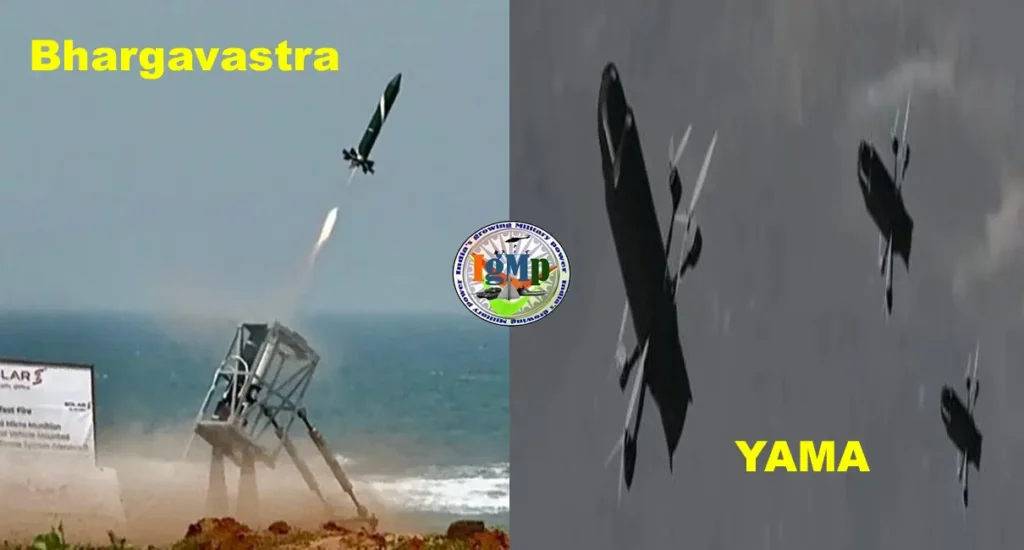
In the wake of drone-saturated conflicts in Ukraine and the Middle East, the Indian Armed Forces have increasingly focused on a layered counter-swarm doctrine to defend airbases, ammunition depots and command centers from mass unmanned attacks. Unlike traditional air defence systems designed to intercept aircraft or ballistic missiles, swarm drones pose a different challenge: dozens of low-cost UAVs approaching simultaneously from multiple directions, overwhelming radars and expensive missile interceptors. India’s answer is emerging through the complementary deployment of the Bhargavastra Counter-Swarm Drone System and the YAMA Interceptor Drone System—two indigenous technologies built around a coordinated “soft-kill and hard-kill” strategy.
The concept is simple but strategically important. Bhargavastra acts as the electronic warfare shield, disrupting and degrading swarm coordination, while YAMA functions as the kinetic sword that eliminates drones which survive electronic disruption. This synergy addresses a critical weakness in counter-drone warfare: electronic jamming alone may not stop autonomous drones, and kinetic interception alone can be too costly or slow when facing dozens of targets.
Bhargavastra, a product of Solar Industries Limited, is designed as the inner defensive layer, focusing on disabling drones through advanced electronic warfare methods. The system is believed to employ high-power microwave bursts and multi-band jamming capable of simultaneously targeting several drones within a swarm. By attacking the electronics of incoming UAVs—navigation modules, communication links and onboard processors—it effectively “blinds” or destabilizes the formation. Once a swarm loses synchronization, individual drones become easier to track and destroy. In dense drone attacks where dozens of UAVs attempt to saturate defences, this electronic disruption can neutralize a large percentage of threats without firing a single missile.
YAMA, a product of Flying Wedge Defence and Aerospace, by contrast, represents the hard-kill layer. Instead of relying on radar-guided missiles, the system uses loitering interceptor drones capable of autonomously pursuing hostile UAVs. Once launched, these interceptors track targets using AI-based visual recognition and onboard sensors, allowing them to engage even in GPS-denied environments where electronic countermeasures may disrupt navigation signals. The interceptor can either ram an enemy drone or detonate a small proximity charge nearby, destroying the target mid-air. This method ensures that any drones which slip through electronic jamming can still be physically eliminated before reaching critical infrastructure.
| Layer | System | Mechanism | Target Type |
|---|---|---|---|
| Outer Layer (10 km+) | YAMA | Kinetic interception (Hard-Kill) | Lead drones, command drones or “mothership” UAVs |
| Inner Layer (5 km–1 km) | Bhargavastra | High-power microwave and electronic jamming | Massed swarm formations |
| Final Layer (<1 km) | Point Defence Systems | Laser or anti-aircraft guns | Residual drones that penetrate earlier layers |
Both systems are expected to operate within a broader surveillance network linked to India’s battlefield sensor grid, often associated with platforms such as the **DRISHTI Surveillance Network. Through this shared data environment, incoming drones detected by ground radars or electro-optical sensors can be automatically classified, with Bhargavastra disrupting the swarm while YAMA interceptors receive target coordinates for precision engagement.
Another key advantage lies in cost asymmetry. Traditional air defence missiles such as the **Akash Surface-to-Air Missile or the **Barak-8 Air Defence System are extremely capable but expensive when used against small UAVs. A relatively inexpensive interceptor drone like YAMA neutralizing hostile drones valued at similar or higher cost creates a far more sustainable defensive model during prolonged conflicts.
The development of Bhargavastra and YAMA also reflects India’s strategic response to the expanding drone programs across the Indo-Pacific, including swarm initiatives reportedly explored by **China. By combining electronic disruption with autonomous interception, the two systems together form a layered defensive web that can degrade, fragment and ultimately destroy coordinated drone attacks before they reach high-value targets.
As drone warfare becomes more central to modern military strategy, India’s evolving counter-swarm architecture suggests a shift toward smarter, scalable defences that rely not only on missiles but also on electronic warfare, artificial intelligence and unmanned interceptors operating in a tightly integrated network.