Synopsis
- According to the 2026 assessment, China is gradually pivoting toward nuclear propulsion as the backbone of its future undersea fleet, marking a fundamental departure from more than fifty years of construction patterns.
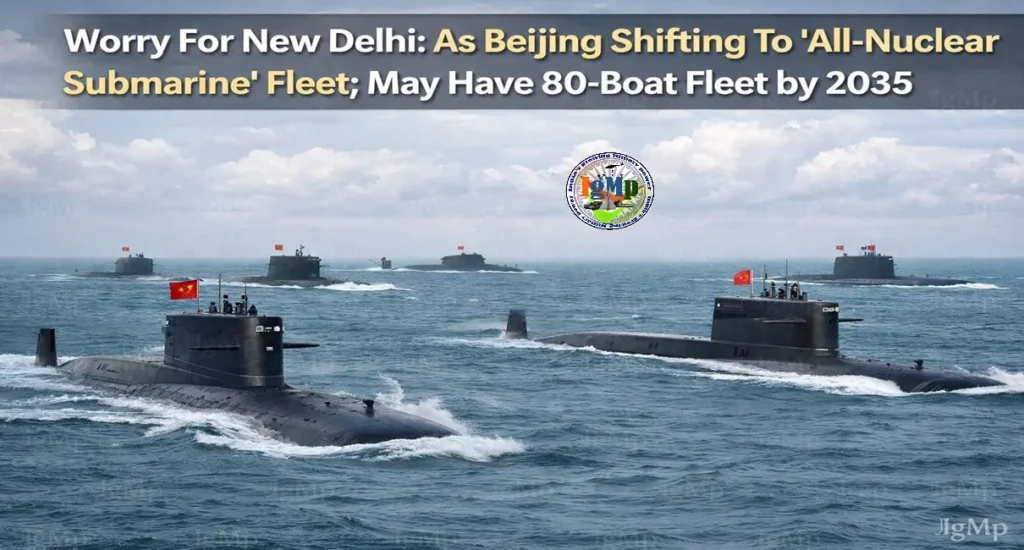
China’s quiet naval transformation beneath the ocean surface is drawing renewed attention after a warning from Mike Brookes, the intelligence chief of the United States Navy. In testimony delivered on March 2, 2026 to the U.S.-China Economic and Security Review Commission, Brookes revealed that Beijing is executing what he described as a “significant strategic shift” toward an all-nuclear submarine construction model.
For decades, the People’s Liberation Army Navy relied heavily on diesel-electric submarines designed mainly for coastal defence and regional patrols. That approach is now evolving. According to the 2026 assessment, China is gradually pivoting toward nuclear propulsion as the backbone of its future undersea fleet, marking a fundamental departure from more than fifty years of construction patterns.
Synopsis: The March 2026 testimony by Rear Adm. Mike Brookes indicates that China is transitioning toward “all-nuclear submarine construction.” The PLAN could field nearly 80 submarines by 2035, with around half powered by nuclear reactors, enabling long-range patrols far beyond East Asian waters. The transition is anchored by the emerging Type 041 Zhou-class submarine—a hybrid concept that combines nuclear endurance with the compact footprint of conventional submarines. For both the United States and India, this development could significantly reshape the undersea balance of power across the Indo-Pacific.
The Type 041 Zhou-Class and China’s Expanding Shipyard Capacity
China currently operates more than 60 submarines, but only about 14 are nuclear-powered platforms, including attack submarines and ballistic missile submarines. The majority remain diesel-electric vessels, which are extremely quiet but limited by the need to periodically surface or snorkel to recharge batteries.
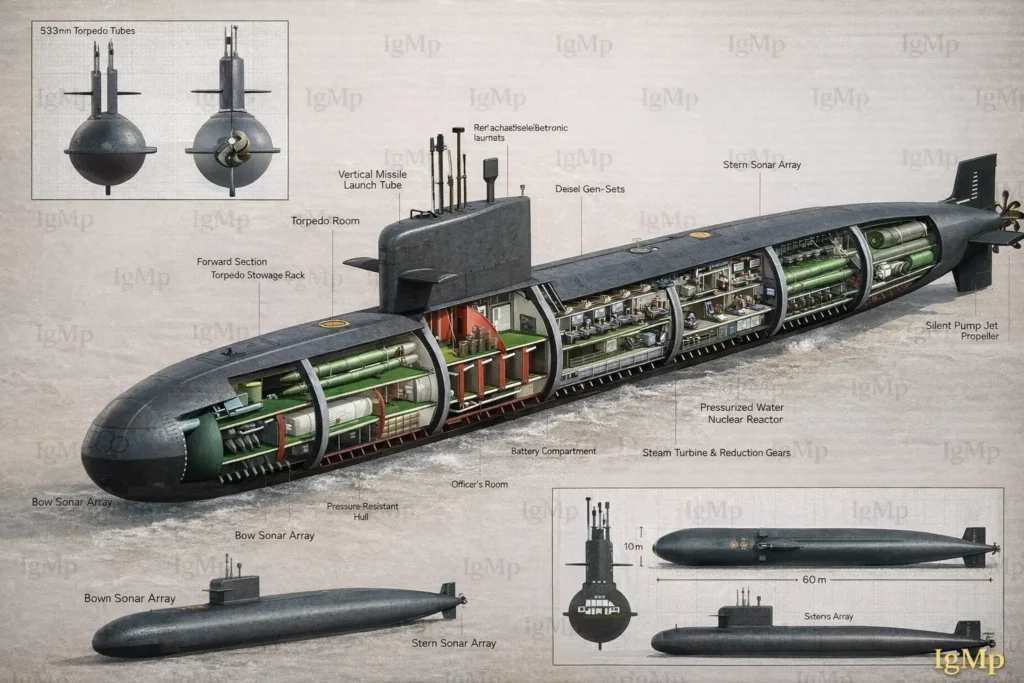
The emerging centerpiece of China’s transition is the Type 041 Zhou-class submarine. Unlike large nuclear attack submarines traditionally built for extended blue-water deployments, this design appears to combine nuclear propulsion with a smaller, more economical structure similar in size to conventional boats. Analysts believe the goal is to create a mass-producible nuclear submarine capable of scaling fleet size quickly while maintaining the endurance advantages of nuclear propulsion.
The program has not been without setbacks. One early hull reportedly sank pier-side at a shipyard near Wuhan in 2024 before sea trials, raising questions about construction standards and procurement oversight. Yet the March 2026 assessment suggests the Zhou-class remains the “transition backbone” of China’s evolving submarine force.
Behind this push lies a massive industrial expansion. Chinese shipyards, particularly the strategic submarine construction complex at Huludao, have dramatically expanded their building halls and assembly lines since 2019. Analysts now describe the production rhythm as roughly “1+2” annually—one ballistic missile submarine and two nuclear attack submarines—placing China among the fastest submarine producers globally.
Strategic Timeline of China’s Submarine Expansion
| Milestone | Projection (March 2026 Assessment) | Strategic Impact |
|---|---|---|
| Current Fleet | 60+ boats, mostly diesel-electric | Regional “near seas” defence |
| 2027 Milestone | Around 70 submarines | Expanding far-seas presence |
| 2035 Target | ~80 submarines with about 50% nuclear-powered | Potential global undersea reach |
| Key Platform | Type 041 Zhou-class | Mass-producible nuclear hybrid |
Implications for the United States and India
For the United States, China’s shift toward nuclear submarine construction introduces a new level of complexity in undersea warfare across the Indo-Pacific. Nuclear-powered submarines possess far greater endurance and operational reach than conventional boats, enabling the PLAN to maintain long-duration patrols across vast ocean spaces. This means Chinese submarines could operate more frequently in contested zones across the western Pacific, challenging the traditional dominance of the United States Navy in undersea operations.
A growing fleet of Chinese nuclear attack submarines could also complicate American carrier strike group deployments and logistics lines. Because nuclear submarines can travel thousands of kilometres without refuelling and remain submerged for extended periods, detecting and tracking them requires a sophisticated network of sensors, aircraft, and allied naval assets. As China expands its undersea surveillance networks and deploys more advanced submarines, the operational environment for U.S. naval forces is expected to become far more contested.
For India, the implications are equally serious but geographically closer to home. China’s expanding nuclear submarine fleet would allow the People’s Liberation Army Navy to maintain a sustained presence in the Indian Ocean Region. Such submarines could patrol vital maritime routes and remain undetected for long durations, especially around strategic chokepoints such as the Strait of Malacca.
The Indian Navy has already begun adjusting its long-term strategy in response. New Delhi is reportedly accelerating work under Project-77 India nuclear submarine program to strengthen its fleet of nuclear attack submarines. Meanwhile, the strategic submarine facility at INS Varsha naval base on India’s eastern coast is being developed to support expanded underwater operations and secure deterrence patrols.
Many Indian naval planners believe that maintaining a credible underwater deterrent in the coming decades will require around 30 nuclear submarines, combining ballistic missile submarines (SSBNs) and nuclear attack submarines (SSNs). This nuclear fleet would ideally be supported by around 24 advanced conventional submarines equipped with air-independent propulsion systems, allowing India to guard chokepoints, conduct stealth patrols, and maintain maritime dominance in the Indian Ocean.
The Emerging Undersea Balance of Power in the Indo-Pacific
China’s shift toward an all-nuclear submarine construction model signals that the next phase of maritime competition will increasingly unfold beneath the waves. As Beijing expands its silent fleet and strengthens underwater surveillance networks, the strategic contest across the Indo-Pacific is likely to intensify.
For Washington and New Delhi, maintaining stability in this evolving environment will depend on deeper cooperation in anti-submarine warfare, maritime intelligence sharing, and undersea technology development. Coordinated naval exercises, shared sensor networks, and joint innovation in submarine capabilities could play a crucial role in preserving the undersea balance of power in a region where stealth and endurance increasingly define strategic advantage.