Synopsis
- With a defined number and a clear production intent, the approval transforms the Ghatak from a technology demonstrator into a structured strategic capability.
IgMp Bulletin
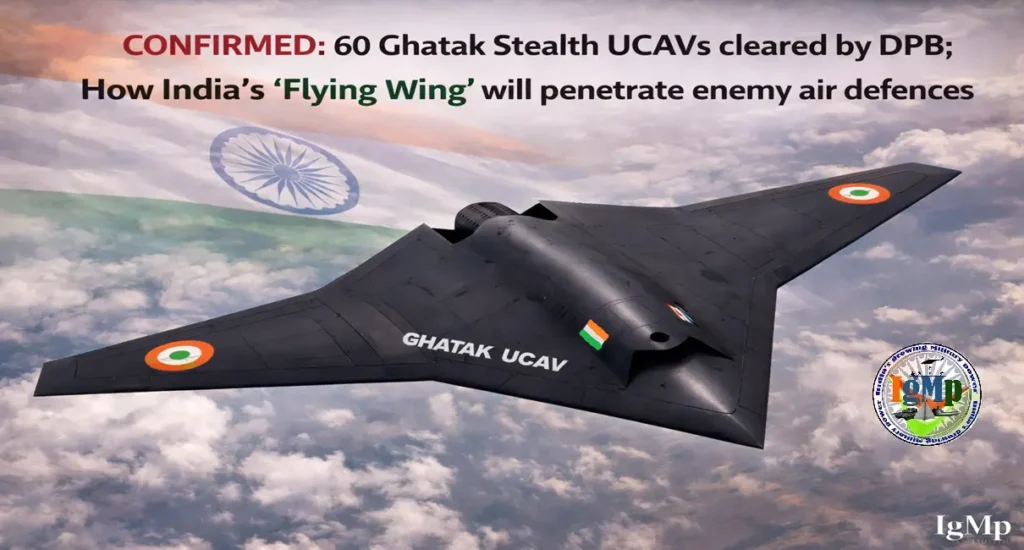
Following yesterday’s reports of a major UCAV clearance (see our previous analysis here), it has now been confirmed that the Defence Procurement Board (DPB) has greenlit 60 Ghatak Stealth UCAVs, marking one of the most significant unmanned combat aviation decisions in India’s military modernization drive [Source: Business Standard].
This is no longer a speculative development. With a defined number and a clear production intent, the approval transforms the Ghatak from a technology demonstrator into a structured strategic capability. For India’s defence ecosystem, this signals operational intent, industrial scale-up, and a doctrinal shift toward deep-penetration unmanned strike missions.
From Prototype to Squadron: What 60 UCAVs Really Mean
In air force planning terms, 60 combat aircraft are not symbolic—they are structural. That number is sufficient to raise multiple dedicated stealth drone squadrons, factoring in operational availability, training units, reserves, and maintenance cycles.
Unlike reconnaissance drones, the Ghatak is designed as a strike-first platform, capable of penetrating heavily defended airspace. With 60 units, India is effectively building a persistent unmanned strike arm that can operate independently or alongside manned fighters such as Su-30MKIs or Rafales.
This also reduces pilot risk in high-threat environments. Instead of sending manned aircraft into contested zones covered by advanced air defence systems, stealth UCAVs can lead the first wave.
The Stealth Factor: Why a Flying Wing Changes the Game
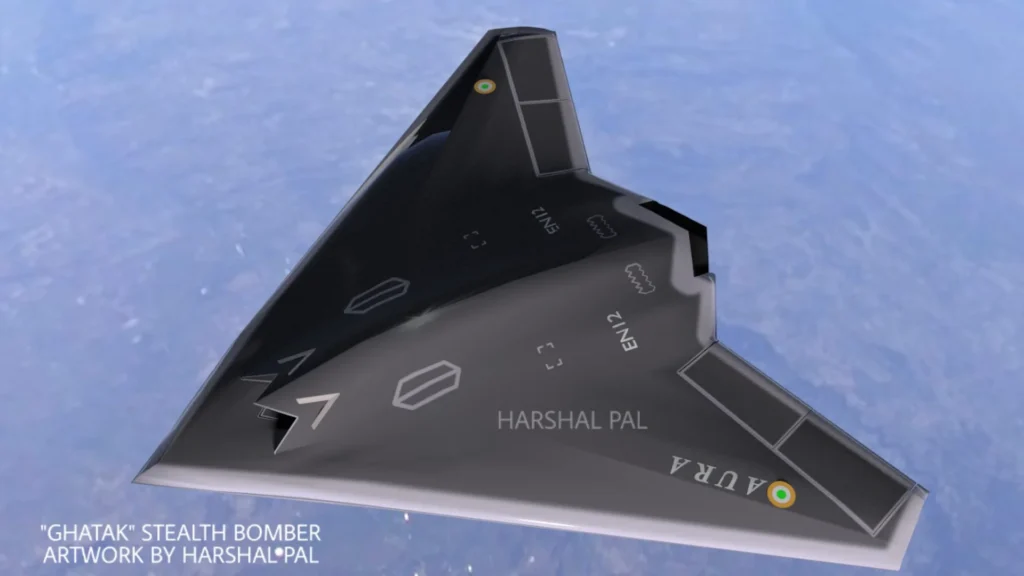
The Ghatak’s defining feature is its stealth flying wing design. Unlike conventional MALE (Medium Altitude Long Endurance) drones that resemble scaled-down aircraft with external hardpoints, Ghatak adopts a blended, tailless configuration optimized for low radar cross-section.
Stealth is not cosmetic—it determines survivability. A flying wing reduces radar reflections and infrared signatures, allowing the UCAV to slip into defended airspace, conduct strikes, and exit before detection thresholds are crossed.
This gives it a fundamentally different role compared to India’s other UAV programs.
Confirmed Procurement: The Ghatak Stealth Advantage
| Feature | Ghatak UCAV (Approved) | Archer-NG (MALE) |
|---|---|---|
| Quantity Cleared | 60 Units | TBD / Development Phase |
| Design Type | Stealth Flying Wing | Conventional (Predator-style) |
| Primary Mission | Deep Penetration Strike | Surveillance & Stand-off Strike |
| Radar Signature | Very Low (LO) | Moderate |
| Engine | Modified Kaveri (Dry) | Turbo-prop / Diesel |
The comparison makes the doctrinal difference clear. While the Archer-NG is optimized for intelligence, surveillance, and long-duration loiter roles, Ghatak is designed to enter contested airspace—including areas protected by systems like the S-400—and strike high-value targets.
In other words, 60 stealth drones are exponentially more disruptive than 60 conventional MALE UAVs.
Strategic Implications: Entering the Stealth Club
Only a handful of nations are actively fielding or developing operational stealth UCAVs. By approving 60 Ghataks, India signals that it intends to join that select category—not merely as a developer, but as an operator at scale.
The timing is also crucial. Modern warfare is increasingly defined by:
- Layered air defence networks
- Long-range precision strikes
- Drone swarms and electronic warfare
A stealth UCAV force directly addresses the first two challenges. It allows India to hold adversary command centers, missile batteries, and radar installations at risk—without committing manned strike packages in the opening hours of a conflict.
Regimental Structure and Force Projection
With 60 airframes, the Indian Air Force could realistically structure:
- 3–4 operational stealth UCAV squadrons
- Dedicated training and conversion units
- Strategic reserves for surge operations
This creates a distributed strike grid capable of simultaneous operations across multiple fronts. In a two-front contingency, stealth UCAV squadrons could conduct suppression of enemy air defence (SEAD), radar hunting, and infrastructure strikes—without risking pilots.
The psychological impact is also significant. A stealth drone force complicates adversary planning because detection windows shrink dramatically. Targets previously considered “safe” under dense air defence umbrellas become vulnerable.
Industrial Impact: Serial Production Begins
A 60-unit clearance is not a token order. It indicates serial production planning, long-term funding visibility, and industrial scaling.
The program is led by the Aeronautical Development Establishment, under the broader umbrella of Defence Research and Development Organisation. However, production at this scale will almost certainly involve manufacturing partners such as Hindustan Aeronautics Limited and potentially private-sector aerospace firms.
Serial production has ripple effects:
- Engine refinement and supply-chain stabilization
- Advanced composites manufacturing expansion
- Indigenous avionics ecosystem growth
- Long-term maintenance, repair and overhaul (MRO) contracts
In economic terms, this transforms Ghatak into a multi-decade aerospace pipeline rather than a one-off R&D experiment.
Engine Factor: The Modified Kaveri Boost
One of the most closely watched aspects of the program is its power plant. The UCAV is expected to use a modified, dry (non-afterburning) variant of the Kaveri engine rechristened as ‘Kaveri Derivative Engine or KDE’, generating a whopping 49-52 kilonewton of dry thrust.
Even in a non-afterburning configuration, the engine’s adaptation for a stealth drone marks a technological milestone. It reflects a shift toward optimizing thrust, reducing thermal signature, and improving fuel efficiency rather than raw speed.
If successful, this integration could serve as a stepping stone for future indigenous jet engine programs.
Why This Is a Strategic Pivot
The confirmation of 60 Ghatak UCAVs represents more than a procurement update. It reflects a structural evolution in India’s doctrine—from defensive airspace protection toward proactive, stealth-enabled deep strike capability.
Where MALE drones extend surveillance reach, stealth UCAVs reshape deterrence mathematics. They operate quietly, penetrate deeply, and strike precisely.
With 60 units cleared, India is not experimenting anymore. It is building a new arm of strategic power projection—one designed for the contested airspaces of the future.