Synopsis
- India has taken another significant step in strengthening its short-range air defence network, with the Defence Research and Development Organisation (DRDO) conducting three consecutive successful flight trials of the indigenous Very Short-Range Air Defence System (VSHORADS) from the Integrated Test Range at Chandipur, Odisha.
Source : IgMp Bulletin
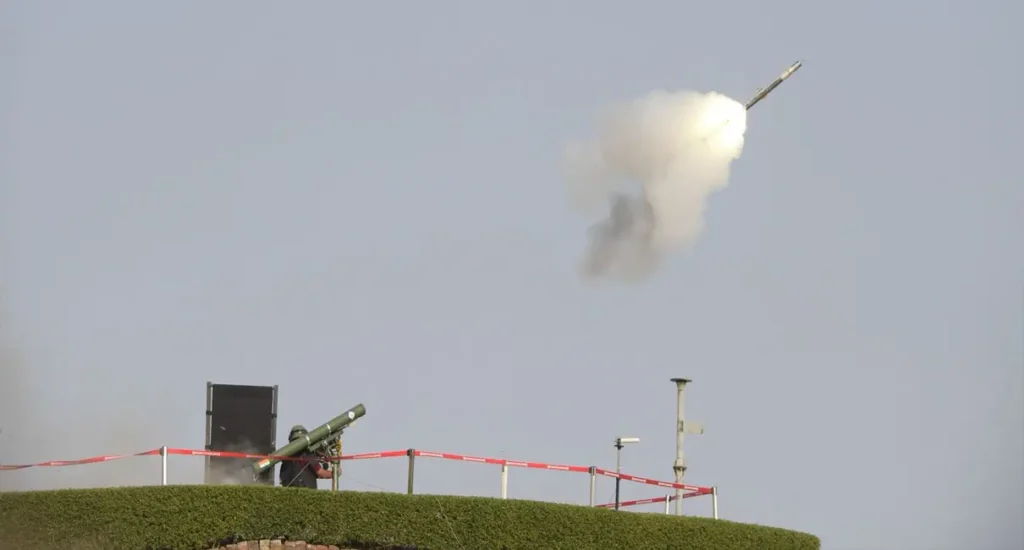
India has taken another significant step in strengthening its short-range air defence network, with the Defence Research and Development Organisation (DRDO) conducting three consecutive successful flight trials of the indigenous Very Short-Range Air Defence System (VSHORADS) from the Integrated Test Range at Chandipur, Odisha. The back-to-back tests are seen as a critical milestone in validating the missile’s performance against fast-moving aerial threats under different operational conditions.
According to officials familiar with the programme, the trials were designed to revalidate the missile’s ability to intercept high-speed targets flying at varying altitudes, ranges and approach profiles. Such repeated testing is not just procedural; it is central to ensuring reliability before induction into frontline units. In modern combat scenarios, particularly along contested borders, low-flying drones, helicopters, and cruise missiles present real-time challenges. A responsive and mobile short-range missile system is often the last line of defence for troops and critical assets.
The indigenous VSHORADS has been developed to replace ageing legacy systems and reduce dependence on imports in a category where many countries traditionally rely on foreign suppliers. Built with an advanced infrared seeker and designed for quick reaction, the system is meant to be portable and deployable across varied terrains, from high-altitude sectors to coastal regions. Its capability to engage targets under electronic countermeasure environments is particularly relevant as air threats become more sophisticated.
What makes these successive trials noteworthy is the consistency demonstrated across all three firings. Defence analysts point out that modern air defence systems must operate seamlessly across multiple engagement scenarios, not just under ideal test conditions. By validating performance at different speeds and heights, the programme team has shown confidence in the missile’s guidance, propulsion and terminal accuracy systems.
Defence Minister Rajnath Singh congratulated the scientists, armed forces personnel and industry partners involved in the project, calling the series of successful tests a major achievement. His remarks reflect a broader policy push toward indigenous capability development in critical defence technologies. Over the past decade, India has steadily invested in layered air defence solutions ranging from long-range interceptors to tactical battlefield systems. The VSHORADS fits into the innermost tier of this architecture, designed to protect troops, airfields and forward bases from sudden aerial threats.
From a strategic perspective, the importance of short-range air defence has grown sharply due to the proliferation of armed drones and loitering munitions. Conflicts across the world have shown how relatively low-cost aerial platforms can disrupt conventional forces. Systems like VSHORADS provide mobility and flexibility, allowing infantry units to carry organic air defence protection without waiting for heavier assets to deploy.
The successful trials also underscore collaboration between government laboratories and domestic industry. Over the years, India’s defence ecosystem has matured to include private manufacturers capable of producing advanced components such as seekers, propulsion modules and control systems. This synergy shortens supply chains and improves lifecycle support once the system enters service.
If induction proceeds as expected, the VSHORADS will strengthen India’s ability to secure its skies at the tactical level. While long-range systems draw headlines, it is often these compact, responsive missiles that determine survivability on the battlefield. Three consecutive successful tests signal not just technical validation, but operational readiness for a system that could soon become a key pillar of India’s ground-based air defence grid.