Synopsis
Source : IgMp Bulletin
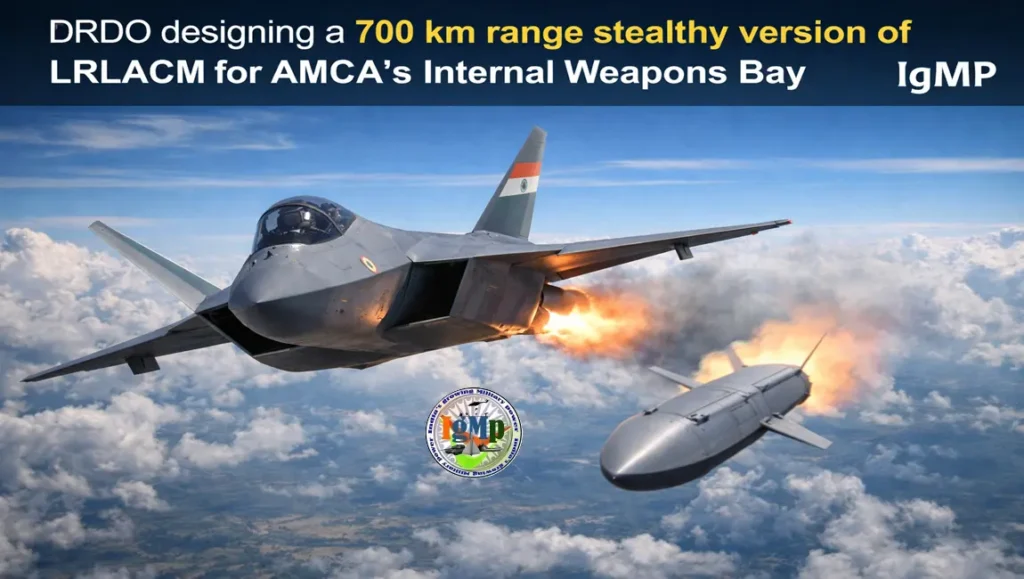
The development of a fifth-generation fighter jet by India is being accompanied by another development of a new set of precision weapons that are specifically designed for it. Defence Research and Development Organisation (DRDO) is working on a stealth-optimized variant of the Long Range Land Attack Cruise Missile (LRLACM) that is to be developed to fit the Advanced Medium Combat Aircraft, or AMCA. This new missile is being designed unlike its current counterparts, which must fit inside the internal weapons bay located under the belly of the aircraft, which will keep its low observability profile.
The work is a reflection of a primary lesson of air combat in the modern era: stealth is based not only on the ability to design an aircraft to be invisible to radar, but also on the ability to make sure the weapons it carries do not compromise that benefit. Pylons mounted externally and under-wing stores can enhance firepower, but they increase the radar cross-section value of the aircraft overall. In a stealth system such as the AMCA, which is likely to bet heavily on low detectability to survive best in a contested airspace, internally carrying the weapons inside the aircraft will play an important role in high-risk operations.
The cruise missile being developed will have a weight of approximately 1,000 kilograms, which is far less than the current Long Range Land Attack Cruise Missile (LRLACM) design. This weight reduction is important. It enables the AMCA to have two of these missiles in its internal bay and have room left to house air-to-air missiles, which means that the aircraft does not compromise on self-defense power in favor of strike power.
The concept of developing such a small cruise missile to be carried internally is much more difficult than just fitting an existing system. All components, such as propulsion and guidance electronics, will have to be optimized for space, weight and stealth. Engineers have also been working on stealth-based modes of shaping, with their attention paid to smooth lines and radar-absorbing materials, to make sure that the missile itself does not cause a radar signature constituent in case bay doors are opened during launch.
The approximate range of 700 kilometers certainly puts the missile well in the deep strike category. This would provide the AMCA with the ability to attack high-value targets deep into the enemy territory even before it gets into heavily defended areas. This is a stand-off ability that is the main purpose of the operation of stealth fighters throughout the world. Instead of using dogfights or short-range fighting as the only strategies, fifth-generation airplanes are becoming regarded as the precision strike platforms that can attack strategic targets at an objectively long range.
In the case of India, the development is strategically important, other than the missile itself. The AMCA program is a significant advancement in the design of indigenous fighters, such as stealth shaping, state-of-the-art avionics, and supercruising, which will be introduced in subsequent variants. Combining it with a specially designed internal cruise missile carrying capability proves beneficial in order to make the most out of the capabilities of the aircraft. Immediate solutions are not often ideal fits for high-technology stealth platforms, particularly when internal weapons bay dimensions and weight limits are tightly measured.
The decision to make a smaller version of the Long Range Land Attack Cruise Missile (LRLACM) is also indicative of being practical. DRDO does not seem to be pioneering a totally new weapon system upon which they are building on current technological platforms, but instead they are re-inventing the shape and invisibility of the existing missile. This minimizes risk in development and reduces development time significantly, but provides a next-generation capability, nonetheless.
Surface shaping is not the only type of stealth optimization. Radar waves are absorbed or scattered by materials, which are of critical importance. The design should have a new missile incorporating the use of advanced composites and coatings, which minimizes its radar signature as it experiences flight. Internal carriage of the missile also makes it more complex, as the missile should have a limited amount of space, and it should be capable of easily fitting inside some very narrow dimensions, and it should also be able to release dynamically in order to be fit for high-velocity usage.
The other consideration is thermal management. The engines of cruise missiles produce heat and infrared signatures that should be controlled in the same way as radar reflection. In the battlefields where infrared search and track systems are upgraded with high sophistication, the reduction of heat emissions can help a survivor. Consolidating these concerns into a small design is a challenging engineering job.
The internal facilities to carry two stealth cruise missiles with retention of air-to-air missiles make the AMCA have a balanced mission profile. Practically, this implies that the plane will be able not only to fly into a dangerous airspace and strike a target with precision in a major infrastructure or command post but also manage to self-defend against other aircraft. This agility is good in providing survivability to the missions and eliminates dependency on escort fighters.
The importance of internal weapons bays in operational framework has been proven globally by the fifth generation aircrafts like the F-35 and F-22 that operate around the world. A similar grasp of modern trends in air war is being followed by India in its move to arm the AMCA with a specially designed internal cruise missile. It also highlights the fact that there has been an increase in sophistication in domestic defense research and development capabilities.
The estimated 700-kilometer range of the proposed cruise missile is especially applicable within the field of regional security. It allows the use of deep strike opportunities without exposing the aircraft to dense surface-to-air missile systems. Stand-off weapons would be effective in a high-threat situation to undermine enemy air defense, logistics, and strategic assets, even before other waves are launched. This has become a common practice among the technologically advanced air forces, where this is used as a means to conduct a layered approach to air operations.
On the part of program management, it will be imperative that the missile development schedule matches that of the AMCA program. Integration trials, such as fit checks, separation testing, and live firing tests, should be arranged well. Internal carriage significantly causes certain aerodynamic and mechanical problems, in particular, when launching missiles and when engines start/stop.
This defence project also goes along with a larger Indian project to achieve defense self-sufficiency. The country creates its own platform and its main strike weapon, which makes it less dependent on external suppliers and prevents possible export restrictions. Such discretion comes in handy when circumstances are geopolitically strained, and the supply of vital elements or updates may be limited.
The presence of industry participation will probably have a hand in the scale production when the design matures. The experience involved in the development of a stealth-optimized cruise missile might be spilled over to other programs, such as the naval and land-based systems. Competency in miniaturization of propulsion, miniaturization of guidance, and stealth materials is applicable in a variety of fields.
In the case of the AMCA, the last attribute of an integration of this type of missile solidifies its status as a fifth-generation aircraft and not a transitional platform. The force multiplier effect is the capability of deep strike with the aid of stealth and sophisticated sensors. It enables smaller groups of aircrafts to accomplish goals that needed bigger groups before.
Although the program remains in its developmental stages with more specifications likely to emerge soon, the objective is obvious, which is to provide the future stealth fighter of India with a weapon that suits its design philosophy. Internal carriage, long range, lower radar signature, and multi-role flexibility are not separate attributes but components of a contemporary combat structure system.
Following the work, the rate at which such an ability is operationalized depends on the rate at which testing and validation become successful. Assuming that development progresses as planned, the AMCA, armed with internally carried stealth cruise missiles, would make India’s airpower much more potent. More to the point, it would be evidence of the increasing maturity of indigenous defense engineering as compared to the increasingly taxing needs of next-generation warfare.