Synopsis
- This work is closely pursued by the 300kilometre Pinaka Mk-4, which is already in progress and is an indication of the definite aim of taking the Pinaka family past the common battlefield rocket artillery to the next level of deep-strike or deeper strike systems.
Source : IgMp Bulletin
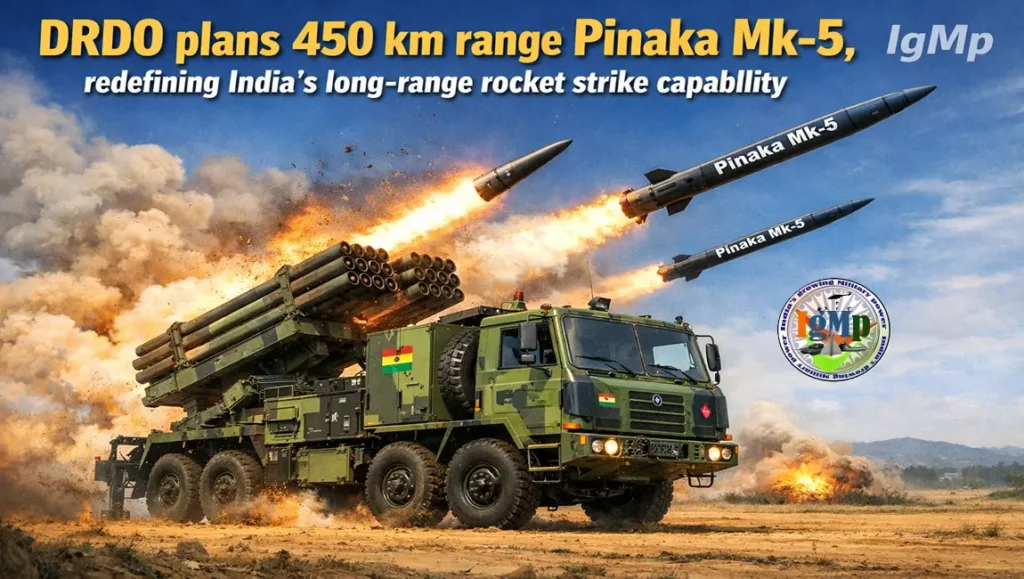
India’s long-range precision strike option is soon positioned to undergo a significant boost, with new reports emerging that the Defence Research and Development Organisation will start work to develop a 450 km variant of the Pinaka guided rocket system, which is tentatively named Pinaka Mk-5. If the program succeeds, it would become the longest-range guided rocket in India’s inventory and mark a decisive step towards bridging the long-standing gap between conventional long-range artillery and tactical ballistic missiles.
This work is closely pursued by the 300kilometre Pinaka Mk-4, which is already in progress and is an indication of the definite aim of taking the Pinaka family past the common battlefield rocket artillery to the next level of deep-strike or deeper strike systems. The rationale for planners is simple and clear: modern high-intensity wars are increasingly demanding the capability to deliver rapid, precise, and high-volume fire onto time-sensitive targets at greater distances without the immediate use of costly missile systems.
Proposed Pinaka Mk-5 with a 450 km range will likely fit this role perfectly. In contrast to tactical ballistic missiles, long-range guided rockets are a less costly alternative that enables sustained strike campaigns by being optimised to require targets of select and high value, and deploying elaborate trajectories and counter-air-defence penetration strategies. They enable commanders to overwhelm target areas, destroy enemy logistics, command nodes, and staging areas, and maintain pressure throughout the depth of the battlefield. This difference proves to be decisive in weighing the cost, availability, and pace of operations in the case of a long military operation.
This reasoning has gradually been conceived by the experience of India throughout the last decade. The Pinaka system, which was initially designed to replace older rocket launcher systems from the Soviet era, has a range of approximately 40 kilometres. With time, small improvements saw this envelope extended to approximately 90 kilometres; the addition of guided variants enhanced accuracy and minimised wastage due to ammunition. The current roadmap represents a much more ambitious vision, and this turns Pinaka into not just a corps but a theatre-level precision strike capability.
When the Mk-4 and Mk-5 variants become fully operational, the Pinaka family will provide a resorted level of strikes that span between approximately 40 to 90 kilometres, will incorporate a directed shot within the 120 kilometres category, and eventually to 300 to 450 kilometres. This hierarchical design enables commanders to deploy responses within a range of target values, urgency, and required effects needed, all with a shared launcher ecosystem and support infrastructure.
More importantly, the 450 km range Pinaka Mk-5 rocket will not substitute the Indian tactical ballistic weapons, but should rather augment them. Should hardened or high-value targets be targeted by systems like Pralay, they are optimised to make precision attacks and use quasi-ballistic trajectories to make them difficult to intercept by contemporary air defence systems. The missiles are costly and strategically important, such that they are only applicable for selective usage, rather than routine high-volume fire. For comparison, a long-range guided rocket such as Pinaka Mk-5 can absorb significant weight in long-range fires, leaving inventories of the Pralay missiles to be used when their requirement arises in special operations.
Such a strategy fits with the force structural strategy in the context of India intensifying its rocket and missile capabilities within its long-range strike doctrine, which is partially more integrated to a greater degree. It stresses more on the capability to implement quick, accurate attacks throughout the breadth of enemy land in the initial stages of the conflict, destabilizing the mobilisation, logistic, and command hierarchies before they can be brought fully into operation. Extended-range Pinaka rockets are an example, and in this regard, it has a flexible, scalable toolset.
Technical issues are still large. To make a guided rocket fly 450 kilometres requires propulsion, lightweight materials, aerodynamic efficiency, and control systems that can be accurate and on target over extensive flight paths. It is no trivial engineering endeavor to maintain accuracy over miles without incorporating the sophistication of a ballistic missile. Nevertheless, the steady progress of DRDO in the field of long-range rocket motors, composite casings, and satellite-aided navigation indicates that all these hurdles are being tackled systematically.
One of the key design factors is cost-effectiveness. A major benefit of the Pinaka system, and to this day, has been the relatively low cost-per-round for the missiles. This needs to be sustained over the longer range so that the Mk-5 can meet its projected need as a high-volume strike weapon. It is being hinted that the emphasis is going to be found on range/accuracy vs. manufacturability/affordability, making the system capable of being manufactured in significant volumes and not just a niche feature.
The value of such systems has been enhanced through the lessons of recent conflicts in which they were operational. The ability to provide long-range fires with precision and scale has proven effective in high-intensity warfare, as the ability to provide even just a few fires with precision can decisively shape the battlefield in ways that air power typically is unable to do, particularly when there is a contest in a heavily defended airspace. Ground-launched precision rockets are resilient, responsive, and continuously available in such settings. These properties are especially applicable to India, which has a multifaceted actual terrain and multidimensional threat axes.
One dramatic implication of the Pinaka program will also be industrial. The local production of long-range guided rockets enhances domestic capabilities in propulsion, guidance, and systems integration. It promotes an increasing number of public and private participants in the ecosystem of production of launchers, rockets, and subsystems. Over time, this level of industrialization may decrease reliance on imports and hasten the adjustment to the changing operational demands.
In the larger military context, the maturity level of Pinaka Mk-5 would go a long way in giving the Indian Army formations a greater degree of strike options. Along with missiles and air-delivered precision missiles, the long-range rockets would be part of a multi-domain, layered strike architecture, which has the capacity to impose costs throughout the entire depth of the operational environment of an adversary. This style is also becoming a key component of contemporary deterrence, in which the capacity to react swiftly and, accordingly, to respond in a manner that is proportionate may affect the force of escalation.
In a strategic sense, the shift to a 450-kilometre range Pinaka Mk-5 guided rocket is a sign that India is planning to become prepared in case of future confrontations, which are most likely to be fast-paced, technology-driven, and waged over a distance. India is securing itself against uncertainty, and by investing in a range of precision strike missiles instead of depending on a single category of armaments, India will be able to have flexibility in both deterrence and conflict.
As growth becomes a reality, testing, validation, and integration into all existing command-and-control networks will be the topmost focus. The effectiveness with which Pinaka Mk-5 can be employed in the real world will be dictated by thorough targeting, data integration, and coordination with other assets used in the strikes. When all these factors are put to play as planned, the long-range Pinaka missiles have the potential to completely transform the manner in which India goes about its deep strikes, providing it with a resolute, economical, and scalable choice in precision strikes in the new arena of high-intensity warfare.