Synopsis
- Instead of focusing on a single stealth drone project, India is shaping a multi-tier fleet that ranges from technology demonstrators to heavy unmanned fighters like Ghatak UCAV and FUFA capable of operating alongside next-generation manned jets.
IgMp Bulletin
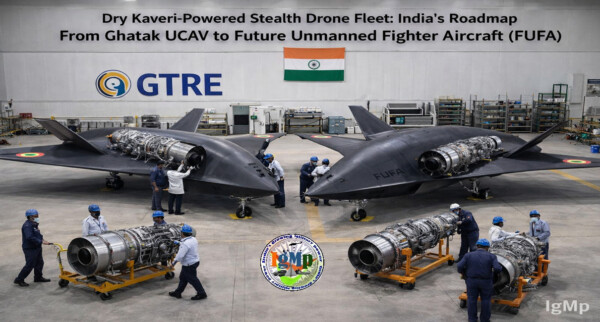
India’s next phase of air combat planning is increasingly centered on autonomous stealth aircraft powered by indigenous engines. After years of development setbacks and redesigns, the Kaveri engine programme has quietly reached a turning point, and defence planners are now building an entire unmanned combat ecosystem around its dry variant, the Dry Kaveri Derivative Engine. Instead of focusing on a single stealth drone project, India is shaping a multi-tier fleet that ranges from technology demonstrators to heavy unmanned fighters like Ghatak UCAV and FUFA capable of operating alongside next-generation manned jets.
The breakthrough that made this roadmap viable is the maturation of the so-called “Dry Kaveri” engine, a non-afterburning turbofan variant developed by the Gas Turbine Research Establishment (GTRE) under the Defence Research and Development Organisation (DRDO). Following high-altitude trials conducted between late 2024 and early 2025, the engine demonstrated thrust in the range of roughly 46–48 kilonewtons. That performance level is now considered sufficient to power India’s stealth unmanned combat aircraft programmes, moving the technology beyond its earlier “derivative” stage into a baseline propulsion solution for multiple platforms.
Stealth Fleet Tier
| Platform | Role | Engine | Estimated Weight |
|---|---|---|---|
| Ghatak UCAV | Deep Penetration Strike (SEAD/DEAD) | 46 kN Dry Kaveri | 8–10 tonnes |
| FUFA (Unmanned Fighter) | Air Superiority / Loyal Wingman | Dual Dry Kaveri (planned) | 22–24 tonnes |
| SWiFT Testbed | Technology Validation | Small turbofan (NMITLI) | ~1 tonne |
The most immediate beneficiary of this propulsion milestone is the Ghatak unmanned combat aerial vehicle, a flying-wing stealth drone designed for deep penetration strike missions. Unlike reconnaissance drones, the Ghatak is intended to operate inside heavily defended airspace, striking high-value targets such as radar sites, air defence batteries and strategic infrastructure. In professional military terminology, these missions fall under the categories of Suppression and Destruction of Enemy Air Defences, commonly known as SEAD and DEAD operations. In such missions, a non-afterburning turbofan like the Dry Kaveri offers a tactical advantage because it produces a lower infrared signature than engines using afterburners, making the aircraft harder for heat-seeking missiles to track.
Technology validation for the stealth drone architecture has already been carried out through the experimental Stealth Wing Flying Testbed (SWiFT) programme. The demonstrator aircraft confirmed the aerodynamic behaviour of the flying-wing configuration that will define the larger operational platform. Engineers involved in the programme have indicated that radar cross-section measurements during prototype trials suggested signatures comparable to those of small birds, a level of stealth that could allow the aircraft to slip through radar coverage when combined with terrain-following flight profiles.
As development progresses, defence planners are also studying a heavier unmanned aircraft concept often referred to as the Futuristic Unmanned Fighter Aircraft (FUFA). This proposed platform would weigh roughly 22 to 24 tonnes and could be powered by twin Dry Kaveri engines. Unlike the Ghatak, which focuses on deep-strike missions, the larger unmanned fighter is envisioned as a versatile platform capable of air-to-air combat, long-range interception and coordinated operations with piloted aircraft.
The idea is closely tied to India’s emerging concept of network-centric air warfare, where manned fighters operate alongside autonomous systems that expand their sensing and strike reach. One of the key elements of this doctrine is the Combat Air Teaming System, an architecture that allows different aircraft—manned and unmanned—to share sensor data and coordinate attacks in real time. Under this framework, platforms like the CATS Warrior are expected to act as loyal wingmen, flying ahead of manned aircraft to conduct surveillance, electronic warfare or even sacrificial decoy missions.
The reliance on the Kaveri engine family gives India’s drone ecosystem a distinctive advantage in terms of logistics. Unlike some international programmes that rely on mixed propulsion systems sourced from multiple suppliers, the Indian roadmap is anchored around a single indigenous engine core. This simplifies maintenance, repair and overhaul cycles while reducing long-term dependence on imported propulsion technology.
Another crucial aspect of the emerging stealth fleet is its integration with India’s expanding indigenous weapons inventory. The Ghatak and future unmanned fighters are expected to carry beyond-visual-range air-to-air weapons such as the Astra missile family while also supporting strike missions with systems like the Naval Anti-Ship Missile Short Range. Combining stealth aircraft with domestically produced precision weapons allows the armed forces to maintain a fully sovereign strike capability without relying heavily on foreign systems.
The Kaveri programme itself also holds broader significance beyond unmanned aircraft. Engineers see it as a technological stepping stone toward the much more powerful engine required for India’s next-generation fighter aircraft. Lessons learned in materials science, turbine cooling and fuel efficiency from the 46–48 kN Dry Kaveri could feed directly into the development of a future 110-kilonewton class engine planned for the Advanced Medium Combat Aircraft project.
What is gradually emerging is not just a single stealth drone programme but an integrated unmanned combat fleet built around indigenous propulsion, AI-enabled autonomy and locally developed precision weapons. By scaling the Kaveri engine across multiple aircraft classes—from testbeds to heavy unmanned fighters—India is laying the technological groundwork for a future where manned and unmanned platforms operate as a unified air combat network.