Synopsis
- Signals emerging from defence and aerospace circles suggest New Delhi may be waiting to see whether the United States is willing to place a concrete proposal on the table for the F-35, and more importantly, whether such an offer would come with the level of sovereign control India considers essential.
Source : IgMp Bulletin
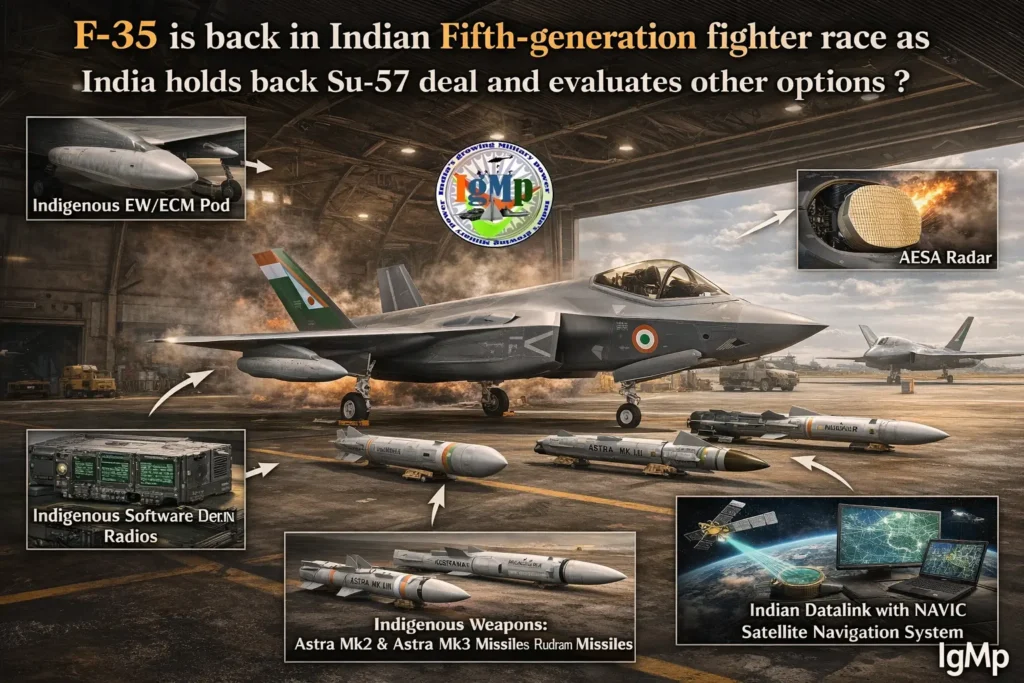
India’s approach to fifth-generation fighter acquisitions appears to be entering a deliberate pause, not out of indecision but strategic calculation. Signals emerging from defence and aerospace circles suggest New Delhi may be waiting to see whether the United States is willing to place a concrete proposal on the table for the F-35, and more importantly, whether such an offer would come with the level of sovereign control India considers essential. The discussion is not centred on acquiring a stealth aircraft at any cost. It is about the terms under which such a platform would fit into India’s long-term airpower doctrine without compromising autonomy.
At the heart of India’s fighter roadmap is its indigenous fifth-generation programme, the Advanced Medium Combat Aircraft (AMCA), which is designed to give the country full control over design, software, sensors, and upgrades. Yet the regional airpower balance is shifting rapidly, with stealth platforms becoming central to deterrence and survivability. This has kept alive the debate over whether a limited number of foreign fifth-generation fighters could serve as an interim capability or a force multiplier while domestic programmes mature. Within this context, the F-35 is often mentioned, but only hypothetically, pending clarity from Washington.
What makes the discussion nuanced is India’s clear preference for a model closer to Israel’s unique F-35I configuration rather than a standard export version. Israel remains the only operator allowed to run its own sovereign software layer on the aircraft, sitting above the core mission systems developed by Lockheed Martin. This arrangement enables Israel to update threat libraries, mission data, and electronic warfare responses independently, without relying on U.S. software update cycles. For India, operating in a dense and diverse threat environment, such flexibility would not be optional.
The operational reality for the Indian Air Force involves facing advanced radar networks, layered surface-to-air missile systems, and increasingly sophisticated electronic warfare challenges across multiple fronts. In such conditions, the ability to rapidly tailor onboard systems to local threat matrices can directly influence survivability and mission success. An aircraft whose software architecture and electronic warfare suite cannot be independently customised risks becoming predictable in a contested battlespace.
This requirement also explains why India’s existing inventory factors into the equation. The presence of Russian-origin air defence systems, including the S-400, has long been a sensitive issue in U.S. defence policy discussions involving the F-35. Washington has traditionally been cautious about deploying the aircraft in environments where such systems operate, citing concerns about data security and intelligence exposure. Whether broader geopolitical considerations and Indo-Pacific dynamics could prompt a more flexible stance in India’s case remains an open question.
From New Delhi’s perspective, any potential offer would be assessed against a clear set of criteria: software sovereignty, control over electronic warfare architecture, freedom to integrate indigenous sensors and data links, and meaningful industrial participation. Platform performance alone is not the decisive factor. Without guarantees on data ownership and upgrade independence, even a highly capable aircraft could impose long-term operational constraints.
There is also the question of balance. Acquiring a small number of foreign fifth-generation fighters could provide immediate stealth capability and interoperability with partner air forces, but it could also divert attention and resources from indigenous development. Policymakers appear conscious of this trade-off. The emphasis remains on ensuring that any interim solution strengthens, rather than sidelines, domestic aerospace ambitions.
For now, the situation suggests watchful waiting rather than active pursuit. If the United States were to extend a formal proposal aligned with India’s expectations of sovereign control, it would likely be evaluated seriously. If not, the centre of gravity will continue to rest on indigenous programmes that promise full autonomy over the aircraft’s lifecycle. In that sense, the real decision facing India is less about choosing between platforms and more about defining the boundaries of strategic independence in an era where software and data increasingly determine air combat outcomes.