Synopsis
- Instead of functioning only as a fighter aircraft, the AMCA Mk2 is expected to operate as a central command node that links satellites, sensors and unmanned systems into a single data network.
IgMp Bulletin
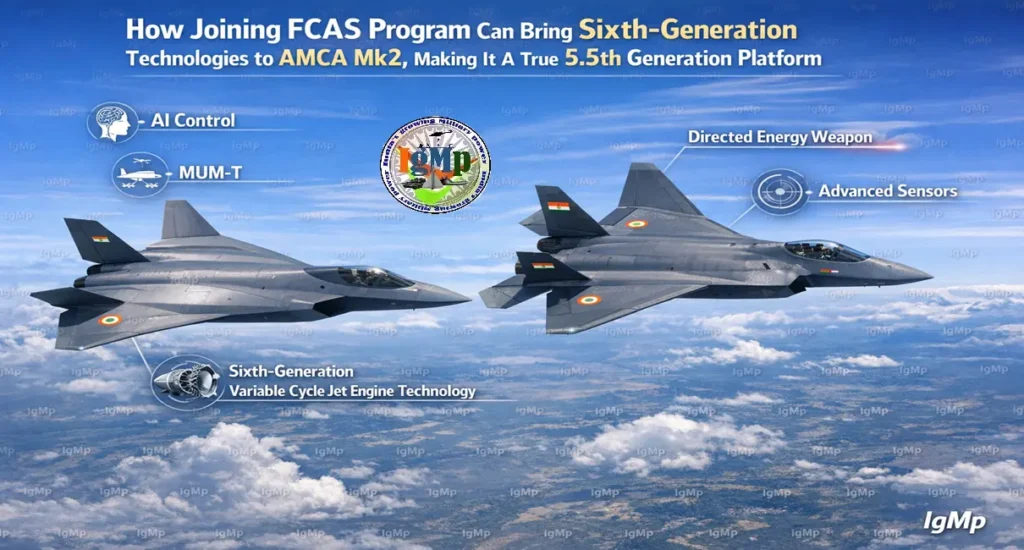
India’s indigenous stealth fighter program is entering a new strategic phase after New Delhi formally expressed interest in joining the European Future Combat Air System (FCAS) ecosystem during the 6th India-France Annual Defence Dialogue held in Bengaluru last month. The move signals a shift in thinking within India’s aerospace community: the Advanced Medium Combat Aircraft (AMCA) is no longer being viewed simply as a standalone fifth-generation fighter but as a future digital node inside a broader sixth-generation combat network.
The timing is significant. The year 2026 has been declared the “Indo-French Year of Innovation,” and defence technology collaboration sits at the center of that initiative. Within this framework, propulsion research has taken a major leap forward through a landmark ₹61,000-crore ($7.3 billion) agreement between Safran Aircraft Engines and India’s Gas Turbine Research Establishment under the Defence Research and Development Organisation. The partnership will jointly develop a new 120–140 kilonewton class turbofan engine intended for the AMCA Mk2.
What makes the deal unprecedented is its technology transfer structure. For the first time, India will co-develop a fighter engine core aligned with sixth-generation design principles while retaining full intellectual property rights for the Indian side. In practical terms, this means critical hot-section technologies, high-temperature turbine materials and advanced thermal management systems will be developed jointly rather than licensed.
Equally important is how the new engine is being integrated into the aircraft design. Engineers are reportedly shaping the powerplant so it can fit within the same engine bay currently planned for the General Electric F414-GE-INS6 used in the first AMCA variant. This “plug-and-play” approach allows the aircraft’s structure to remain largely unchanged while the propulsion system evolves from a fifth-generation configuration to a far more powerful sixth-generation core.
The AMCA program itself is being structured around a tiered strategy. The AMCA Mk1, powered by the F414 engine, will prioritize stealth shaping, avionics maturity and operational induction. The follow-on AMCA Mk2 will then introduce technologies associated with the next era of aerial warfare, including advanced sensor fusion, high-power onboard electronics and deeper integration with autonomous systems.
| Feature | AMCA Mk1 (5th Gen) | AMCA Mk2 (5.5 Gen / FCAS Influence) |
|---|---|---|
| Engine | GE F414-INS6 (98 kN) | Indo-French 120–140 kN core |
| Stealth | Physical shaping + RAM | “Smart Skin” + active stealth |
| MUM-T | Limited drone coordination | AI-led combat cloud integration |
| Timeline | First flight: 2028–29 | Induction target: 2038–2040 |
One of the most transformative elements of this evolution is the shift toward a combat-cloud architecture. Instead of functioning only as a fighter aircraft, the AMCA Mk2 is expected to operate as a central command node that links satellites, sensors and unmanned systems into a single data network. Within such a system, pilots gain access to real-time battlefield information shared across multiple platforms.
This capability directly connects with India’s own loyal wingman concept being developed through the HAL CATS Warrior program. Under the combat-cloud model, an AMCA Mk2 pilot could coordinate a group of autonomous drones tasked with electronic warfare, reconnaissance or strike missions. Artificial intelligence tools would assist in processing the enormous volume of sensor data generated during combat operations.
Stealth technology is also expected to evolve beyond conventional radar-absorbing coatings. Research associated with the FCAS roadmap is exploring “smart skin” structures—aircraft surfaces embedded with distributed sensors and antennas. Such systems could dramatically improve situational awareness while maintaining low radar visibility, effectively turning the aircraft itself into a multi-function sensor platform.
The geopolitical context adds further urgency to India’s strategy. Rapid advances in China’s stealth aircraft fleet, including developments around the Chengdu J‑20 and Shenyang J‑35, are pushing multiple nations to accelerate sixth-generation research. Meanwhile, parallel efforts such as the British-Japanese-Italian Global Combat Air Programme highlight how major powers are forming technology coalitions to shape the next era of air combat.
Some defence analysts also note that internal industrial disagreements within the European FCAS program—particularly between partners in France and Germany—may open the door for India to emerge as a strategic Tier-0 collaborator. From Paris’ perspective, expanding cooperation with India strengthens industrial stability while ensuring the long-term viability of next-generation fighter development.
For India, the benefits are equally strategic. By combining indigenous aircraft design with advanced propulsion, AI-driven avionics and network-centric warfare concepts drawn from the Future Combat Air System roadmap, the AMCA Mk2 could evolve into a genuine 5.5-generation platform—bridging the gap between today’s stealth fighters and the fully digital combat aircraft expected to dominate air warfare in the 2040s.