Synopsis
- The approval, granted by the board chaired by Defence Secretary Rajesh Kumar Singh, sets in motion one of the largest airlift modernisation programmes undertaken by the country in recent years and reflects a broader shift in how India views air mobility as a core operational capability rather than a supporting function [Source.
IgMp Bulletin
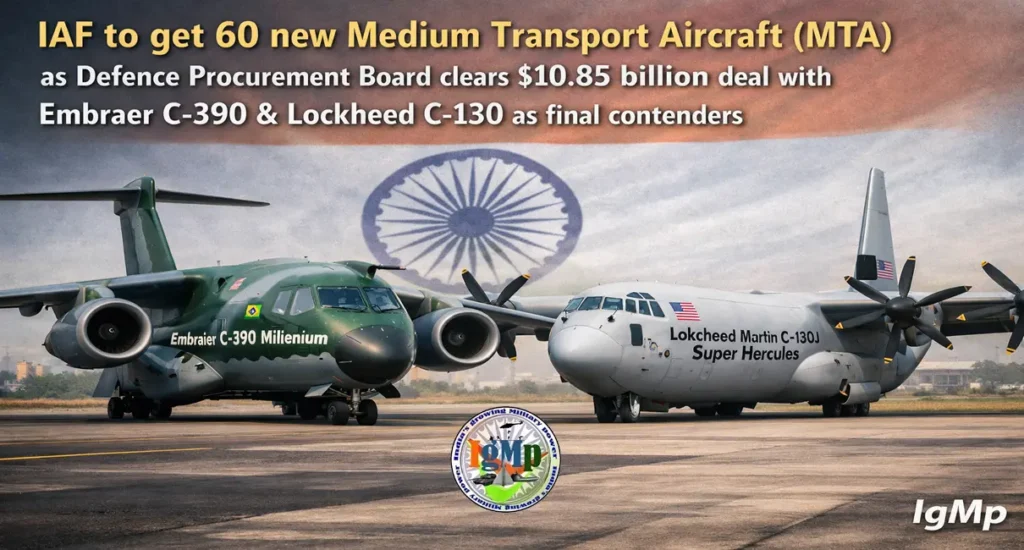
India’s long-pending effort to modernise the Indian Air Force’s medium transport fleet has entered a decisive phase after the Defence Procurement Board (DPB) cleared a proposal to acquire 60 new Medium Transport Aircraft (MTA). The approval, granted by the board chaired by Defence Secretary Rajesh Kumar Singh, sets in motion one of the largest airlift modernisation programmes undertaken by the country in recent years and reflects a broader shift in how India views air mobility as a core operational capability rather than a supporting function [Source: The New Indian Express].
The clearance allows the proposal to move to the Defence Acquisition Council (DAC) for Acceptance of Necessity (AoN), after which the programme will formally enter the tendering and evaluation stage. Estimated at around ₹1 lakh crore ($10.85 billion), the acquisition is designed to replace the Indian Air Force’s ageing Antonov An-32 fleet, inducted in the mid-1980s and now increasingly constrained by maintenance challenges and dwindling spare parts. The new aircraft are also expected to absorb some missions currently flown by the older Il-76 fleet, helping rationalise the IAF’s transport inventory and create a clearer separation between light, medium, and heavy lift roles.
Operational experience over the last decade, particularly during the military standoff in Eastern Ladakh, has reinforced the importance of tactical airlift. Transport aircraft were central to sustaining forward deployments, moving troops, artillery, and supplies into high-altitude sectors where surface routes are limited and weather-dependent. For the IAF, the lesson was clear: airlift is not merely logistical support, but a strategic enabler that directly affects readiness and deterrence along contested borders.
The Head-to-Head Comparison: Embraer C-390 Millennium vs Lockheed Martin C-130J Super Hercules
A competitive field is now emerging, with two serious contenders expected to define the race. Brazil’s Embraer, partnered with Mahindra Defence, is offering the C-390 Millennium, while US-based Lockheed Martin, working with Tata Advanced Systems, has pitched the C-130J Super Hercules, already in service with the IAF.
| Feature | Embraer C-390 Millennium | Lockheed C-130J-30 Super Hercules |
|---|---|---|
| Engine Type | 2× IAE V2500-E5 turbofans | 4× Rolls-Royce AE 2100D3 turboprops |
| Maximum Payload | ~26 tonnes | ~20 tonnes |
| Cruise Speed | ~870 km/h (Mach 0.8) | ~644 km/h (Mach 0.59) |
| IAF Familiarity | New platform, higher induction risk | Existing fleet, lower logistics risk |
| Service Ceiling | 36,000 ft | 28,000 ft |
| Key Advantage | High speed, modern jet design | Proven in Ladakh, global spares network |
The C-390 is pitched on speed, jet efficiency, and a modern design philosophy, sitting at the upper end of the IAF’s payload requirement. The C-130J, while offering a lower payload, benefits from a proven operational record in Indian conditions, an established maintenance ecosystem, and familiarity among IAF crews.
The Himalayan Challenge: Why Altitude Defines the MTA Choice
In the Indian context, the success of a transport aircraft is not determined on long concrete runways in the plains, but at advanced landing grounds such as Daulat Beg Oldie or Nyoma. These airfields bring the “density altitude” problem into sharp focus. At high altitudes, thinner air reduces engine thrust and wing lift, forcing aircraft to operate closer to their performance margins during take-off and landing.
This is where the technical debate between jet engines and turboprops becomes critical. The C-390’s turbofans provide high cruise speeds and the ability to operate above many terrain obstacles, but turboprops like those on the C-130J are traditionally favoured for “high and hot” conditions. Turboprops deliver strong low-speed thrust and rapid response, qualities that are valuable when operating from short, semi-prepared Himalayan strips. The IAF’s evaluation will therefore hinge less on headline specifications and more on consistent performance at 16,000 feet and above, under real operational loads.
Aatmanirbhar Bharat: The “Buy and Make” Strategy Explained
The programme will be executed under the “Buy and Make (Indian)” category, with 12 aircraft acquired in flyaway condition and the remaining 48 manufactured in India. This structure mirrors the approach used in the C-295 transport aircraft programme and is designed to create a sustainable domestic aerospace ecosystem rather than simple assembly lines.
By producing the bulk of the fleet domestically, India aims to establish a long-term transport aircraft manufacturing and maintenance hub. Such a facility would support not only the Indian Air Force but also potentially serve global operators, reducing dependence on overseas supply chains for spares, upgrades, and airframe life management over the next four decades. Aerospace clusters in cities such as Bengaluru and Hyderabad are widely seen as potential beneficiaries of this industrial push.
Beyond fleet replacement, the medium transport aircraft program underscores a larger strategic shift. By combining operational performance with domestic manufacturing and long-term sustainment, the IAF’s transport modernisation effort strengthens India’s ability to move forces rapidly across difficult terrain while reinforcing sovereignty over critical defence capabilities. In an era where mobility increasingly shapes military outcomes, the decision carries implications that extend well beyond the transport fleet itself.