Synopsis
- While the long-awaited “Super Sukhoi” upgrade for 84 Su-30MKI fighters awaits final clearance from the Cabinet Committee on Security, the IAF has opened a parallel line of engagement with Russia to modernise a larger portion of its fleet, potentially covering around 175 aircraft.
Source : IgMp Bulletin
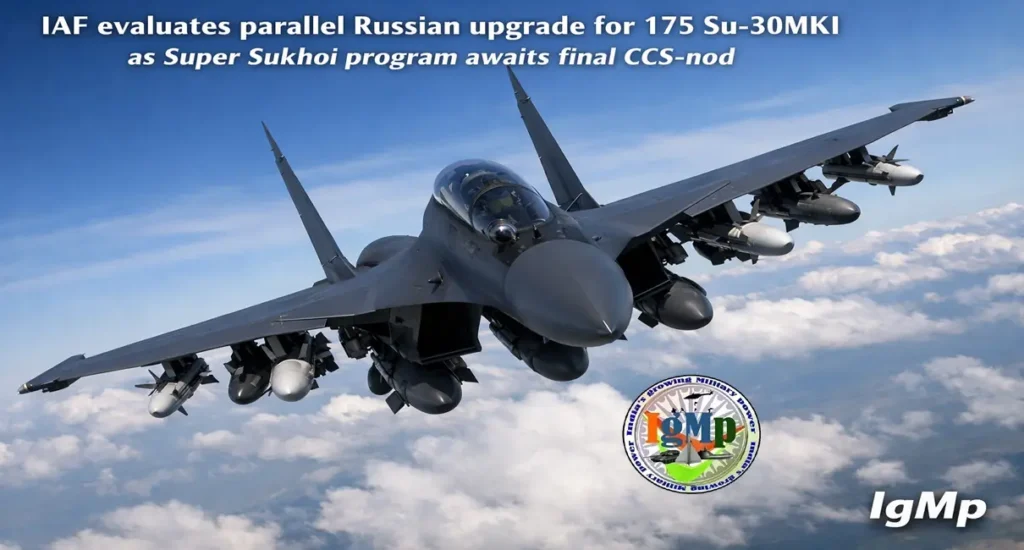
The Indian Air Force is quietly recalibrating its combat aircraft modernisation plans at a time when timelines matter as much as technology. While the long-awaited “Super Sukhoi” upgrade for 84 Su-30MKI fighters awaits final clearance from the Cabinet Committee on Security, the IAF has opened a parallel line of engagement with Russia to modernise a larger portion of its fleet, potentially covering around 175 aircraft.
This move reflects a practical concern inside the service: time. Even after formal approval, the HAL-led upgrade programme is expected to take nearly seven years for development, testing and certification, followed by another several years to complete modifications across the selected jets. In military planning terms, that pushes full operational capability deep into the next decade. For an air force managing squadron shortages and a complex two-front security environment, such delays carry operational risks.
The Su-30MKI remains the backbone of the IAF, forming the largest share of its fighter inventory. Any capability gap in this segment directly affects air dominance, deep strike and maritime roles. A parallel Russian upgrade track is therefore being evaluated not as a replacement for the indigenous programme, but as a hedge against extended timelines and evolving threats.
The indigenous Super Sukhoi upgrade, led by Hindustan Aeronautics Limited in partnership with DRDO, is ambitious. It centres on the Virupaksha AESA radar, an advanced development derived from the Uttam AESA architecture but tailored for the larger nose and power availability of the Su-30MKI. Built around Gallium Nitride technology, the radar is expected to significantly enhance detection range, multi-target tracking and electronic counter-countermeasure capability. Alongside this, the aircraft would receive new avionics, improved mission computers and integration of weapons such as Astra beyond-visual-range missiles, BrahMos-ER cruise missiles and Rudram anti-radiation missiles.
However, advanced radar integration and certification are complex tasks. The Uttam radar itself is still progressing through full operational validation on lighter platforms. Scaling it up for a heavy twin-engine fighter introduces fresh engineering challenges. While DRDO has reportedly continued work with internal funding, full-scale development and integration depend on major financial sanction.
In parallel, Russia has signalled readiness to offer upgrades focusing on radar and electronic warfare improvements. One proposal under evaluation includes the more powerful AL-41 engine as a potential replacement for the current AL-31 powerplant, promising better thrust and possibly improved reliability. A Russian technical team’s recent visit to HAL’s Nashik facility indicates that discussions have moved beyond informal exchanges.
Strategically, the timing is significant. India is also moving closer to formalising a decision on a fifth-generation fighter, with Russia’s Su-57 among the contenders. Deeper engagement on the Su-30MKI upgrade could reinforce industrial cooperation and smooth the path for broader aerospace collaboration. At the same time, New Delhi remains committed to increasing indigenous content and technological self-reliance, making the balancing act more nuanced than in past decades.
Defence procurement in India has often been slowed by cost negotiations, technology transfer discussions and the push for local manufacturing. The Su-30MKI upgrade journey itself began as far back as 2006, and despite receiving Acceptance of Necessity in late 2023, it still awaits final approval. A dual-track approach could mirror earlier upgrade models where Indian and Russian agencies shared responsibilities, accelerating capability induction while retaining domestic participation.
From an operational standpoint, the logic is clear. The IAF cannot afford to wait until the mid-2030s for a fully modernised fleet when regional air forces are inducting advanced sensors, long-range missiles and network-centric capabilities today. Ensuring that the Su-30MKI remains a credible 4.5-generation platform over the next 15 years is essential for deterrence and warfighting flexibility.
Ultimately, the parallel upgrade consideration is less about choosing between Moscow and domestic industry, and more about managing risk. In a period of rapid technological change and tightening security margins, redundancy in planning may prove to be as important as innovation itself.