Synopsis
- It is efficiency at scale, survivability in contested airspace, and the ability to plug into a network-centric warfare environment where transport aircraft can double as force multipliers.
IgMp Bulletin
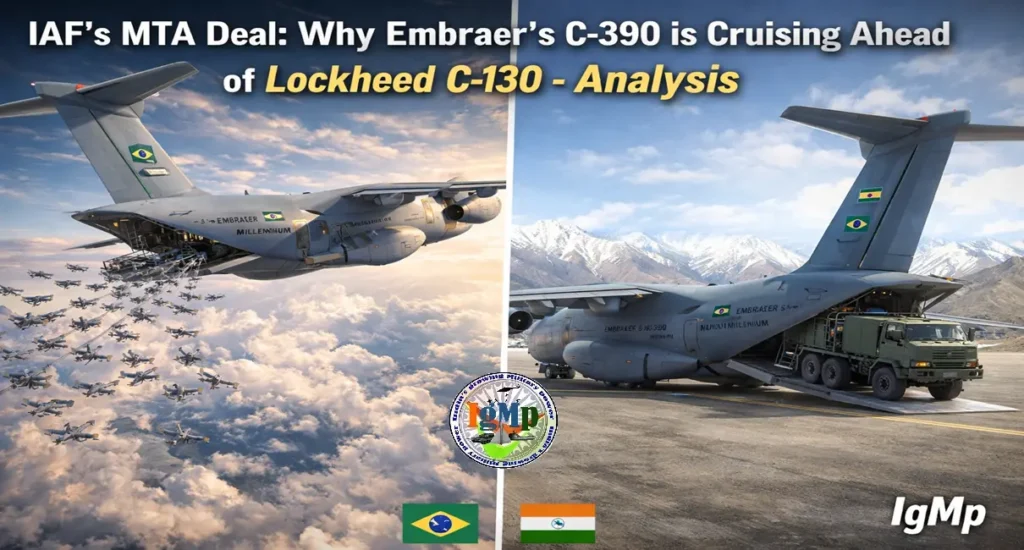
India’s Medium Transport Aircraft (MTA) requirement has quietly become one of the most strategically important airlift decisions of the decade. The Indian Air Force is not just replacing ageing platforms; it is selecting the backbone of tactical mobility for the next 30 years. In this contest, Brazil’s Embraer has positioned the Embraer C-390 Millennium as a high-speed, high-altitude, multi-role solution competing directly with the Lockheed Martin C-130J-30 Super Hercules in IAF’s MTA deal.
What makes this contest different from past airlift evaluations is that the benchmark is no longer just payload. It is efficiency at scale, survivability in contested airspace, and the ability to plug into a network-centric warfare environment where transport aircraft can double as force multipliers.
IAF’s MTA Deal: The 26-Ton Advantage of C-390: Why Capacity Matching Matters for India
On paper, the IAF’s stated requirement is often described as “up to 30 tonnes.” The C-390 offers a certified payload of 26 tonnes. At first glance, critics may ask: why not go all the way to 30 or even 40 tonnes?
The answer lies in operational sweet spots. A 26-ton capacity allows the C-390 to carry heavy 8×8 armoured vehicles, artillery systems, fully equipped infantry combat vehicles like the BMP-2, or large logistics pallets in a single sortie. By contrast, aircraft in the 20-ton class often require weight compromises, especially in hot-and-high conditions.
Moving up to a 40–50 ton class aircraft such as the Airbus A400M significantly increases acquisition and operating costs. India already operates heavy-lift platforms for strategic missions. The gap the IAF is trying to fill is between light tactical transports and large strategic lifters. In that context, 26 tonnes is not a shortfall—it is an optimal efficiency band, offering near-30-ton performance without strategic-level operating expenses.
For a country with vast distances—from southern naval bases to forward Himalayan airstrips—fuel burn per ton-mile becomes a critical metric. Here, the C-390’s turbofan architecture plays a decisive role.
Beyond Cargo: The C-390 as a Drone Swarm ‘Mothership’
The real innovation in Embraer’s pitch is not payload; it is modularity. The C-390 is being marketed as a potential airborne systems carrier capable of launching and coordinating unmanned systems in a network-centric warfare environment.
Unlike legacy transport aircraft designed primarily for logistics, the C-390 was built around digital fly-by-wire controls and an advanced mission management architecture. This makes it easier to automate complex release sequences for palletized systems or drone swarms.
The aircraft’s cargo hold width—approximately 3.45 meters—provides a crucial edge over the C-130J’s roughly 3.12-meter internal width. That extra space is not cosmetic. For palletized deployment systems inspired by concepts like “Rapid Dragon,” width determines how many launch modules can be accommodated side by side and how safely they can be extracted through the rear ramp without interference.
In drone swarm configurations, the wider hold allows carriage of larger unmanned aerial vehicles or more densely packed autonomous systems. In operational terms, that translates into greater massed effects per sortie.
Rapid Dragon Compatibility: Turning Airlifters into Arsenal Planes
The Rapid Dragon concept, developed in the United States, demonstrated how palletized munitions or systems could be rolled out of a transport aircraft and activated mid-air. While India’s doctrinal path would be sovereign and policy-driven, the compatibility of the C-390 with similar palletized architectures enhances its long-term flexibility.
A transport aircraft that can shift from carrying humanitarian aid one week to acting as a launch platform for networked unmanned systems the next provides unmatched mission adaptability. In a crisis, such adaptability compresses response time without requiring entirely new fleets.
Fly-by-wire controls further support this evolution. Digital control systems enable precise automated flight profiles during pallet release, improving safety margins. In contrast, turboprop platforms with older manual control philosophies may require more pilot workload during complex deployment sequences.
Technical Comparison: Turbofan Speed vs. Turboprop Legacy
Below is a structured comparison relevant to the IAF’s operational environment:
| Feature | Embraer C-390 Millennium | Lockheed Martin C-130J-30 |
|---|---|---|
| Propulsion | 2× IAE V2500-E5 Turbofans (Jet) | 4× Rolls-Royce AE 2100D3 Turboprops |
| Max Payload | 26 Tonnes | ~20 Tonnes |
| Service Ceiling | 36,000 feet (11,000 m) | 28,000 feet (8,500 m) |
| Max Speed | 870 km/h (Mach 0.8) | 670 km/h |
| Cargo Hold Width | ~3.45 m | ~3.12 m |
| Drone Launching Potential | Rapid Dragon–style compatible | Limited by fuselage width |
| Operational Advantage | High-altitude, high-speed transit | Exceptional short-field performance |
The service ceiling difference is particularly relevant for India. At 36,000 feet, the C-390 can cruise above much of the weather turbulence common in Himalayan sectors. This reduces structural fatigue, improves passenger comfort and enhances operational safety. It also allows the aircraft to remain outside the engagement envelope of many man-portable air defense systems during transit.
From a fuel efficiency standpoint, turbofan engines like the V2500 are optimized for higher-altitude cruise. Covering long distances at 36,000 feet can result in lower fuel burn per ton-mile compared to lower-altitude turboprop operations over extended routes.
The C-130J retains a strong advantage in short, rough-field performance—a factor the IAF will weigh carefully. But for rapid cross-country transit and high-altitude survivability, the C-390’s performance envelope is notably broader.
The Mahindra–Embraer Industrial Roadmap for Aatmanirbhar Bharat
Beyond performance metrics, industrial participation will influence the final decision. Embraer has signed a Memorandum of Understanding with Mahindra Defence Systems to explore local assembly and manufacturing opportunities in India.
This is not merely symbolic. A domestic production line would integrate Indian suppliers into the global C-390 ecosystem, opening opportunities in aerostructures, avionics integration and mission systems. For India’s Aatmanirbhar Bharat push, local production reduces long-term dependence and strengthens aerospace capabilities at home.
Co-development pathways could also allow India to customize mission software, drone integration frameworks and secure data links in line with national doctrine. In a world where software defines combat effectiveness, that flexibility matters as much as hardware.
Why the C-390 Is Emerging as a Strategic Choice
The IAF’s MTA selection will balance runway performance, lifecycle cost, survivability and industrial returns. The C-130J remains a proven, globally trusted workhorse. However, the C-390 introduces a generational shift—jet speed, higher ceiling, wider cargo hold, digital fly-by-wire systems and a clear roadmap toward modular, drone-enabled operations.
If the future battlefield is networked, distributed and increasingly unmanned, the aircraft chosen today must be ready for that tomorrow. In that sense, the debate is no longer just about lifting capacity. It is about lifting capability.