Synopsis
- Developed through the Indo-French collaboration between the Gas Turbine Research Establishment (GTRE) and France’s Safran, the project is increasingly being seen not just as an engine programme but as a strategic move to keep India competitive in the emerging sixth-generation fighter race.
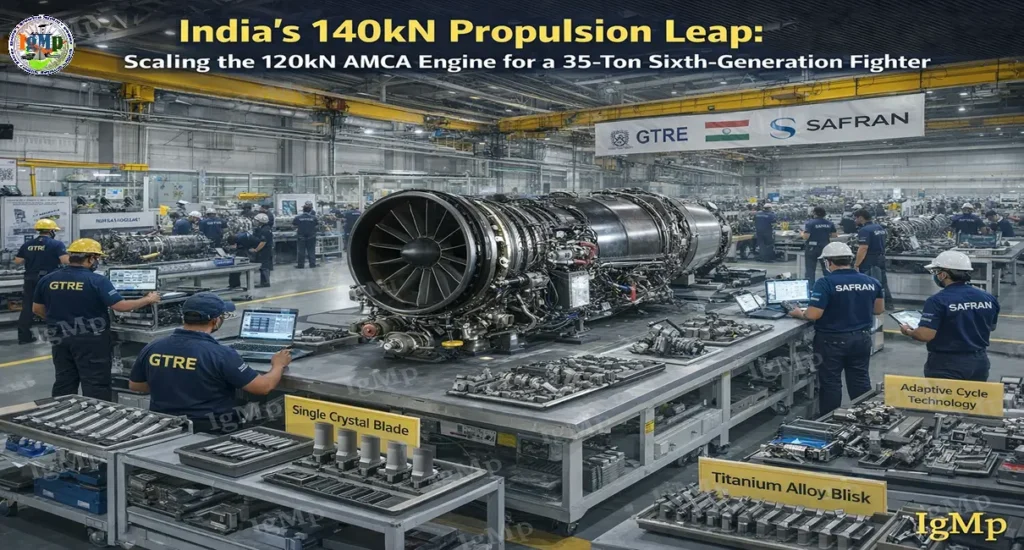
India’s long-term fighter aviation roadmap took a decisive step forward in March 2026 as the country outlined plans to scale its upcoming indigenous 120kN fighter engine for the AMCA into a far more powerful 140kN class propulsion system. Developed through the Indo-French collaboration between the Gas Turbine Research Establishment (GTRE) and France’s Safran, the project is increasingly being seen not just as an engine programme but as a strategic move to keep India competitive in the emerging sixth-generation fighter race.
The roadmap revolves around a baseline 120 kilo-Newton turbofan being developed for the Advanced Medium Combat Aircraft Mk2 and the naval Twin Engine Deck Based Fighter. But defence planners have already begun working on a scaled 140kN derivative that could power a much heavier next-generation stealth platform weighing around 35 tons at maximum take-off weight. That thrust class places India in the same technological league as the heavy stealth fighters currently shaping global airpower strategies.
This future aircraft, often discussed under India’s Next Generation Fighter concept, is envisioned as a sixth-generation platform capable of operating alongside autonomous drones, advanced electronic warfare systems and potentially directed-energy weapons. Such a platform demands significantly higher thrust and electrical power generation than existing fifth-generation aircraft, making the 140kN engine an essential building block rather than a simple upgrade.
Unlike traditional procurement models, the Indo-French partnership focuses on co-development and technology ownership. India is expected to retain full intellectual property rights for both the 120kN baseline engine and the future 140kN variant. That control over design data, source codes and manufacturing processes means India can modify or evolve the engine without external restrictions—something that has historically limited the country’s aerospace programmes.
The engineering leap from 120kN to 140kN will rely heavily on improvements to the engine’s core architecture. Engineers plan to enhance airflow through optimized fan and compressor stages while pushing turbine temperatures to new limits using advanced materials. Ceramic matrix composites and single-crystal turbine blades will play a crucial role in this process, allowing the engine to operate in environments exceeding 1800°C while maintaining durability.
Another major technological focus is Adaptive Cycle Technology. Unlike conventional fighter engines that operate with a fixed airflow path, adaptive cycle engines can dynamically alter their configuration. During long-distance transit, the engine can prioritize fuel efficiency, reducing consumption and heat signature. In combat situations, it can shift to a high-thrust mode that delivers the performance required for rapid acceleration and sustained supersonic flight.
This capability is especially important for achieving supercruise—the ability to fly at supersonic speeds without engaging fuel-hungry afterburners. Supercruise is increasingly viewed as critical for penetrating heavily defended airspace and surviving modern Anti-Access/Area-Denial environments.
One of the most striking aspects of the programme is its compact design goal. Engineers aim to pack the performance of a 140kN engine into a physical frame comparable in size to the widely used General Electric F414, which produces around 98kN of thrust. Achieving such power in a similar footprint would represent a significant leap in thrust-to-weight efficiency and thermal engineering.
The development roadmap is also staged to reduce technical risk. The 120kN baseline engine is expected to enter flight testing around 2028 and move toward production in the mid-2030s. The more advanced 140kN prototype is projected to appear around 2031–2032, targeting the heavy sixth-generation fighter concept that India is studying for the 2040 timeframe.
| Engine Variant | Thrust (kN) | Target Platform | Generation |
|---|---|---|---|
| GTRE-Safran Baseline | 120kN | AMCA Mk2 / TEDBF | 5.5 Gen |
| GTRE-Safran Scaled | 140kN | 35-Ton Heavy Fighter | 6th Gen |
| General Electric F414 | 98kN | Tejas Mk2 / AMCA Mk1 | 4.5-5 Gen |
| Saturn AL‑31F | 123kN | Sukhoi Su-30MKI | 4 Gen |
Strategically, the programme could also help India narrow the propulsion gap with other major aerospace powers. China’s latest fighter engines, including those powering the Chengdu J-20, are already pushing into the high-thrust class needed for heavy stealth fighters. By pursuing its own scalable 140kN engine architecture now, India is attempting to ensure that its future aircraft designs remain competitive for decades.
For India’s defence ecosystem, the implications go beyond a single fighter project. Mastering advanced jet engine technology opens the door to indigenous powerplants for unmanned combat aircraft, long-range strike drones and potentially even civilian aerospace derivatives. With the government pushing aggressively for defence self-reliance, the success of this programme could determine whether India finally joins the small group of nations capable of designing and producing cutting-edge fighter engines entirely on its own.