Synopsis
- India has cleared plans to build a new military airfield in the Andaman and Nicobar Islands, a move that reflects New Delhi’s sharper strategic focus on the Indo-Pacific and growing concerns over China’s expanding footprint in the region.
Source : IgMp Bulletin
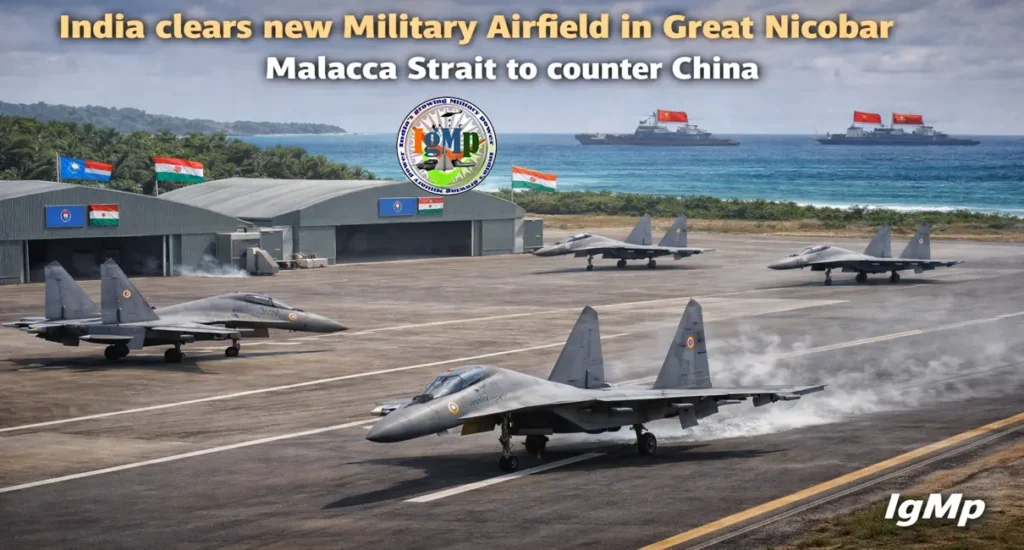
India has cleared plans to build a new military airfield in the Andaman and Nicobar Islands, a move that reflects New Delhi’s sharper strategic focus on the Indo-Pacific and growing concerns over China’s expanding footprint in the region. The proposed airport will come up on Great Nicobar Island, just about 40 nautical miles from the Malacca Strait—one of the world’s busiest and most strategically sensitive maritime choke points.
Approved by the Union Cabinet and to be steered by the Ministry of Defence, the project is estimated to cost around ₹150 billion. The new facility will feature dual runways capable of handling large military aircraft as well as civilian flights, blending strategic utility with economic potential. Officials have indicated that operations could begin within the next three years, depending on construction timelines and environmental clearances.
The location itself explains the urgency. The Malacca Strait carries roughly a third of global trade and a substantial portion of China’s energy imports. Any disruption along this corridor would have immediate geopolitical consequences. For India, establishing a robust air and surveillance presence near this sea lane significantly enhances its ability to monitor shipping activity and maintain maritime domain awareness across the eastern Indian Ocean.
The Andaman and Nicobar archipelago already hosts India’s only tri-services command, the Andaman and Nicobar Command, which integrates the Army, Navy and Air Force. However, infrastructure limitations have long restricted its full operational potential. The new airfield on Great Nicobar is expected to change that by enabling sustained deployment of long-range maritime patrol aircraft, heavy transport planes and potentially fighter assets during contingencies.
India’s fleet of Boeing P-8I Poseidon aircraft, the naval variant of the Boeing P-8 Poseidon, plays a critical role in tracking submarines and surface vessels. With additional aircraft acquisitions recently approved, expanded runway capacity in the islands will provide forward basing options that reduce response time and extend operational reach toward Southeast Asia and the South China Sea.
The infrastructure push does not stop with Great Nicobar. Authorities have outlined runway extensions and upgrades at other airstrips in the chain, including facilities near Sri Vijaya Puram, formerly known as Port Blair. Upgraded airfields will be capable of handling larger aircraft, improving both logistical resilience and rapid troop mobilisation capabilities.
Beyond traditional military considerations, the new airport is expected to support civilian aviation and tourism, though the project sits in an ecologically sensitive zone. Balancing environmental protection with strategic imperatives will be a key test for policymakers. Infrastructure development in remote island territories often raises concerns about biodiversity and indigenous communities, making transparent planning and sustainable design essential.
Strategically, the expansion signals India’s intent to maintain a credible presence in waters increasingly marked by competition. China’s naval deployments in the Indian Ocean have grown more frequent, and its investments in ports across the region have reshaped maritime geopolitics. Strengthening forward infrastructure allows India to safeguard undersea communication cables, secure sea lanes and coordinate more effectively with partners such as the United States, Japan and Australia.
From a defence planning perspective, proximity matters. Aircraft operating from mainland bases must cover vast distances before reaching critical sea lanes. A forward airfield in Great Nicobar compresses that gap, allowing faster surveillance, quicker interception and improved disaster response capability in the broader Bay of Bengal region.
As the Indo-Pacific emerges as the centre of global economic and security activity, infrastructure choices made today will define strategic leverage tomorrow. India’s decision to invest heavily in its island territories underscores a long-term approach—one that blends deterrence, domain awareness and regional connectivity in equal measure.