Synopsis
- As per reports of The Hindu, India is going ahead to finalise a $3 billion deal with Armenia to supply an unknown number of HAL-manufactured Sukhoi Su-30MKI jets.
IgMp Bulletin
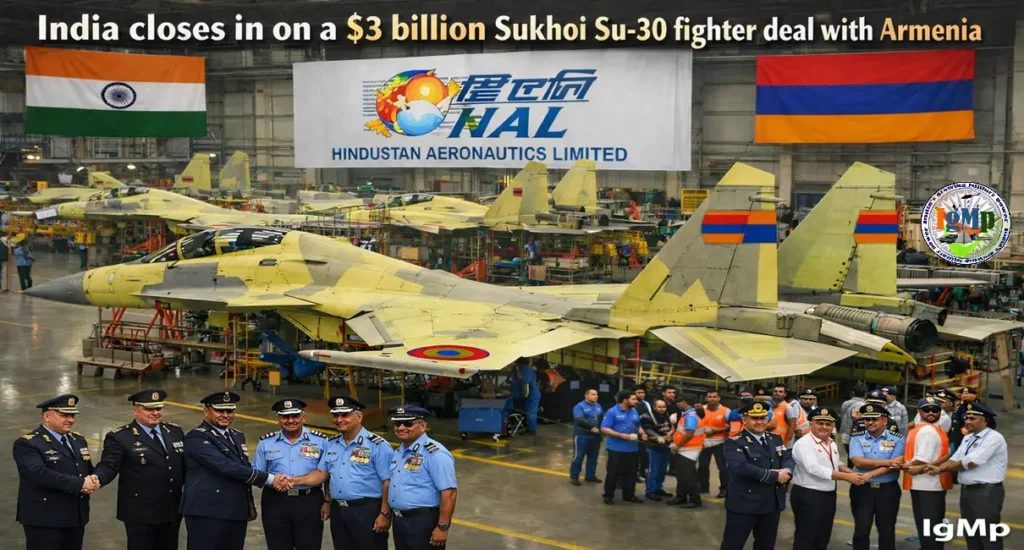
As per reports of The Hindu, India is going ahead to finalise a $3 billion deal with Armenia to supply an unknown number of HAL-manufactured Sukhoi Su-30MKI jets. These aircraft are expected to feature an Indian AESA radar variant derived from the Uttam AESA program, an indigenous electronic warfare suite, and a fully Indian weapons package. The armament suite will reportedly include Astra Mk1 and Astra Mk2 beyond-visual-range missiles, the Rudram-1 anti-radiation missile series, as well as the Smart Anti-Airfield Weapon developed by India’s defence research establishment.
If finalized at the reported scale, India’s proposed $3 billion export of upgraded Su-30MKI fighters to Armenia would mark the single largest aerospace export in Indian history. More importantly, it would signal that India has transitioned from being the world’s largest arms importer to a high-end combat aircraft exporter capable of integrating, upgrading, and sustaining complex fourth-generation platforms independently.
At the center of this transformation is Hindustan Aeronautics Limited (HAL), which has manufactured over 270 Su-30MKI fighters under license at its Nashik facility. Over two decades, India has indigenized avionics, mission computers, electronic warfare suites, and weapons integration—effectively transforming the Russian-origin Su-30 into a uniquely Indian “Super Sukhoi.”
For Armenia, this is not just a procurement. It is a strategic recalibration of airpower in the South Caucasus.
Neutralizing the JF-17 Threat: The Astra Mk2 and Uttam AESA Advantage
Azerbaijan’s expanding fleet of JF-17 Thunder Block III fighters—equipped with AESA radar and PL-15E long-range missiles—has significantly altered the regional airpower equation. The Armenia-bound Sukhoi Su-30MKI variant, however, appears configured specifically to neutralize that advantage.
The “First Look, First Kill” Comparison
| Feature | Indian Su-30MKI (Armenia Variant) | JF-17 Block III (Azerbaijan) |
|---|---|---|
| Radar | Uttam-Derived AESA (GaN-based) | KLJ-7A AESA |
| BVR Missile | Astra Mk2 (160–200+ km) | PL-15E (145–150 km) |
| Engagement Lead | ~25% Range Advantage | Baseline BVR |
| Payload Capacity | 8,000 kg (Heavy Multi-role) | 3,700 kg (Lightweight) |
| Operational Edge | Superior Persistence & Electronic Warfare | High Mobility / Lower Endurance |
BVR Range Advantage: The Decisive Margin
India’s Astra Mk2 provides what could amount to roughly a 25% engagement lead over the export-grade PL-15E under certain combat conditions. In beyond-visual-range warfare, even a 10–15% range margin can determine who fires first. A 20–25% advantage fundamentally shifts engagement geometry.
Paired with a high-power Uttam-derived AESA radar—built around Gallium Nitride (GaN) transmit-receive modules—the Su-30MKI can detect, track, and engage targets earlier while maintaining better resistance to electronic interference.
The Electronic Warfare Edge: Blinding the Opponent
A critical but often overlooked dimension is electronic warfare dominance.
The DRDO-developed EW suite integrated into the Armenian-bound Su-30MKI is specifically designed to counter Chinese-origin radar architectures such as the KLJ-7A. By incorporating indigenous Digital Radio Frequency Memory (DRFM) technology, the aircraft can jam, spoof, or create false targets within an adversary’s radar picture. In a BVR scenario, this could potentially degrade or “blind” the JF-17’s situational awareness at the exact moment missile engagement decisions are made.
In modern air combat, victory often goes not to the faster jet—but to the aircraft with superior sensor fusion and electronic deception capability.
India as the Global Flanker Hub: The MRO Proof of Concept
Beyond combat capability, the Armenia deal carries major geopolitical weight.
With Russia’s Maintenance, Repair, and Overhaul (MRO) capacity heavily focused on sustaining its own operational commitments, global operators of the Su-27/30 “Flanker” family face long-term sustainment concerns. Nations such as Vietnam, Malaysia, Indonesia, and Algeria operate variants of the platform and require reliable lifecycle support.
India, through Hindustan Aeronautics Limited, has spent over two decades building sovereign overhaul, upgrade, and manufacturing capacity for the Su-30MKI fleet. Offering Armenia a fully supported aircraft package—radar, weapons, avionics, and long-term MRO—creates a “proof of concept” that India can serve as a global Flanker sustainment hub.
This is not merely an export of aircraft; it is the export of an ecosystem.
If successful, it positions India as an independent aerospace systems integrator capable of:
- Indigenous radar and avionics upgrades
- Weapons integration without foreign clearance bottlenecks
- Lifecycle maintenance independent of Russian supply chains
For the international market, that is a powerful signal of reliability and strategic autonomy.ly operate Sukhois—but modernize and sustain them at scale.
Reviving Nashik: The Industrial Renaissance of HAL’s Sukhoi Line
The Su-30MKI production line at HAL Nashik was nearing the completion of Indian Air Force orders. A major export deal would:
- Sustain thousands of high-skilled aerospace jobs
- Keep over 400 Indian MSMEs active in the Sukhoi supply chain
- Strengthen the Maharashtra aerospace cluster
Beyond economics, continuity of production preserves sovereign manufacturing expertise. Restarting a complex fighter line after shutdown is costly and difficult. An export pipeline ensures India retains critical aerospace competencies while transitioning toward next-generation platforms.
Shifting the Geopolitical Balance in the Caucasus
This deal is not merely transactional. It redefines India’s role in global aerospace, strengthens Armenia’s deterrence posture, and introduces a technologically upgraded Su-30MKI variant tailored for modern network-centric warfare.
In the Caucasus, where airpower asymmetry can decisively shape outcomes, the combination of AESA radar, Astra Mk2 missiles, and heavy twin-engine performance alters the calculus against Azerbaijan’s JF-17 Block III fleet.
Strategically, India emerges as both arms exporter and systems integrator—capable of delivering not just aircraft, but an ecosystem of sensors, weapons, and sustainment.