Synopsis
- ” As New Delhi weighs its options to counter regional threats like the J-20, the Su-57M1E has emerged as a serious contender for a fast-tracked Government-to-Government (G2G) deal.
Source : IgMp Bulletin
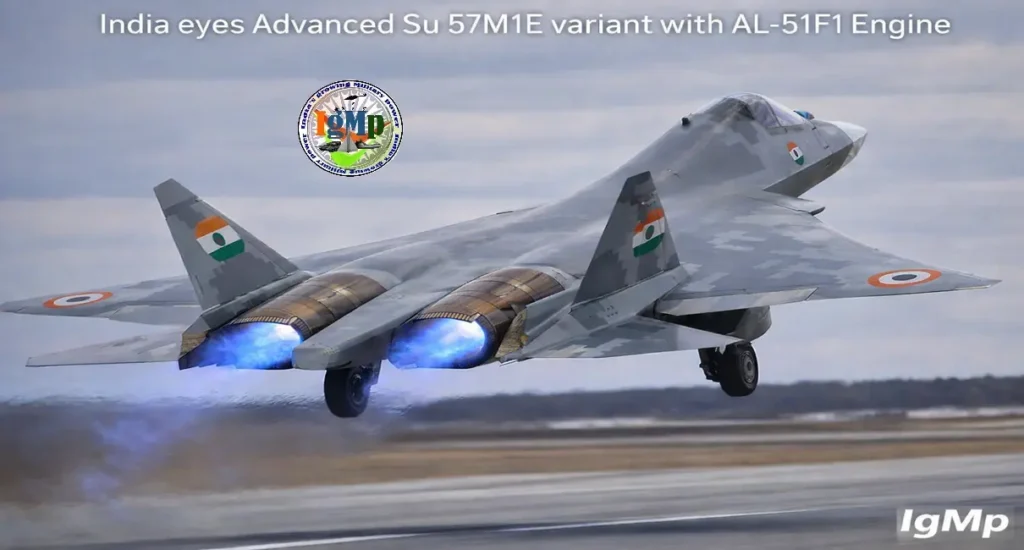
India’s engagement with Russia’s fifth-generation fighter program is entering a decisive new phase. Reliable defense sources indicate that the Indian Air Force (IAF) is no longer interested in the baseline production models; instead, the focus has shifted entirely to the upgraded Sukhoi Su-57M1E.
While the early Su-57 (Felon) faced criticism for its “Stage 1” engine limitations and rear-aspect stealth vulnerabilities, the M1E variant represents the aircraft’s “final form.” As New Delhi weighs its options to counter regional threats like the J-20, the Su-57M1E has emerged as a serious contender for a fast-tracked Government-to-Government (G2G) deal.
The AL-51F1 Breakthrough: True 5th-Gen Power
The heart of the Su-57M1E is the revolutionary AL-51F1 engine (formerly known as Izdeliye 30). Unlike the interim AL-41F1 engines that powered early prototypes, the AL-51F1 is a clean-sheet design specifically built for stealth operations.
Why the AL-51F1 is a Game-Changer:
- Sustained Supercruise: It enables the jet to fly at Mach 1.6 without using fuel-heavy afterburners, a critical requirement for 5th-gen air superiority.
- Thrust Increase: Delivers a massive 17,500 kgf of thrust (afterburning), providing a 15–20% boost in energy retention during high-G maneuvers.
- Thermal Stealth: Features redesigned, serrated exhaust nozzles that significantly reduce the aircraft’s infrared (IR) signature, making it harder for heat-seeking missiles to lock on.
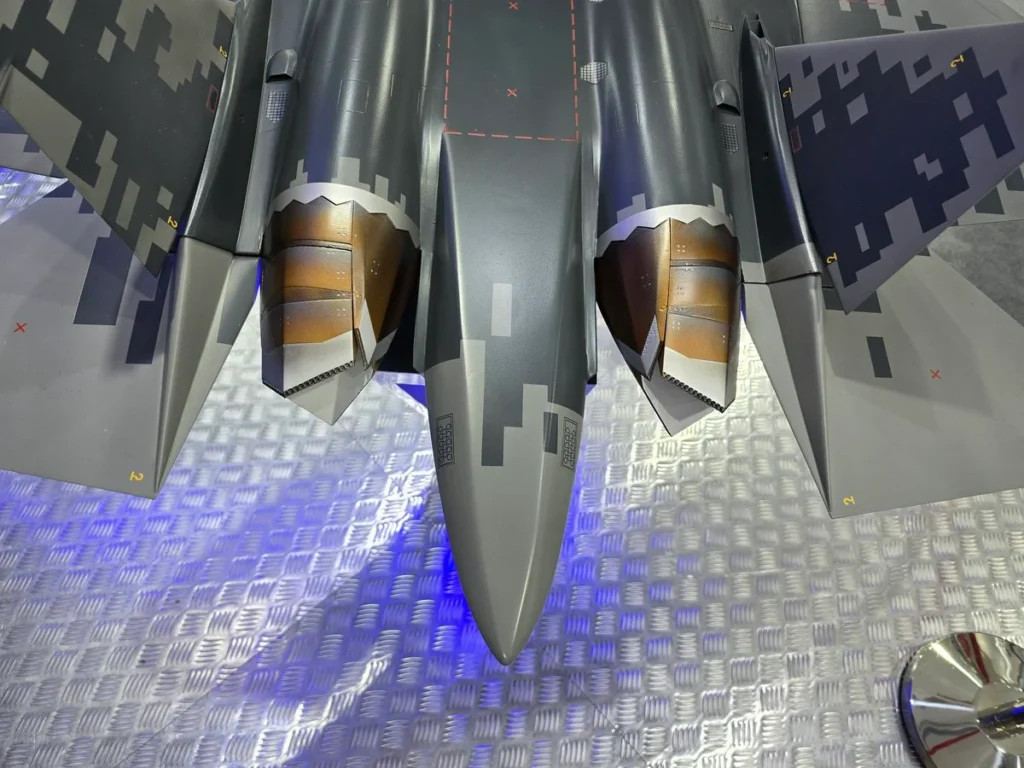
Technical Comparison: Baseline Su-57 vs. Su-57M1E
| Feature | Baseline Su-57 | Su-57M1E Variant |
| Engine | AL-41F1 (Interim) | AL-51F1 (Product 30) |
| Supercruise | Limited / Struggles | Approx. Mach 1.6 |
| Nozzle Design | Round / Exposed | Serrated / Stealth-Optimized |
| Radar | Early AESA | Refined N036 with L-Band |
| Cockpit | Dual Multi-Function Displays | Wide-Area Display + AI Suite |
Stealth Refinements & N036 Byelka Radar Suite
The Su-57M1E isn’t just an engine upgrade; it’s a structural overhaul. The airframe has been refined to minimize its Radar Cross Section (RCS), addressing long-standing concerns about manufacturing tolerances and “exposed” rivets.
A Unique “Multi-Band” Sensory Edge:
One distinctive feature of the Su-57 family is the N036 Byelka radar suite. While Western jets like the F-35 rely primarily on X-band radar, the Su-57M1E utilizes L-band radar arrays embedded in the wing leading edges.
Strategic Value: L-band frequencies are traditionally better at detecting stealth aircraft optimized against X-band fire-control radars. For India, this provides a unique “counter-stealth” tool against emerging regional threats.
The AI-Driven Cockpit: Reducing Pilot Workload
Modern air combat is a battle of information. The Su-57M1E features a redesigned cockpit centered around a Wide-Area Display (WAD).
- 90% Automation: An onboard AI suite handles flight micromanagement, allowing the pilot to focus solely on tactical decisions.
- Sensor Fusion: The jet merges data from its radar, IRST (Infrared Search and Track), and electronic warfare suites into a single, unified tactical picture.
Strategic Context: A Bridge to AMCA
The “Stopgap” Strategy:
The most critical question is how this fits into India’s Aatmanirbhar Bharat mission. The IAF is currently facing a dwindling squadron strength, and the indigenous Advanced Medium Combat Aircraft (AMCA) isn’t expected to enter service until the mid-2030s.
A direct G2G acquisition of 36 to 40 Su-57M1E jets could serve as an interim bridge. This would provide the IAF with immediate 5th-gen exposure and a “tip-of-the-spear” capability without derailing the long-term development of the AMCA. Furthermore, Russia has reportedly offered full technology transfer, which could potentially benefit India’s own domestic stealth manufacturing.