Synopsis
- At the core of the LR-LACM program is the Manik Small Turbofan Engine, a compact propulsion system developed domestically to power India’s future cruise missiles.
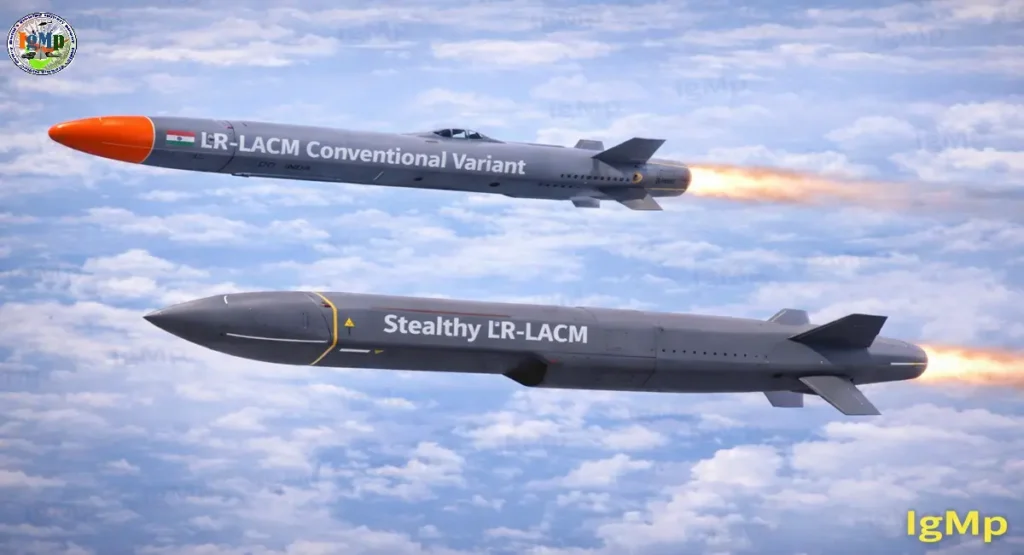
India is quietly advancing a next-generation cruise missile ecosystem that could redefine long-range strike capability across Asia. As of March 2026, the Long Range Land Attack Cruise Missile (LR-LACM) is no longer just a concept. The missile is undergoing active carriage trials on the Sukhoi Su-30MKI, signaling that India is moving toward operational deployment.
Instead of building a single weapon, Indian planners are developing a dual-track architecture: a 1,500-km conventional LR-LACM for long-range saturation strikes and a compact stealth variant designed for internal carriage inside the Advanced Medium Combat Aircraft (AMCA). This “Hi-Lo mix” gives the Indian military both mass-strike capability and stealth deep-penetration power.
What is the difference between LR-LACM and BrahMos?
The key difference lies in speed vs endurance. The BrahMos missile is a supersonic strike weapon designed to destroy targets using speed and kinetic impact.
The LR-LACM, by contrast, focuses on long-range persistence, stealthy terrain-hugging flight, and deep penetration, with a reach of up to 1,500 km, allowing strikes far beyond heavily defended zones.
Key Technical Specifications
- Range: 1,000–1,500 km (Conventional) | 700–900 km (Stealth Variant)
- Propulsion: Indigenous Manik Small Turbofan Engine (STFE) producing ~4.5 kN thrust
- Guidance: NavIC satellite navigation with anti-jamming capability
- Airframe: Composite materials with reduced radar signature
- Deployment Platforms:
- Sukhoi Su-30MKI (air-launched trials underway)
- Universal Vertical Launch Module (UVLM) on naval ships
- Land-based launchers
- Future internal carriage inside Advanced Medium Combat Aircraft
Manik Engine: The Heart of India’s Indigenous Subsonic Revolution
At the core of the LR-LACM program is the Manik Small Turbofan Engine, a compact propulsion system developed domestically to power India’s future cruise missiles.
Generating about 4.5 kN of thrust, the engine enables sustained subsonic, terrain-hugging flight profiles across distances exceeding 1,000 kilometers. Its efficient fuel consumption allows the missile to fly low and avoid radar detection while maintaining long endurance.
Equally important, the Manik engine represents a major Atmanirbhar Bharat milestone, eliminating reliance on foreign propulsion systems for strategic strike weapons.
From Su-30MKI to AMCA: One Missile, Two Lethal Variants
India’s LR-LACM program is structured around two operational variants, each tailored for different combat roles.
Conventional LR-LACM
The larger variant functions as India’s “Tomahawk-class” long-range strike missile.
When integrated with the Sukhoi Su-30MKI, it allows the aircraft to launch stand-off strikes hundreds of kilometers away from heavily defended zones, targeting command centers, airbases, radar networks, and logistics hubs.
This version is also designed for naval and land-based launch platforms, creating a flexible long-range strike capability across the Indian armed forces.
Stealth LR-LACM (Compact Variant)
The second variant is a miniaturized stealth cruise missile designed specifically for internal carriage inside the weapons bays of the Advanced Medium Combat Aircraft.
The compact stealth LR-LACM serves as India’s equivalent to the American AGM-158 JASSM, providing a low-observable deep-strike option for fifth-generation platforms.
Key stealth features include:
- Faceted fuselage geometry to deflect radar signals
- Radar-absorbent composite materials
- Reduced thermal and radar signatures
Launched from a stealth fighter, this missile would enable deep penetration missions against heavily defended targets without exposing the aircraft to enemy air defenses.
5 Reasons the LR-LACM is a Game Changer for the IAF
- Saturation Warfare: Enables mass cruise-missile strikes capable of overwhelming advanced air-defense systems such as the S-400 Triumf air defense system or the HQ-9 surface-to-air missile system.
- Deep Penetration: The stealth variant’s faceted design allows it to operate in high-threat environments when launched from the Advanced Medium Combat Aircraft.
- Atmanirbhar Propulsion: Powered entirely by the indigenous Manik Small Turbofan Engine, ensuring independence from foreign suppliers.
- Multi-Platform Versatility: Compatible with Sukhoi Su-30MKI aircraft, naval UVLM launchers, and land-based missile batteries.
- NavIC Sovereignty: Guided by NavIC, ensuring jam-resistant navigation even in GPS-denied environments.
Comparison: Conventional vs Stealth LR-LACM
| Feature | Conventional LR-LACM | Stealth LR-LACM |
|---|---|---|
| Primary Goal | Mass Saturation Strike | Deep Penetration Strike |
| Launch Platforms | Ships, land launchers, Su-30MKI | AMCA (internal bay), future fighters |
| Range | 1,000–1,500 km | 700–900 km |
| Stealth Level | Terrain-hugging reduced RCS | Faceted shape + radar-absorbent materials |
| Propulsion | Manik Turbofan | Manik Turbofan (optimized) |
Strategic Impact
Together with the BrahMos missile, the LR-LACM creates a layered cruise-missile strategy for India:
- BrahMos: High-speed precision strike
- LR-LACM: Long-range saturation attack
- Stealth LR-LACM: Deep-penetration strike from stealth fighters
With Su-30MKI carriage trials underway and AMCA integration planned, India is building a fully indigenous long-range strike architecture powered by NavIC navigation and indigenous propulsion.
In strategic terms, this means India is preparing to field a scalable, stealth-capable cruise-missile network able to strike targets more than a thousand kilometers away—without relying on foreign technology.