Synopsis
- As per sources close to the IgMp, it can be said that India’s underwater deterrence is entering a decisive phase, as the Indian Navy accelerates construction work on two major nuclear submarine programs—the S5 SSBN (Nuclear Ballistic Missile Submarine) and the Project-77 SSN (Nuclear Attack Submarine).
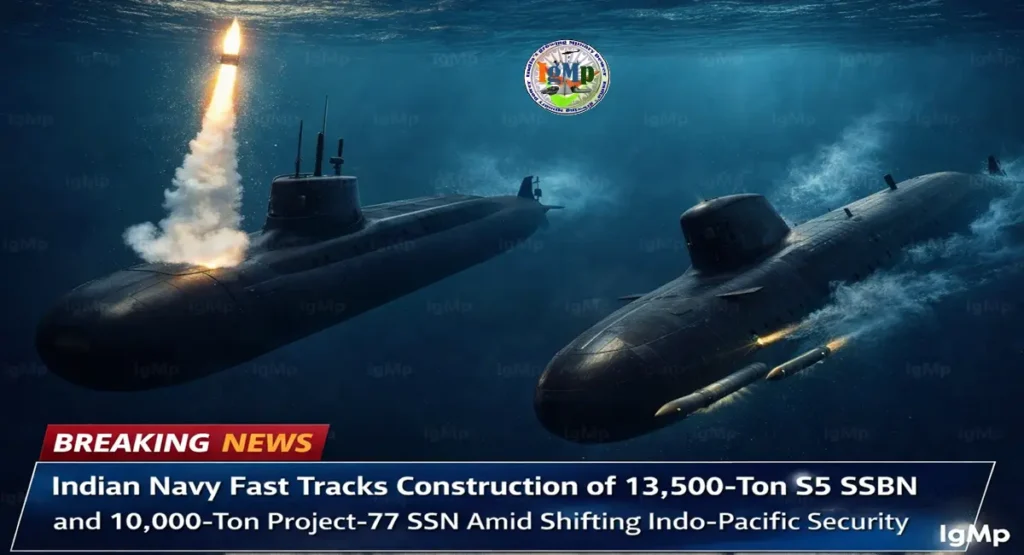
As per sources close to the IgMp, it can be said that India’s underwater deterrence is entering a decisive phase, as the Indian Navy accelerates construction work on two major nuclear submarine programs—the S5 SSBN (Nuclear Ballistic Missile Submarine) and the Project-77 SSN (Nuclear Attack Submarine). Both platforms are expected to use the next-generation 190–200 MW Compact Light Water Reactor (CLWR-B2) developed by the Bhabha Atomic Research Centre.
Together, the two submarines form the backbone of India’s future undersea strategy. The 13,500-ton S5 SSBN acts as the strategic “shield”, ensuring survivable nuclear deterrence at sea. Meanwhile, the 10,000-ton Project-77 SSN is designed as the tactical “sword,” tasked with hunting hostile submarines, escorting strategic assets, and countering adversary fleets across the Indo-Pacific.
Recent geopolitical developments—including growing submarine activity by the People’s Liberation Army Navy and new underwater combat incidents in the Indian Ocean—are accelerating India’s timeline for both programs.
S5 SSBN vs Project-77 SSN: Core Technology and Mission Roles
India’s long-term maritime doctrine envisions both submarine classes operating together in a layered undersea force.
S5-Class Ballistic Missile Submarine (Strategic Deterrence)
- Displacement: ~13,500 tons surfaced (~17,000 tons submerged)
- Reactor: 190–200 MW CLWR-B2 nuclear reactor
- Primary Armament: 12–16 vertical launch tubes for K6 SLBMs
- Estimated Range: 8,000+ km with MIRV capability
- Operational Role: Strategic second-strike deterrence within India’s nuclear triad
- Design Goal: Deep-ocean stealth and long-duration patrols
Project-77 Nuclear Attack Submarine (Hunter-Killer)
- Displacement: ~10,000 tons
- Reactor: Advanced compact nuclear propulsion derived from CLWR-B2 technology
- Primary Armament: Heavyweight torpedoes and long-range cruise missiles including BrahMos‑II
- Future Weapons: Hypersonic strike systems linked to the HSTDV program
- Operational Role: Hunting submarines, destroying carrier strike groups, and escorting India’s SSBN fleet
- Performance Target: High-speed blue-water operations exceeding 30 knots
March 2026 Milestones: Construction Momentum Builds
By March 2026, India’s submarine expansion has crossed an important industrial milestone. Construction of the first two S5-class hulls has begun at the highly secured Ship Building Centre or Hindustan Shipyard Limited (HSL) in Vizag.
The earlier Arihant‑class submarine served as the technological foundation for this new generation of larger SSBNs. Engineers are now targeting an ambitious seven-year construction cycle per S5 boat once production stabilizes.
To avoid production bottlenecks, parallel infrastructure is being developed. A modern submarine construction complex at the Hindustan Shipyard Limited (HSL) is now operational, while separate dry-dock facilities are being prepared specifically for the upcoming Project-77 SSN fleet.
Industrial Ecosystem Supporting the Program
India’s nuclear submarine expansion is backed by a large domestic industrial network:
- Larsen & Toubro – submarine hull construction and heavy engineering
- Hindustan Shipyard Limited – specialized naval shipbuilding support
- SEC Industries – precision components and structural systems
Together with reactor design from Bhabha Atomic Research Centre, this ecosystem forms the backbone of India’s indigenous nuclear submarine capability.
Strategic Context: From the Iran War to Indo-Pacific Submarine Rivalry
Recent naval events have highlighted the growing importance of submarine warfare in the region. In March 2026, a United States Navy nuclear attack submarine sank the Iranian Navy frigate IRIS Dena in the Indian Ocean using a Mark-48 torpedo, marking the first confirmed U.S. submarine torpedo sinking of a warship in combat since World War II. The incident occurred near Sri Lanka while the ship was returning from a multinational naval event hosted by India. (Wikipedia)
The episode demonstrated how decisive underwater platforms can be in modern naval warfare. At the same time, the expanding nuclear submarine fleet of the People’s Liberation Army Navy—including both SSBN and SSN classes—has intensified competition in the Indo-Pacific.
For India, these developments reinforce the urgency of building both strategic deterrence submarines and fast attack submarines capable of sustained blue-water operations.
The Malacca Strait Factor
One of the key missions envisioned for the Project-77 SSN fleet is long-range patrol in critical maritime chokepoints such as the Strait of Malacca.
Fast, nuclear-powered attack submarines can maintain extended underwater presence while operating at high speeds. In a crisis scenario, stealthy SSNs could monitor or shadow adversary fleets moving through these sea lanes, creating a form of silent maritime pressure without openly escalating conflict.
India’s Emerging Two-Layer Undersea Strategy
The parallel development of the S5 SSBN and Project-77 SSN reflects a deliberate shift toward a two-layer underwater doctrine. Strategic submarines ensure the survivability of India’s nuclear deterrent, while attack submarines actively shape the maritime battlespace by tracking adversary fleets and protecting strategic assets.
As both programs move through the late 2020s and early 2030s, they are expected to form the backbone of India’s future undersea power—combining stealth, endurance, and indigenous shipbuilding capability to secure India’s interests across the wider Indo-Pacific.