Synopsis
- The system uses a mobile launcher carrying up to 64 micro-rockets and interceptor missiles, giving it the capacity to engage large numbers of drones within seconds.
IgMp Bulletin
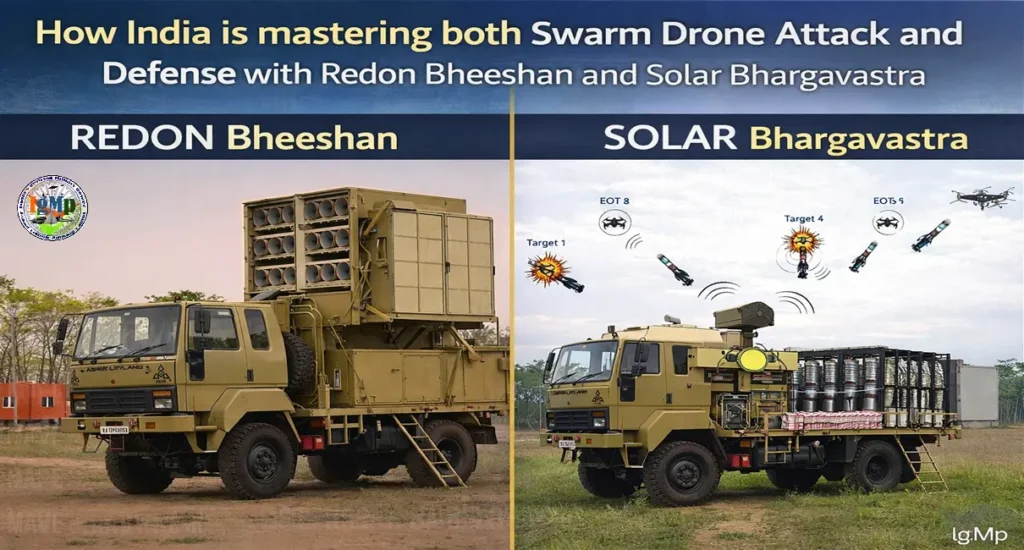
Drone warfare is evolving rapidly, and one of the biggest strategic questions facing modern militaries is how to attack with autonomous systems while simultaneously defending against them. India appears to be developing a rare dual capability that answers both challenges at once. With the offensive Bheeshan mobile loitering munition launcher and the defensive Bhargavastra counter-drone interceptor system, the country is shaping what analysts increasingly describe as a “swarm-versus-swarm” doctrine for future battlefields.
The offensive element of this concept comes from the Bheeshan Mobile Multi-Barrel Munition Launcher System (MMBMLS) developed by Hyderabad-based Redon Systems. Designed as a high-volume launcher for loitering munitions, Bheeshan functions almost like a drone artillery system. Instead of firing conventional shells, it launches multiple autonomous strike drones capable of searching for targets before attacking. The system’s most striking capability is its launch tempo: it can fire 18 loitering munitions in just 120 seconds, creating an instant aerial swarm capable of overwhelming enemy defences.
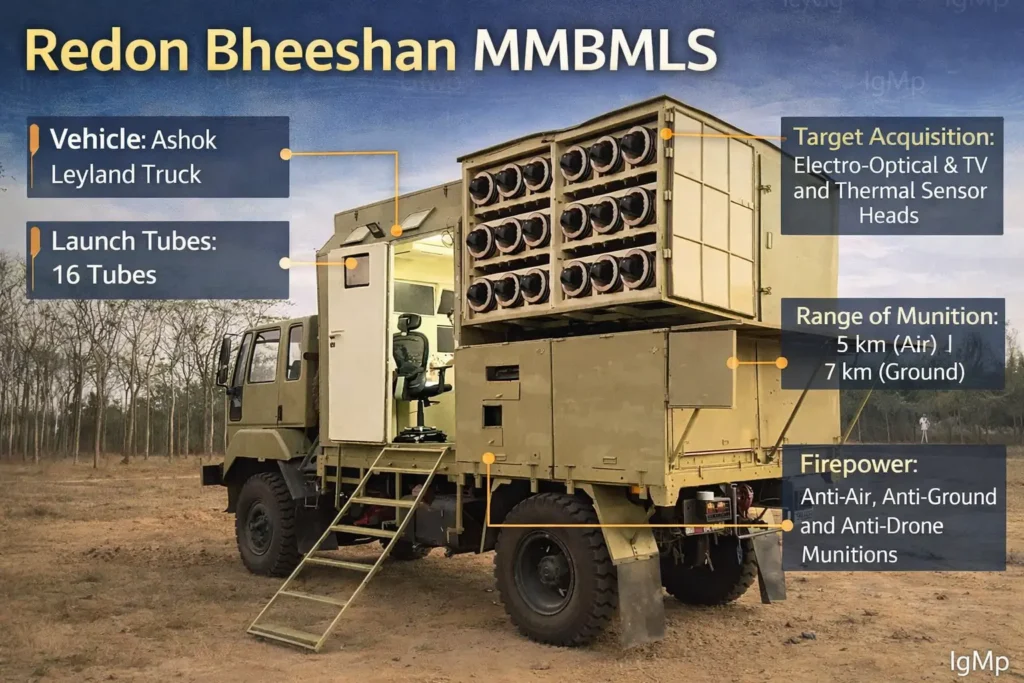
The drones launched by the system belong to the Achuk family of loitering munitions. These fixed-wing drones can travel up to roughly 30 kilometres from the launch platform and loiter over the battlefield while transmitting real-time video to operators. Once a target is identified—such as a radar installation, command vehicle, or armored unit—the drone can dive directly onto the objective with a precision warhead. Each munition carries a relatively small payload, but when deployed in coordinated swarms, they can saturate air defence networks and strike multiple targets simultaneously.
| Capability | Bheeshan (Offensive Sword) | Bhargavastra (Defensive Shield) |
|---|---|---|
| Primary Role | Swarm Loitering Munition Strike | Counter-Unmanned Swarm Interception |
| Launch Capacity | 18 Achuk Munitions in 120 Seconds | 64 Interceptor Rockets/Missiles |
| Operational Range | ~30 km Strike Radius | 6 km Detection / ~2 km Intercept |
| Key Advantage | High-volume precision swarm attack | Low-cost kinetic drone denial |
On the defensive side of the equation stands the Bhargavastra Mobile Counter-Unmanned Aerial Interceptor System (MCUAIS) developed by Solar Industries India Limited through its defence subsidiaries. If Bheeshan acts as the offensive “sword,” Bhargavastra is designed to serve as the protective “shield,” intercepting incoming drone swarms before they reach critical assets. The system uses a mobile launcher carrying up to 64 micro-rockets and interceptor missiles, giving it the capacity to engage large numbers of drones within seconds.
Bhargavastra’s design reflects a growing concern among military planners worldwide: the cost imbalance of drone warfare. In many cases, defending against small unmanned aircraft requires expensive surface-to-air missiles that cost far more than the drone being intercepted. Bhargavastra addresses this challenge by using micro-interceptors that are dramatically cheaper—reportedly capable of neutralizing threats for less than a thousand dollars per engagement. This “price-per-kill” advantage is becoming a defining factor in modern air defence strategies.
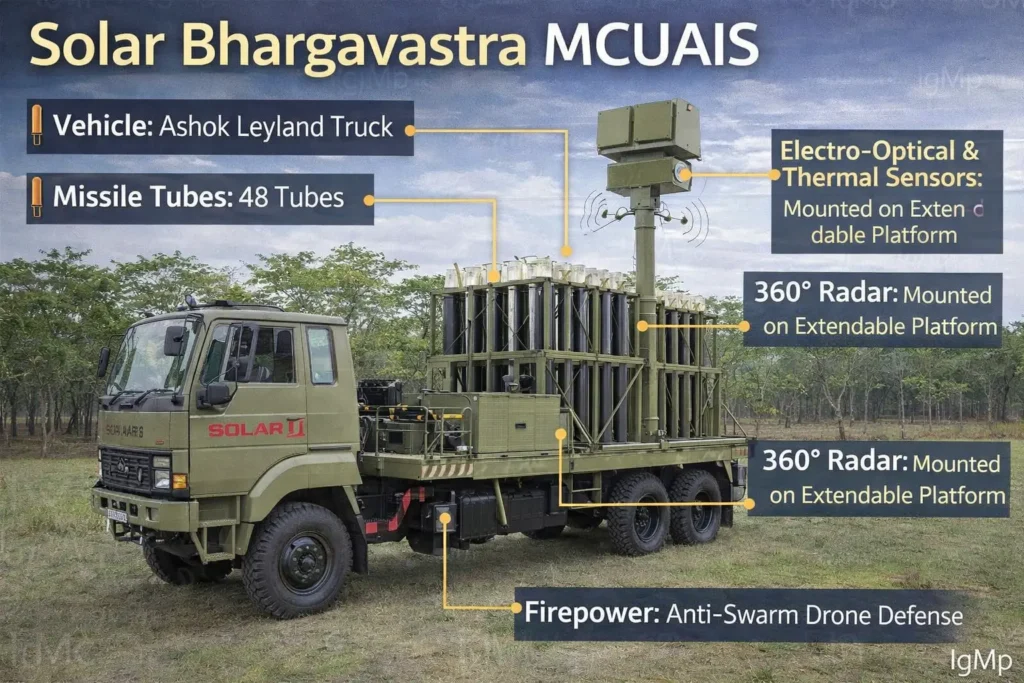
The interceptor system employs a two-layer engagement approach. The first layer uses unguided micro-rockets fired in rapid salvo mode to saturate the airspace where a swarm is approaching. These rockets create a lethal interception zone capable of destroying multiple drones within a radius of roughly twenty metres. If any drones survive the initial barrage, guided micro-missiles provide precision interception against individual targets.
Sensors integrated into the system include radar and electro-optical tracking units capable of detecting small drones at distances between six and ten kilometres. Once a threat is confirmed, the entire detection-to-engagement cycle can occur in under sixteen seconds, enabling rapid response against fast-moving aerial threats. The system is mounted on a mobile 4×4 tactical platform weighing roughly seven tonnes, allowing operators to relocate quickly using “shoot-and-scoot” tactics after firing.
One notable aspect of both Bheeshan and Bhargavastra is their ability to function in GPS-denied environments, which is increasingly important in modern electronic warfare scenarios. The Bheeshan loitering munitions can navigate using advanced inertial and visual navigation methods, allowing them to continue operating even if satellite signals are jammed. Bhargavastra’s radar tracking systems, meanwhile, are designed to detect so-called “dark drones” that do not emit radio signals, making them harder to detect using traditional electronic surveillance.
Another advantage lies in their adaptability to high-altitude operations. Both systems are designed to operate in extreme conditions, including mountainous regions above 4,500 metres where temperatures fluctuate dramatically. This capability makes them particularly relevant for deployment in challenging terrain such as northern border regions where rapid drone strikes and counter-drone defences could play a decisive role in future conflicts.
The strategic implication of this dual capability is significant. While many technologically advanced countries have developed either offensive loitering munitions or defensive counter-drone systems, relatively few have pursued both concepts at scale within the same operational framework. By pairing a swarm launcher capable of saturating enemy positions with a mobile interceptor system designed to neutralize incoming swarms, India is building a layered doctrine that treats drones as both weapons and threats.
In modern warfare, where inexpensive autonomous systems are increasingly shaping battlefield outcomes, the ability to dominate both sides of the drone equation—launching swarms and destroying them—could become a defining advantage for militaries preparing for the next generation of conflict.