Synopsis
- By the time large numbers of aircraft enter service toward the end of the decade, the Air Force will already have a tested tactical framework and experienced instructor cadre in place.
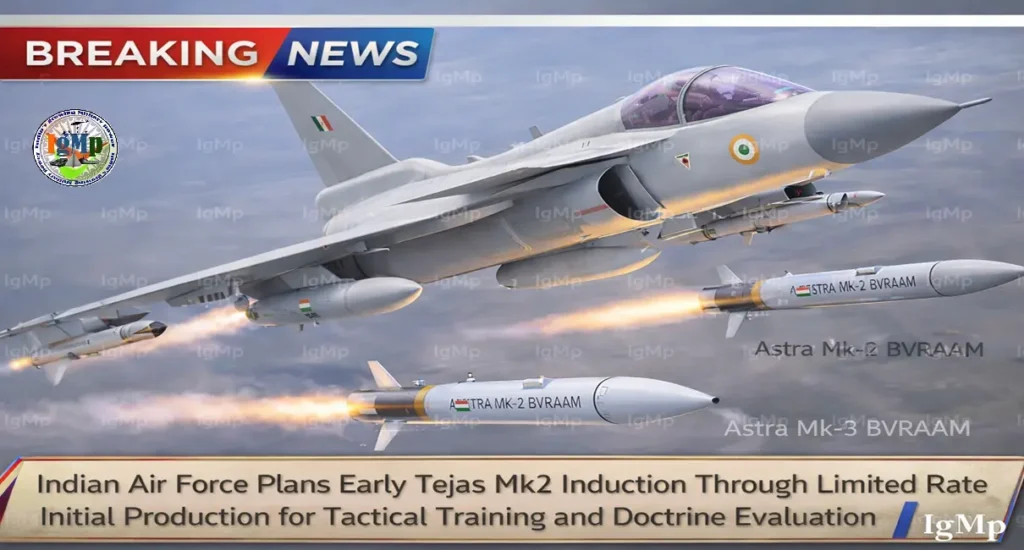
The Indian Air Force (IAF) is preparing to accelerate the operational readiness of the HAL Tejas Mk2 by inducting a small batch of aircraft through Limited Rate Initial Production (LRIP) well before full-scale manufacturing begins.
Instead of waiting for mass production, the plan is to introduce 6–8 early-production aircraft directly into the IAF’s elite tactical development unit. The objective is not immediate squadron deployment, but something arguably more important—developing combat doctrine, refining tactics, and preparing instructor pilots for future squadrons.
This approach allows the Air Force to begin operational experimentation while the aircraft’s final configuration continues to evolve.
Key Points
- Early Induction: Around 6–8 Tejas Mk2 aircraft expected in Limited Rate Initial Production configuration for tactical evaluation.
- Doctrine Development: Advanced air combat exercises such as 2-vs-2 and 4-vs-4 simulations to define operational tactics.
- Sensor Fusion Testing: Evaluation of AESA radar and IRST integration in contested electronic warfare environments.
- Faster Operationalization: Early training could cut squadron readiness timelines by nearly half once full production begins.
The LRIP Strategy: Speeding Up Combat Readiness
The concept behind Limited Rate Initial Production is straightforward. Instead of waiting for the final version of the aircraft to roll off the production line, the Air Force begins training and tactical experimentation using early-production jets.
These LRIP aircraft typically feature baseline flight-control software and mission systems, allowing pilots to begin familiarization and tactical development while engineers continue refining the final configuration.
In the case of the Tejas Mk2, this strategy enables the IAF to build operational knowledge years before full-scale induction begins.
By the time large numbers of aircraft enter service toward the end of the decade, the Air Force will already have a tested tactical framework and experienced instructor cadre in place.
TACDE: Developing the Tejas Mk2 Combat Playbook
The aircraft are expected to be assigned to the Tactics and Air Combat Development Establishment, better known as TACDE.
Often compared to the U.S. Navy’s United States Navy Fighter Weapons School, TACDE is responsible for shaping the IAF’s air combat doctrine and training the service’s top fighter pilots.
By introducing the Tejas Mk2 to TACDE first, the Air Force is effectively allowing its most experienced pilots to test the aircraft’s limits, refine dogfighting tactics, and develop operational procedures.
One area of particular interest will be the aircraft’s close-coupled canard configuration, a distinctive aerodynamic feature that improves maneuverability and enables high-angle-of-attack performance in close combat.
Testing how this configuration performs during complex air combat scenarios will be a key part of TACDE’s evaluation.
Indigenous Weaponry: From Astra to Rudram
Another priority during early induction will be defining the optimal employment of indigenous air-to-air missiles such as the Astra Mk1 and the upcoming Astra Mk2.
TACDE pilots will work to establish Launch Success Zones (LSZ) for these weapons—essentially identifying the distances and engagement conditions where the missiles achieve the highest probability of kill.
In addition, integration of air-to-ground systems like the Rudram will also be evaluated as part of multi-role mission testing.
Such early experimentation allows the Air Force to determine real-world combat envelopes, which often differ from theoretical performance estimates.
Network-Centric Warfare: Linking with AEW&C Assets
The Tejas Mk2 is also expected to operate as part of India’s growing network-centric warfare ecosystem.
During TACDE trials, the aircraft will likely be tested in coordinated missions with airborne surveillance platforms such as the DRDO Netra AEW&C.
This integration allows fighter pilots to receive targeting information and battlefield awareness from airborne command platforms, significantly enhancing combat effectiveness in complex engagements.
Testing these data-sharing capabilities early ensures that future Tejas Mk2 squadrons will be able to operate seamlessly within the IAF’s evolving digital battlefield network.
Why the Early Induction Matters
Introducing the Tejas Mk2 through Limited Rate Initial Production reflects growing confidence within the Indian Air Force in the aircraft’s design and capabilities.
By allowing TACDE to experiment with the platform early, the Air Force ensures that by the time full-scale production begins toward the end of the decade, India will already possess a pool of highly trained instructor pilots and a mature set of combat tactics.
In practical terms, this means new squadrons receiving the Tejas Mk2 will not start from scratch. Instead, they will inherit a fully developed tactical playbook shaped by the IAF’s most experienced fighter pilots.
For India’s indigenous fighter program, that early head start could prove just as important as the aircraft itself.