Synopsis
- In a significant step toward modernising its armoured fleet, the Indian Army has completed the installation of indigenously built Thermal Imaging Fire Control Systems (TIFCS) on 96 of its T-72 main battle tanks.
Source : IgMp Bulletin
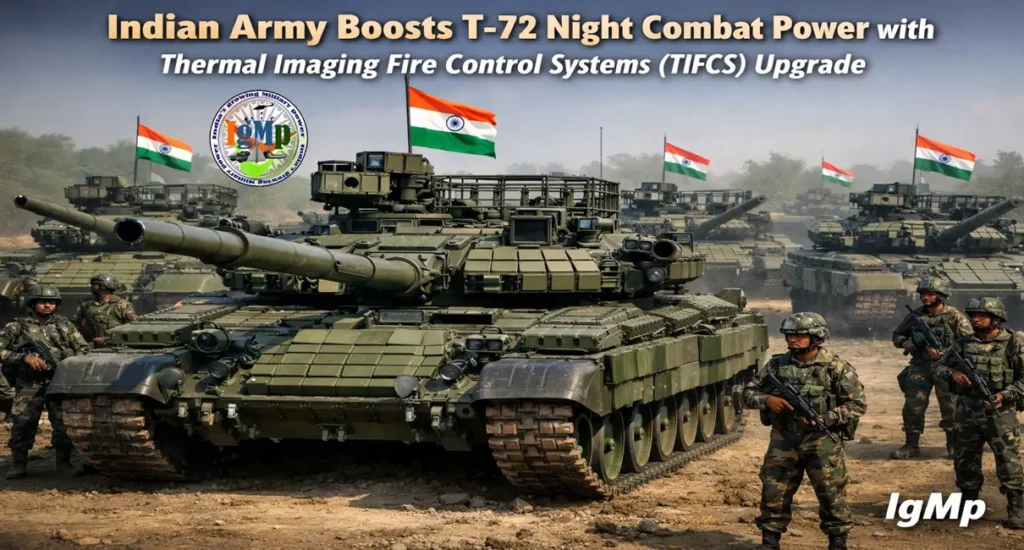
In a significant step toward modernising its armoured fleet, the Indian Army has completed the installation of indigenously built Thermal Imaging Fire Control Systems (TIFCS) on 96 of its T-72 main battle tanks. The upgraded systems have successfully cleared firing validation trials and are set to enhance the tanks’ combat performance, especially in low-visibility and night-time operations where traditional optical systems often fall short.
The T-72 has long formed the backbone of India’s armoured regiments. While newer platforms continue to enter service, the large T-72 fleet remains central to operational planning across diverse terrains—from deserts to high-altitude sectors. Military experts have consistently pointed out that improving situational awareness and target acquisition is one of the most cost-effective ways to extend the battlefield relevance of legacy platforms. The latest thermal fire control upgrade addresses precisely that need.
The new TIFCS integrates advanced thermal imaging sensors with automatic target tracking and ballistic computation. In simple terms, this allows tank crews to detect and engage targets accurately in darkness, fog, dust or smoke—conditions that are common in real-world combat scenarios. By automatically processing sensor data and adjusting firing solutions, the system reduces human error and shortens reaction time, both critical in high-intensity engagements.
The upgrade has been executed by Alpha-Elsec Defence & Aerospace Systems Pvt Ltd, a joint venture between Alpha Design Technologies and Elbit Systems. While earlier versions of similar systems were imported, this batch has been manufactured in India with technical collaboration, aligning with the government’s push for defence indigenisation under the “Make in India” framework. This shift from direct imports to domestic production marks a notable milestone in building long-term self-reliance in critical defence technologies.
From an operational standpoint, thermal imaging fire control systems are no longer optional enhancements—they are essential. Modern battlefields demand round-the-clock capability. Adversaries equipped with night-fighting systems can exploit darkness as a tactical advantage if one side lacks comparable technology. By equipping its T-72 fleet with updated thermal systems, the Army narrows that gap and ensures parity in surveillance and precision engagement.
The firing validation trials conducted in late 2025 tested accuracy, reliability and system integration under field conditions. Such trials are rigorous, involving live ammunition and simulated combat scenarios to ensure that the upgraded systems perform consistently under stress. Successful validation not only confirms technical performance but also reinforces operational confidence among tank crews.
Beyond the immediate tactical benefit, the upgrade reflects a broader structural shift in India’s defence ecosystem. Indigenous production of complex opto-electronic systems strengthens supply chain resilience and reduces dependency on foreign vendors during geopolitical uncertainty. It also nurtures a skilled industrial workforce. Alpha-Elsec, which employs over a hundred specialised professionals, has been steadily expanding into advanced electro-optics for military and paramilitary applications, with some systems even entering export supply chains through its international partnerships.
For the Army, modernisation is not solely about acquiring new tanks; it is about upgrading existing assets to meet emerging threats. Fire control systems act as the “eyes and brain” of an armoured platform. When enhanced with thermal imaging and automated tracking, even older platforms gain renewed operational relevance.
As regional security environments evolve and technology becomes increasingly decisive in warfare outcomes, incremental yet strategic upgrades like these quietly strengthen combat preparedness. By combining indigenous manufacturing capability with advanced technology transfer, the T-72 thermal fire control upgrade signals a steady, capability-driven approach to defence modernisation rather than headline-driven procurement.