Synopsis
- India’s maritime security architecture is poised for a major upgrade as the Indian Navy and the Indian Coast Guard move forward with plans to induct a new fleet of maritime patrol aircraft based on the versatile Airbus C-295 platform.
IgMp Bulletin
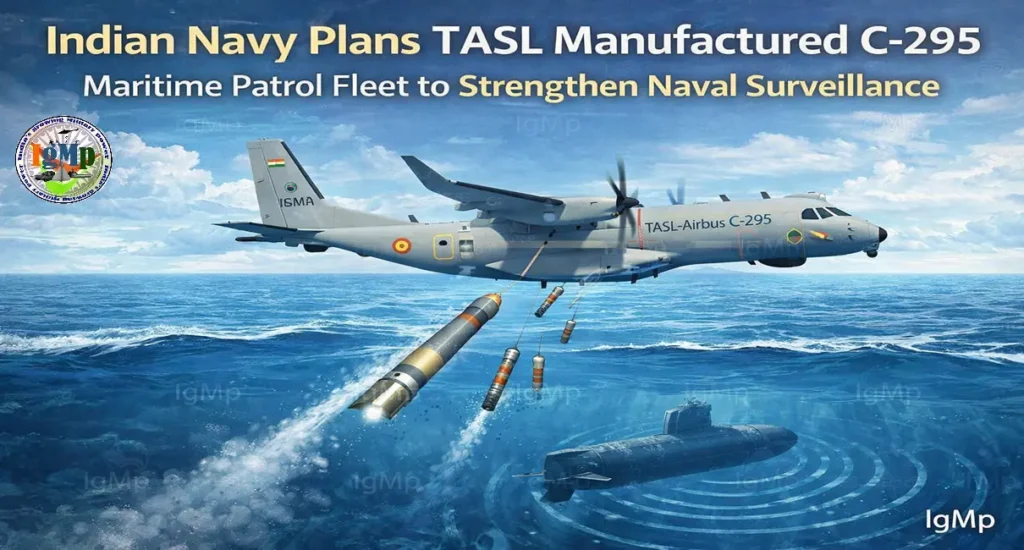
India’s maritime security architecture is poised for a major upgrade as the Indian Navy and the Indian Coast Guard move forward with plans to induct a new fleet of maritime patrol aircraft based on the versatile Airbus C-295 platform. The aircraft will be manufactured in India by Tata Advanced Systems Limited at its Vadodara facility in partnership with Airbus Defence and Space, marking another step in India’s push toward building advanced defence systems domestically.
The naval version, designed for Medium Range Maritime Reconnaissance (MRMR), is widely seen by defence planners as the missing link in India’s tiered maritime surveillance doctrine. Currently, long-range patrols are handled by the powerful Boeing P-8I Poseidon fleet, while coastal monitoring relies heavily on the smaller Dornier Do-228 aircraft. The C-295 MRMR is intended to bridge that operational gap, offering extended endurance and modern sensors capable of monitoring large maritime zones without consuming the high operational hours of strategic patrol aircraft.
| Feature | Indian Navy C-295 MRMR (2026 Status) | Operational Advantage |
|---|---|---|
| Endurance | Up to 11 Hours | Extended “on-station” time for surveillance, anti-piracy and SAR |
| Sensors | DRDO AESA Radar + EO/IR | High-resolution tracking of ships and stealth targets |
| Armament | Lightweight Torpedoes / Anti-Ship Missiles | Dedicated anti-submarine warfare capability |
| Local Content | 75% Targeted Indigenisation | Strategic autonomy and lower lifecycle cost |
India’s maritime variant is being designed with a significantly higher indigenous content than earlier transport versions. While the first aircraft for the Indian Air Force were estimated to have roughly 48 percent local components, the naval MRMR configuration aims to reach around 75 percent indigenisation. The mission systems are being developed by the Defence Research and Development Organisation through its Centre for Airborne Systems, integrating indigenous surveillance technology directly into the platform.
Among the most critical additions is an advanced indigenous Active Electronically Scanned Array radar designed for maritime surveillance. Built using modern gallium-nitride semiconductor technology, the radar is expected to provide long-range detection of ships, submarines at periscope depth, and low-observable maritime targets often referred to as “dark ships.” The aircraft will also incorporate electro-optical sensors, electronic intelligence equipment, and secure data links that allow the aircraft to share targeting information with naval command networks in real time.
Another key sensor expected to be integrated into the naval configuration is a magnetic anomaly detector, a system that helps identify submarines by detecting subtle disturbances in the Earth’s magnetic field caused by large metallic hulls beneath the sea surface. Combined with sonobuoy processing and advanced signal analysis, the aircraft could serve as a highly capable anti-submarine warfare platform.
Although the aircraft will primarily perform surveillance missions, it is also being designed as a fully capable combat platform. Under-wing hardpoints will allow the aircraft to carry lightweight torpedoes, depth charges, and anti-ship missiles if required. Defence analysts often describe this concept as “fitted for but not with,” meaning the aircraft can be rapidly armed when operational situations demand it.
The C-295 MRMR will also play an important role in preserving the operational life of India’s more expensive maritime patrol fleet. Long-range platforms like the P-8I are equipped with powerful jet engines and advanced sensors that are costly to operate. By assigning medium-range patrol missions to the turboprop-powered C-295, the Navy can reserve the P-8I fleet for complex anti-submarine warfare operations and high-priority strategic missions.
Beyond its operational role, the project represents a major milestone for India’s aerospace manufacturing sector. The Vadodara facility operated by Tata Advanced Systems is the first private-sector assembly line in the country capable of producing a full military aircraft from raw structural components to final delivery. The aircraft manufacturing ecosystem created through the program includes dozens of Indian suppliers producing aerostructures, avionics components, and systems.
The scale of the program is also expanding rapidly. With 56 aircraft already ordered for the Indian Air Force and 15 maritime variants planned for the Navy and Coast Guard, India’s total C-295 requirement now stands at 71 aircraft. That figure could make the country the world’s largest operator of the platform, potentially positioning India as a regional hub for maintenance, repair, and overhaul services for C-295 fleets operated by other nations.
As maritime competition intensifies across the Indo-Pacific and underwater activity becomes increasingly difficult to track, medium-range patrol aircraft equipped with modern sensors are emerging as a crucial element of naval power. The upcoming rollout of India’s first domestically assembled C-295 aircraft marks not only a technological milestone but also a significant step toward building a self-reliant maritime surveillance network capable of protecting some of the world’s busiest sea lanes.