Synopsis
- The announcement, made by Chief of Naval Staff Dinesh K Tripathi during the commissioning of INS Anjadip in Chennai, signals a decisive shift in India’s maritime posture at a time when the Indian Ocean Region is becoming the centre of global strategic competition.
Source : IgMp Bulletin
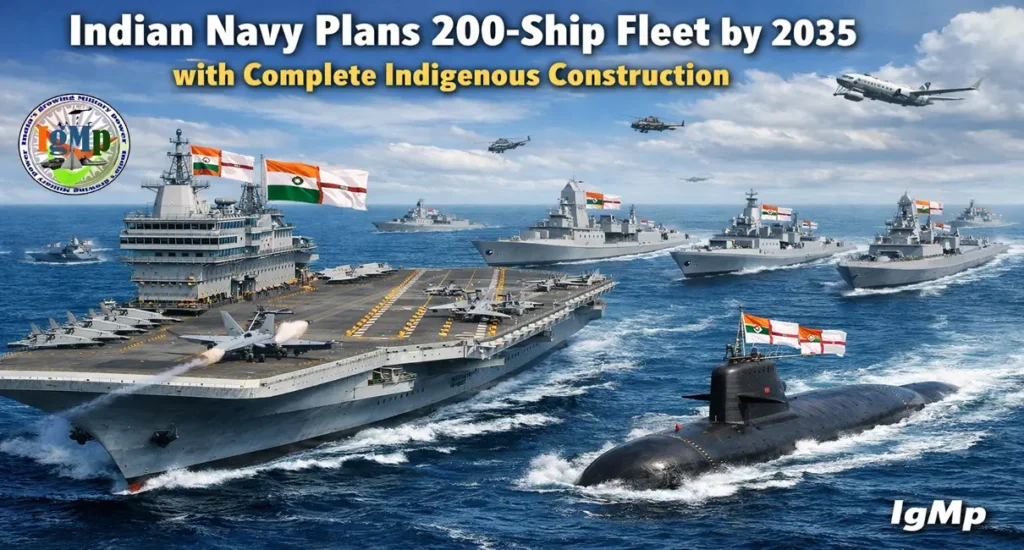
The Indian Navy is preparing for one of the most ambitious expansions in its history, outlining a roadmap to grow into a 200-ship fleet by 2035 while committing to full indigenous construction. The announcement, made by Chief of Naval Staff Dinesh K Tripathi during the commissioning of INS Anjadip in Chennai, signals a decisive shift in India’s maritime posture at a time when the Indian Ocean Region is becoming the centre of global strategic competition.
Unlike earlier phases of naval modernisation that relied partly on foreign collaboration or imports, this expansion carries a clear mandate: every major platform on order will be built in Indian shipyards. Currently, around 50 naval vessels under construction are being assembled domestically, reflecting the maturity of India’s shipbuilding ecosystem across public and private sectors. The emphasis is not just on hull construction, but increasingly on indigenous propulsion systems, sensors, weapons integration and combat management technologies.
The numbers alone reflect momentum. In 2025, the Indian Navy commissioned 12 warships and one submarine, marking one of its busiest induction years. Plans to induct 15 additional vessels by 2026 would set a new benchmark. However, fleet size is only part of the story. The broader objective is operational depth—ensuring that India can maintain persistent deployments across the Arabian Sea, Bay of Bengal and wider Indo-Pacific without overstretching its assets.
INS Anjadip, a shallow water anti-submarine warfare vessel, offers insight into how the Indian Navy is recalibrating its priorities. Designed for coastal and littoral operations, it is equipped with advanced sonars, lightweight torpedoes and anti-submarine rockets. As submarine activity increases in the Indian Ocean, particularly from extra-regional powers, strengthening undersea detection capabilities has become essential. Smaller, specialised platforms such as these complement larger destroyers and frigates, creating a layered maritime defence network.
Future acquisition plans indicate the scale of ambition. The Indian Navy is preparing for 1 Vikrant-class follown on Aircraft Carrier of 45,000-tons, 1 CATOBAR class EMALS-equipped Nuclear Powered Aircraft Carrier INS Vishal of 65,000-70,000-tons, 8-12 Next-Generation Destroyers under Project-18 of 13,000-tons, 7 Stealth Frigates under Project-17B, 8 advanced Corvettes under Project-28A of 3,500-4,000-tons and 6 Next Generation Missile Vessels of 2,500-tons. On the undersea front, the roadmap includes 6 conventional AIP-equipped submarines under Project-75I, 12 indigenous conventional AIP-equipped submarines under Project-76, 6 nuclear-powered attack submarines (SSN) under Project-77, and additional ballistic missile submarines (SSBN) of the 17,000-ton S5 class to reinforce India’s strategic deterrent. If approved in phases over the coming years, these programs will require sustained capital allocation but would fundamentally transform India’s maritime power projection capability.
Financial backing appears aligned with these goals. With India’s defence budget now around $93.5 billion, investment in the Indian Navy and Air Force has gained priority. Maritime capability building is capital-intensive and long-term, often stretching across decades from design to commissioning. Yet such investments yield strategic dividends, particularly for a country whose trade and energy security are heavily sea-dependent.
Operationally, the Indian Navy has already expanded its footprint. Warships and aircraft maintain continuous patrols across chokepoints such as the Strait of Malacca and the Gulf of Aden, conduct anti-piracy missions, and participate in multilateral exercises with partner navies. A 200-ship fleet would allow India to sustain simultaneous presence across multiple theatres, including humanitarian assistance and disaster relief missions that have become a hallmark of its regional engagement.
Indigenisation has evolved from a policy slogan into a structural objective. The transition from “Make in India” to a deeper culture of technological self-confidence—often described as Aatmanirbharta—reflects lessons from past supply chain disruptions and geopolitical uncertainties. Domestic shipbuilding generates high-skilled employment, strengthens ancillary industries and creates export opportunities, while reducing vulnerability to sanctions or delays.
Strategically, maritime strength is closely tied to deterrence. Surface combatants armed with long-range missiles, submarines capable of stealth patrols, and aircraft carriers extending air power into distant waters collectively enhance India’s leverage. At the same time, coastal and shallow-water platforms secure immediate approaches, protecting ports, offshore assets and undersea communication cables.
India’s geography offers both opportunity and responsibility. Sitting astride major sea lanes, the country occupies a vantage position in the Indian Ocean. A larger, more capable Navy enables it to act as a net security provider while safeguarding national interests. The collaborative effort among shipyards in Mumbai, Kochi, Kolkata and Visakhapatnam illustrates a nationwide industrial mobilisation behind this goal.
As the Indo-Pacific becomes the primary theatre of global economic and military activity, naval power will shape strategic outcomes. By targeting a 200-ship fleet by 2035 and insisting on indigenous construction, the Indian Navy is signalling a long-term commitment to maritime strength, technological sovereignty and sustained regional presence.