Synopsis
- The increase in defence budget was much anticipated, because India has long been witnessing defence progresses around its borders, with its two primary threats, namely China and Pakistan was forging a closer ties with China supplying sophisticated arms to Pakistan, including missiles, air defense systems, fighter jets and long-range air-to-air missiles which have ramifications for India in terms of future engagements like we saw in ‘Operation Sindoor’ in May last year.
Source : IgMp Bulletin
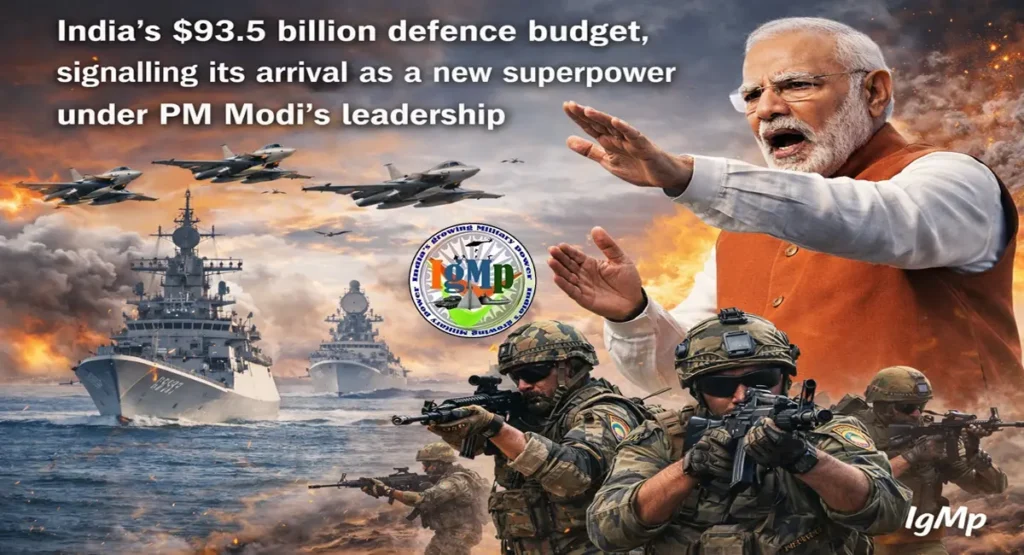
India has unveiled its largest-ever defence allocation, setting aside roughly $93.5 billion (₹7.85 lakh crore) for the financial year 2026-27, a move that signals more than just higher spending. Under Prime Minister Narendra Modi, New Delhi is positioning defence not only as a shield against threats but as a pillar of technological and industrial transformation.
The 15 percent-plus increase over the previous year reflects a deliberate shift in strategic thinking. India is no longer content with being one of the world’s largest arms importers. Instead, the government is channeling resources into domestic production, advanced research and high-end capability development. A striking 75 percent of the capital acquisition budget has been earmarked for Indian industry, reinforcing the “Aatmanirbhar Bharat” vision of reducing dependency on foreign suppliers while building a globally competitive defence ecosystem.
The most intriguing part of this year’s Indian defence budget is that a humongous 75% of the capital acquisition fund, approximately $16.5 billion (₹1.39 lakh crore) was earmarked for the domestic defence industry, which is a mandatory requirement for future engagement and shows Govt’s commitment towards Self reliant India, which PM Modi calls ‘Aatmanirbhar Bharat’ in Hindi.
The increase in defence budget was much anticipated, because India has long been witnessing defence progresses around its borders, with its two primary threats, namely China and Pakistan was forging a closer ties with China supplying sophisticated arms to Pakistan, including missiles, air defense systems, fighter jets and long-range air-to-air missiles which have ramifications for India in terms of future engagements like we saw in ‘Operation Sindoor’ in May last year.
The increase in defence budget was also expected in the backdrop of massive acquisitions like 114 Rafales and at least 40-60 Sukhoi Su-57 stealth jets from Russia, and also the funds required to continue indigenous fighter programs like 4.5th generation Tejas Mk2 and 5th-generation stealth fighter AMCA. India also needs a considerable amount of budget for the 120-kilonewton joint turbofan engine project to be initiated with French jet engine maker Safran, for the AMCA Mk2.
All these investments, along with other large acquisitions like 6 P-8I ASW submarine hunters for the Indian Navy, 6 Netra Mk1A AEW&CS and 6 Netra Mk2 AWACS, 6 Airbus A-330 refuelling tankers for the IAF, 10 Next Generation Destroyers under Project-18, 7 more stealth frigates like Nilgiri class under Project-17B, and 8 Next Generation Corvettes under Project-28A, Project Kusha indigenous air defense system for the IAF, 5 more S-400 battery purchase for the IAF, BMD Phase-II and BMD Phase-III projects, etc.
Importantly, the budget is not just about procurement; it is about ecosystem building. Over the past decade, India has opened its defence sector to private players, start-ups, and foreign direct investment under controlled frameworks. The goal is to create a self-sustaining innovation cycle where domestic companies design, manufactur,e and eventually export advanced systems. Defence exports have already grown steadily, and policymakers see them as both a strategic tool and an economic opportunity.
For investors and industry stakeholders, the record allocation sends a strong signal of policy continuity. Long-gestation programmes such as stealth fighters, next-generation warships, and network-centric systems require predictable funding. By committing substantial resources, the government is attempting to de-risk these programmes and accelerate timelines.
India’s defence budget now places it among the top military spenders globally. Yet the broader narrative is less about raw expenditure and more about transformation. By prioritising indigenous manufacturing, digital warfare capabilities, and high-technology collaboration, New Delhi is laying the financial groundwork for a defence industry that aims to compete on the global stage while securing national interests in an increasingly uncertain security environment.