Synopsis
- In an interconnected global economy where currency pressures can quickly spiral into crises, India’s record forex buffer stands out as a symbol of economic preparedness.
Source : IgMp Bulletin
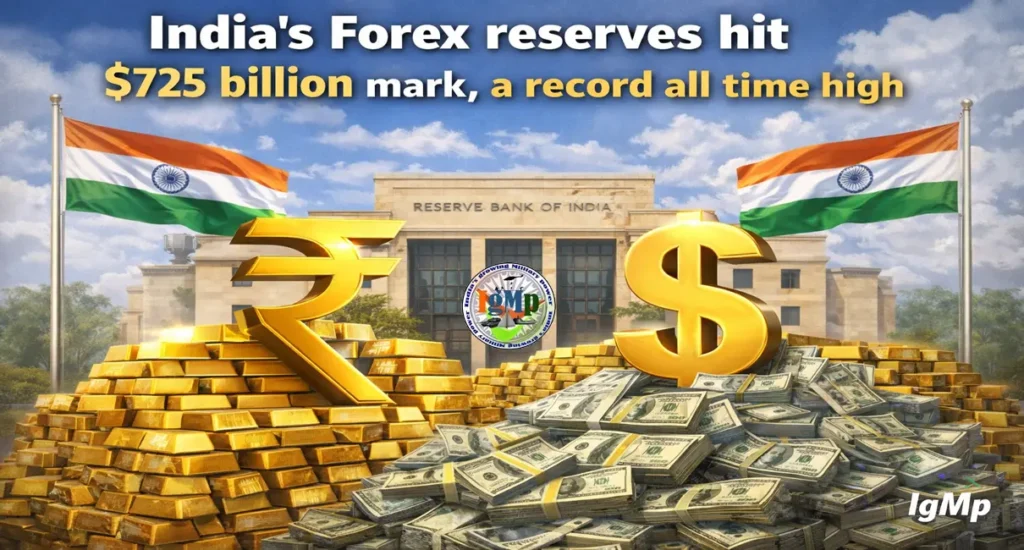
India’s forex reserves or Foreign Exchange Reserves have surged to a record high of $725.7 billion, underlining the country’s strengthening external position at a time of global economic uncertainty. The latest data released by the Reserve Bank of India shows a sharp weekly increase of over $8.6 billion, reflecting steady capital flows, robust currency management and a strategic build-up of gold assets.
A major contributor to this rise has been the jump in gold reserves. The value of India’s gold holdings climbed by nearly $5 billion, pushing the total close to $128.5 billion. In recent years, central banks across the world have been increasing gold purchases as a hedge against inflation, currency volatility and geopolitical risks. India’s move mirrors this broader global trend, while also strengthening confidence in its long-term reserve strategy.
Foreign Currency Assets, which form the largest portion of the reserve pool, also recorded healthy growth. These assets, comprising holdings in major international currencies such as the US dollar, euro, pound and yen, rose by more than $3.5 billion. The diversification across currencies helps cushion India against sudden exchange rate shocks and external financial turbulence.
Additionally, India’s holdings of Special Drawing Rights allocated by the International Monetary Fund registered a modest increase. SDRs serve as supplementary international reserve assets and enhance a country’s liquidity buffer in times of stress.
For policymakers and investors alike, rising forex reserves are more than just a headline number. They act as a financial shield, enabling the central bank to manage currency volatility and meet external payment obligations with confidence. A strong reserve position reassures global markets that India can withstand sudden capital outflows or spikes in import bills, particularly for energy.
This milestone also reflects the broader stability of India’s macroeconomic fundamentals. Despite global headwinds, the country continues to attract foreign investment, maintain healthy remittance inflows and manage its trade dynamics effectively. The build-up of reserves provides additional policy space to support growth without compromising external stability.
In an interconnected global economy where currency pressures can quickly spiral into crises, India’s record forex buffer stands out as a symbol of economic preparedness. It reinforces the perception that the country is not only navigating volatility but doing so from a position of increasing financial strength.