Synopsis
- Iran is reportedly nearing a deal with China to acquire advanced supersonic anti-ship cruise missiles, a development that could significantly alter the security balance in the Persian Gulf at a time of heightened tension with the United States.
Source : IgMp Bulletin
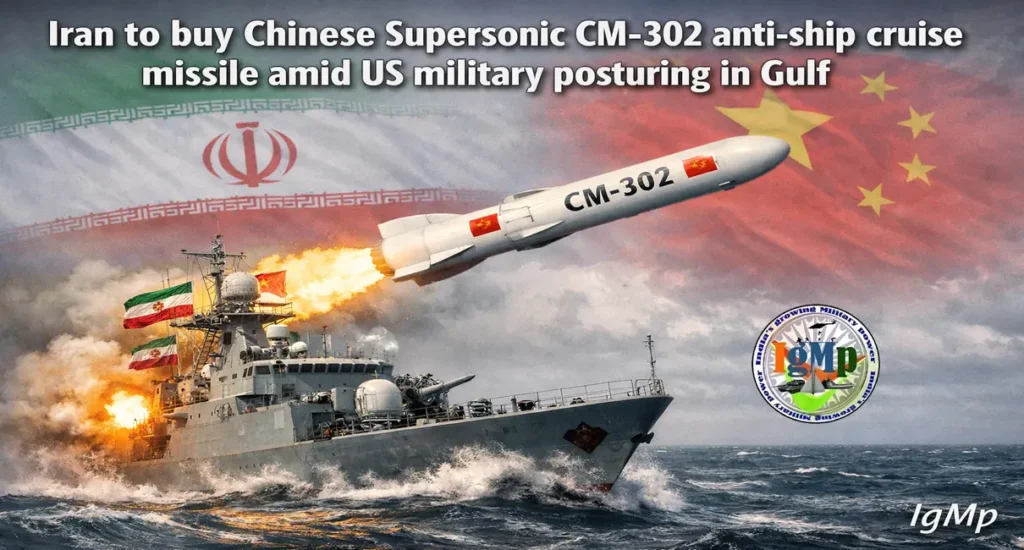
Iran is reportedly nearing a deal with China to acquire advanced supersonic anti-ship cruise missiles, a development that could significantly alter the security balance in the Persian Gulf at a time of heightened tension with the United States. According to multiple officials and security sources cited in international reporting, Tehran is in advanced negotiations to purchase the CM-302 missile system, a long-range weapon designed to strike naval targets at high speed and low altitude.
The CM-302, developed by China Aerospace Science and Industry Corporation, is marketed as a high-performance anti-ship missile capable of traveling at supersonic speeds and engaging targets at distances approaching 300 kilometers. Its design emphasizes sea-skimming flight profiles and terminal maneuvers intended to complicate interception by shipborne air defense systems. If delivered and deployed effectively, such missiles could pose a more complex challenge to U.S. naval assets operating in the region.
The reported talks come as the United States has reinforced its naval presence near Iran. The aircraft carriers USS Abraham Lincoln and USS Gerald R. Ford, along with their strike groups, have been operating in or heading toward waters within reach of Iranian missile systems. Together, these carrier groups represent a formidable concentration of air and maritime power. However, they also serve as high-value targets in any potential escalation scenario.
For Tehran, strengthening anti-ship capabilities fits into a long-standing asymmetric strategy. Iran’s naval doctrine has traditionally relied on fast attack craft, coastal missile batteries, mines, and submarines to offset the technological superiority of Western fleets. A supersonic cruise missile with extended range would enhance Iran’s ability to threaten naval forces in the Strait of Hormuz and surrounding waters, a corridor through which a significant portion of global oil shipments passes.
Military analysts note that supersonic speed alone does not make a missile unstoppable, but it does compress reaction times for defenders. Modern U.S. destroyers and cruisers equipped with layered missile defense systems are designed to counter such threats. Still, saturation tactics—launching multiple missiles simultaneously—could test even advanced defenses. The psychological and strategic impact of possessing such systems can be as important as their operational performance.
The potential deal also reflects evolving geopolitical alignments. China and Iran have expanded economic and security cooperation in recent years, including joint naval exercises with Russia. Beijing has repeatedly stated that it supports Iran’s sovereignty and has criticized unilateral sanctions. At the same time, China publicly maintains that it adheres to export control regimes and international law. Any confirmed transfer of complete advanced missile systems would draw scrutiny, particularly in light of past United Nations sanctions on Iran’s weapons programs.
For Washington, the reported negotiations complicate an already delicate standoff over Iran’s nuclear activities and regional influence. The White House has emphasized both diplomatic pressure and military readiness, signaling that all options remain on the table. A strengthened Iranian coastal defense posture would increase the risks associated with sustained naval operations near its shores.
It is also worth noting that Iran’s missile arsenal has evolved steadily over the past two decades, with significant domestic production in ballistic and cruise missile categories. However, access to advanced foreign-designed systems could accelerate capability improvements, especially in propulsion, guidance, and electronic counter-countermeasure technologies. Even limited numbers of high-performance missiles can serve as force multipliers when integrated into layered coastal defense networks.
As of now, key details remain unclear, including the scale of any potential purchase and the timeline for delivery. Official responses from Beijing have downplayed knowledge of the reported deal, and Washington has not publicly confirmed specific intelligence assessments. In volatile regional environments, negotiations can shift rapidly under diplomatic or economic pressure.
What is clear is that the Gulf remains one of the world’s most strategically sensitive maritime theaters. Any enhancement of Iran’s anti-ship capabilities—real or perceived—will factor into military planning on all sides. In a region where naval deployments, missile ranges, and political deadlines intersect, even the prospect of a new weapons transfer can reshape calculations overnight.