Synopsis
- Although it is also very important to note here, that Defence Minister Rajnath Singh also emphasised on strategic autonomy in defence and aerospace sector, limiting foreign dependence, which can also be interpreted as an indication that India may also pursue its own sixth-generation fighter development soon, with partnership in jet engine technology sharing and manufacturing a completely new jet engine based on clean sheet design having thrust of 120 kilonewton for the indigenous AMCA fifth-generation stealth fighter, will also pave the way for its usage in the proposed sixth-generation fighter, which will ultimately set India free from dependence over foreign countries in the aerospace domain.
Source : IgMp Bulletin
The Indian defence establishment is proposing a resounding change in its future of air power projection planning as Defence Minister Rajnath Singh advocated an early and sustained initiative of the sixth-generation fighter technologies. Talking about the fast changes happening in the field of modern warfare and military aviation today, he emphasized that the pursuing earlier approach of following global programs after their maturity, would put India at a disadvantage in the long term. There is such a rapid change in the aerospace domain now, that according to him, requires a proactive investment as opposed to incremental adjustment.
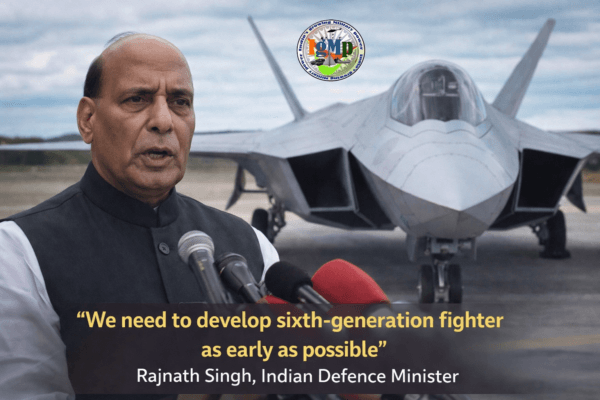
Rajnath Singh said that research in advanced propulsion systems, intelligent and autonomous technologies, and next-generation materials is now a strategic need not just a long-term necessity. The next generation of combat aircraft, he observed, would not only be characterized by speed and stealth, but also by the ability of human-machine teaming together smoothly, network-centric operations, adaptive sensors, and propulsion systems capable of supporting greater range, endurance, and energy demands. These are increasingly becoming capabilities that were initially taken as experimental but which are now becoming prerequisites in the decades to come in the domain of air superiority.
The comments of the Defence Minister represent a rise in consciousness among the Ministry of Defence to the fact that initial research and development will determine which countries will dictate the way the next generation of combat aviation looks like. Early investment is what India hopes to establish to gain experience domestically, limit reliance on foreign suppliers in the long term, and see its aerospace ecosystem continue to be globally competitive long into the middle of the century. This is also a lesson gained out of the past programmes in which the slow timing in technology induction caused capability gaps and a prolonged schedule.
Strategic analysts perceive such remarks as a sign that India is endorsing the possibilities of bypassing the limited path of indigenous development, into a particular version of international cooperation. Among the options under discussion is the potential of alignment with the sixth-generation Future Combat Air System (FCAS) initiative of France that focuses on a system-of-systems approach coordinated with a next-generation fighter, unmanned loyal wingmen, advanced sensors, and a secure combat cloud. India will be able to afford access to the leading research and development as well as offer up its own advantages in software, systems integration, and progressive manufacturing by participating in such a programme on an early basis.
Although it is also very important to note here, that Defence Minister Rajnath Singh also emphasised on strategic autonomy in defence and aerospace sector, limiting foreign dependence, which can also be interpreted as an indication that India may also pursue its own sixth-generation fighter development soon, with partnership in jet engine technology sharing and manufacturing a completely new jet engine based on clean sheet design having thrust of 120 kilonewton for the indigenous AMCA fifth-generation stealth fighter, will also pave the way for its usage in the proposed sixth-generation fighter, which will ultimately set India free from dependence over foreign countries in the aerospace domain. What India needs right now, that it takes the right decision at the right moment, securing its future air power and at the same time building its own defence industrial complex which can rapidly build its own machines at any moment without any foreign dependence.
But it is clear that India has no desire to find itself in the 2030s and 2040s having to implement ways to close the gap imposed by world rivals in the air power domain, which can be strongly emphasized by the call of Rajnath Singh. With the current groundwork in propulsion, artificial intelligence-controlled combat systems, and advanced materials, India seems to be increasingly placing itself in a strategic position to be a relevant and influential aerospace power in an era where technological dominance will become a basis of strategic balance. It will be interesting to see which way India chooses to achieve its aerospace supremacy in the region in future.