Synopsis
- According to a statement issued by Iran’s Islamic Revolutionary Guard Corps (IRGC), Kheibar ballistic missiles were launched in what it described as a carefully planned and surprise “tenth wave” of attacks, targeting not only the prime minister’s office but also a location linked to Israeli Air Force command infrastructure.
Source : IgMp Bulletin
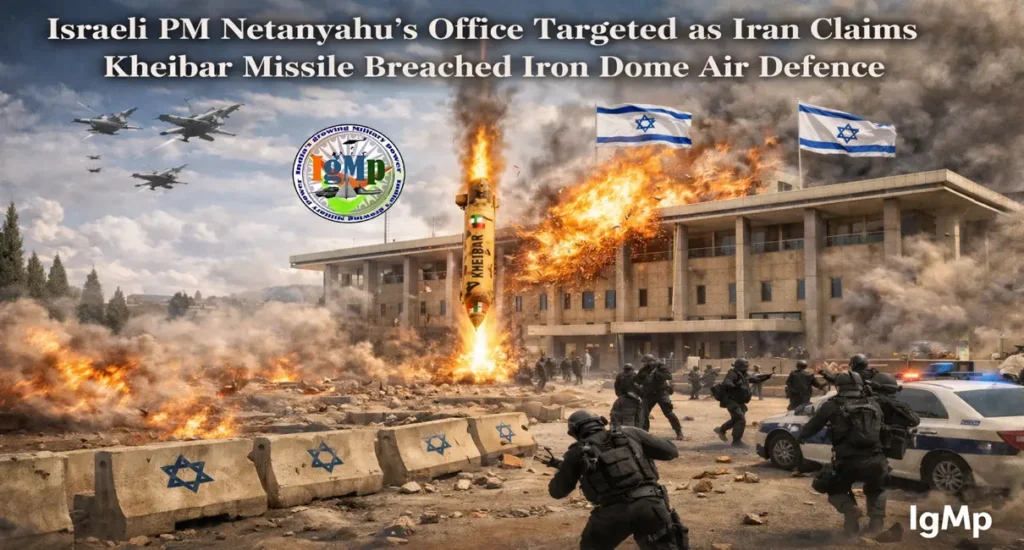
Fresh claims from Iran about a direct missile strike on the office of Israeli Prime Minister Benjamin Netanyahu have injected a new level of intensity into the rapidly escalating confrontation between Iran and Israel. According to a statement issued by Iran’s Islamic Revolutionary Guard Corps (IRGC), Kheibar ballistic missiles were launched in what it described as a carefully planned and surprise “tenth wave” of attacks, targeting not only the prime minister’s office but also a location linked to Israeli Air Force command infrastructure. Israel has not officially confirmed damage to these sites, but the assertion alone has been enough to draw renewed global attention to one of Iran’s most powerful missile systems and its potential to challenge Israel’s layered air defence network.
Iranian messaging around the strike has been deliberate. By naming the alleged targets and publicly identifying the missile used, Tehran appears intent on sending a political as well as a military signal. The choice of the Kheibar missile, also known as Khorramshahr-4, is central to that narrative. It is portrayed by Iranian officials as a weapon designed not just for range or payload, but for survivability against modern interception systems. While independent verification of the claimed impacts remains unavailable, the incident has reopened debate over how even advanced air defence architectures perform under pressure from high-speed, heavy ballistic threats.
The Kheibar missile occupies a distinct place in Iran’s missile arsenal. Unveiled in 2023, it represents the latest evolution of the Khorramshahr family, a line developed with an emphasis on delivering extremely heavy warheads across medium-range distances. With a reported reach of roughly 2,000 kilometres, the missile places much of West Asia within range from Iranian territory. Its payload capacity, estimated at up to 1.8 tonnes, is among the largest attributed to any missile in its class, making it suitable for delivering high-impact conventional warheads rather than relying solely on precision.
Speed and flight profile are where the system draws the most attention. Iranian sources claim the missile reaches hypersonic velocities during different phases of flight, travelling far faster outside the atmosphere before re-entering at speeds that still challenge most interceptors. The design reportedly incorporates a manoeuvrable re-entry vehicle, allowing the warhead to alter its trajectory in the terminal phase. Combined with mid-course guidance updates and electronic counter-measures, these features are intended to complicate radar tracking and interception calculations.
This is where the discussion inevitably turns to Israel’s air defence shield. Israel relies on a multi-layered system built to counter threats ranging from short-range rockets to longer-range ballistic missiles. Systems such as Iron Dome are optimised for high-volume, short-range projectiles, while other layers are designed to address more complex threats. Iran’s claim that the Kheibar missile was able to bypass these defences is therefore significant, even if unproven, because it feeds into a broader argument about saturation, speed, and manoeuvrability outpacing interception capacity.
Iranian officials have made similar assertions in the past, including claims that missiles from the same family reached sensitive sites such as Ben Gurion Airport during earlier escalations. Israel has consistently avoided confirming such details, often citing operational security, while maintaining that its defences intercept the vast majority of incoming threats. The gap between official silence and adversary claims creates an information grey zone that fuels speculation and psychological pressure on both domestic and international audiences.
For Israel, the strategic challenge lies not only in whether a specific missile was intercepted or not, but in managing deterrence credibility. Even isolated penetrations, or credible claims of them, can have outsized political impact when high-profile targets are named. For Iran, highlighting the Kheibar missile serves to underline its ability to threaten hardened and symbolic sites without relying on proxy forces or mass launches.
As the regional conflict continues to evolve, the focus on individual weapons systems like the Kheibar reflects a larger shift in modern warfare. Precision, speed, and the ability to complicate defensive responses are increasingly valued alongside sheer numbers. Whether or not Iran’s latest claims withstand independent scrutiny, the episode reinforces a growing reality in West Asia: missile technology and air defence are locked in a fast-moving contest, where perception, signalling, and technical performance are now inseparable.