Synopsis
- The first batch of upgraded Type-12 missiles arrived at Camp Kengun in Kumamoto Prefecture on March 10, 2026, in a tightly controlled overnight operation that reflects Tokyo’s growing focus on deterrence in the increasingly tense Indo-Pacific security environment.
IgMp Bulletin
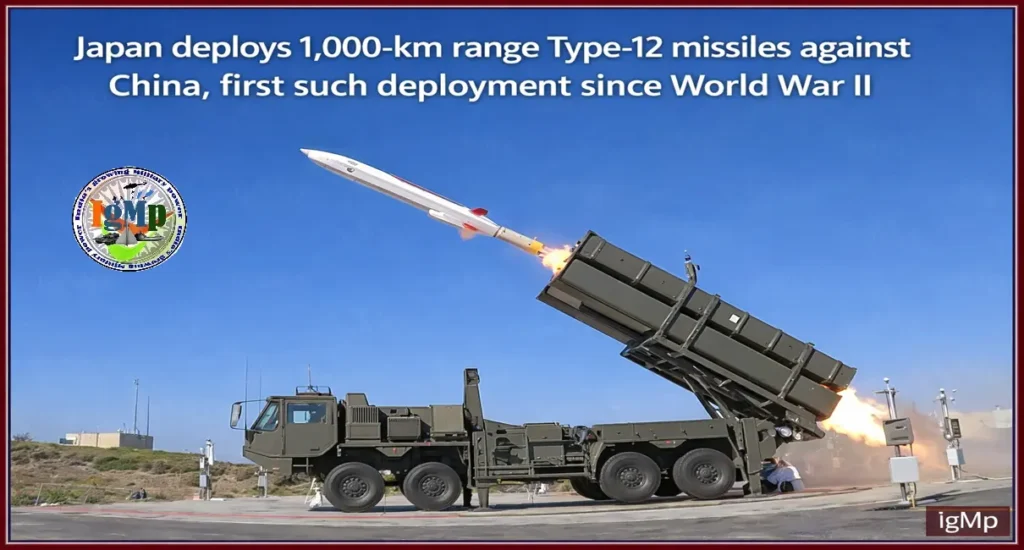
Japan has begun deploying a new generation of long-range cruise missiles that mark a historic shift in its military posture, signaling the country’s first operational counterstrike capability since the end of World War II. The first batch of upgraded Type-12 missiles arrived at Camp Kengun in Kumamoto Prefecture on March 10, 2026, in a tightly controlled overnight operation that reflects Tokyo’s growing focus on deterrence in the increasingly tense Indo-Pacific security environment.
The deployment involves the upgraded Type-12 missile system developed by Mitsubishi Heavy Industries for the Japan Ground Self-Defense Force. Officials say the initial units will become fully operational by March 31, 2026, completing the first phase of Japan’s long-range strike rollout. Unlike the original coastal-defense variant, the new missile is designed for stand-off precision strikes against both maritime and land targets.
Capability Leap: Evolution of Japan’s Type-12 Missile
| Feature | Upgraded Type-12 (Current 2026) | Strategic Impact |
|---|---|---|
| Strike Radius | 1,000 km | Holds Shanghai & North Korea at risk |
| Stealth | Low-Observable Airframe | Penetrates S-400 / HQ-9 air defenses |
| Guidance | QZSS + TERCOM | Precision strike on moving naval targets |
| Doctrine | Active Counterstrike | First offensive capability since WWII |
With an estimated range of about 1,000 kilometers, the missile dramatically extends Japan’s strategic reach across the East China Sea. From Kumamoto in southwestern Japan, the strike envelope places key mainland Chinese coastal regions—including areas near Shanghai—within potential range. Analysts note that several missile bases and strategic facilities in North Korea also fall within the same radius, significantly strengthening Japan’s deterrence posture against regional threats.
Technically, the upgraded Type-12 represents more than just a range extension. The missile now features a redesigned angular airframe intended to reduce radar visibility, giving it a low-observable profile similar in concept to Western stealth cruise missiles such as the AGM-158 JASSM. This design improves survivability against modern integrated air-defense networks and allows the missile to approach targets with reduced detection probability.
Mobility is another critical feature of the system. The missiles are mounted on truck-based launch vehicles that can quickly relocate across Japan’s rugged terrain. In a crisis, these mobile launchers can disperse into mountainous regions, operating from concealed positions that make them extremely difficult to track or destroy through satellite surveillance or pre-emptive strikes.
Guidance technology also plays a key role in the missile’s effectiveness. The upgraded Type-12 integrates satellite navigation from Japan’s Quasi-Zenith Satellite System alongside terrain-matching guidance. Defense experts often describe this capability as effectively “J-20 proof” because QZSS provides highly accurate regional augmentation signals that are harder to jam or spoof than conventional GPS in the contested electronic warfare environment of the East China Sea. This ensures the missile can maintain precision even while striking moving ships at sea.
Strategically, the deployment reflects Japan’s evolving defense doctrine under Prime Minister Sanae Takaichi. Her administration accelerated the long-range missile program by roughly a year following heightened tensions around Taiwan and increased Chinese military activity near Japanese waters.
The broader military implication is tied to geography. With 1,000-kilometer range missiles stationed in Kyushu and additional batteries expected across the Nansei island chain, Japan gains the potential to control key maritime chokepoints such as the Miyako Strait. In a conflict scenario, this capability could effectively restrict the movement of the People’s Liberation Army Navy from the East China Sea into the wider Pacific, reinforcing the defensive barrier commonly known as the First Island Chain.
Beyond the Kumamoto deployment, Japan is already planning a broader long-range strike network. Future variants of the Type-12 are expected to include ship-launched and air-launched versions by 2027, allowing the missile to operate across multiple platforms and creating a flexible triad of stand-off strike options.
For regional security analysts, the importance of this deployment lies not only in the missile’s technical capabilities but also in what it represents politically and strategically. Japan’s decision to operationalize counterstrike weapons signals a profound shift in how Tokyo interprets self-defense in an era defined by rapid military modernization and rising geopolitical competition in the Indo-Pacific.