Synopsis
- India’s decades-long effort to design and develop an indigenous jet engine reached an important inflection point in early 2026, when engineers quietly demonstrated that some of the Kaveri engine programme’s most persistent limitations are finally being tackled at their root.
Source : IgMp Bulletin
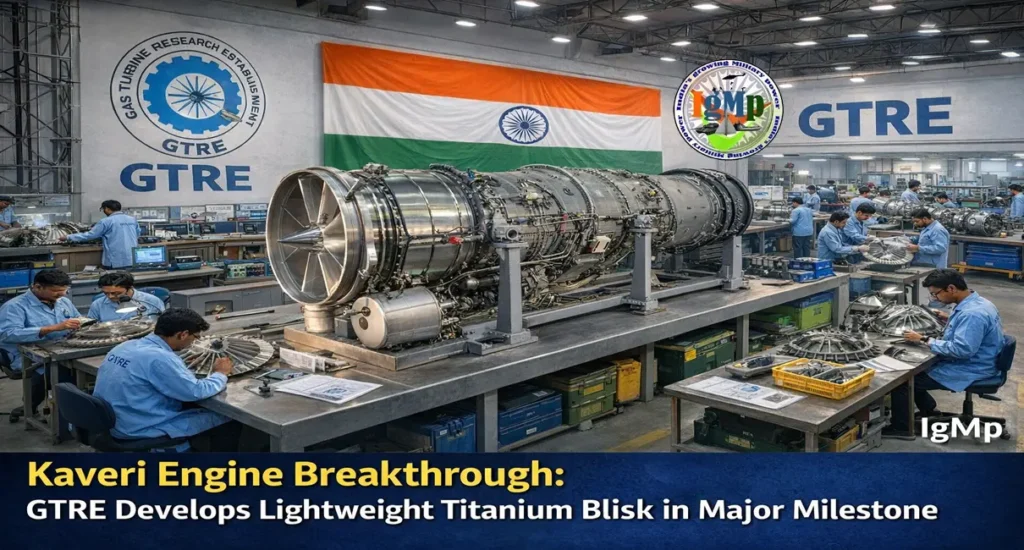
India’s decades-long effort to design and develop an indigenous jet engine reached an important inflection point in early 2026, when engineers quietly demonstrated that some of the Kaveri engine programme’s most persistent limitations are finally being tackled at their root. During Defence Minister Rajnath Singh’s visit to Bengaluru, scientists at Gas Turbine Research Establishment (GTRE) revealed a lightweight titanium alloy blisk developed specifically for the Kaveri engine family. While far less dramatic than a public flight test, this single component represents a structural leap that could decisively reshape the engine’s future.
For years, the Kaveri engine story has been defined by two hard truths: the core design demonstrated promise, but excess weight and efficiency penalties held it back from powering frontline fighter aircraft. Traditional compressor construction, where individual blades are mounted into a disk using fir-tree or dovetail joints, contributed significantly to this problem. These attachment mechanisms are proven and robust, but they add mass, complexity and aerodynamic compromises that accumulate across multiple compressor stages.
The blisk—short for bladed disk—rewrites that equation. By forging the blades and disk as one monolithic structure from a single titanium billet, engineers eliminate blade roots, locking hardware and supporting rims altogether. The result is a weight reduction of roughly 20 to 30 percent per compressor stage, a figure that carries enormous significance for an engine like Kaveri. With the current non-afterburning Kaveri engine “Dry” variant weighing in the region of 1,180 kilograms, internal targets now call for shedding 200 to 230 kilograms to make the engine viable for manned combat aircraft. Titanium alloy blisks are central to achieving that goal.
Beyond weight, the aerodynamic advantages are equally compelling. Integrated blades allow designers to sculpt smoother, more efficient profiles right down to the blade root, an area that traditionally suffers from airflow losses due to mechanical gaps. Fewer discontinuities mean better pressure recovery, higher compressor efficiency and more stable airflow across a wider operating envelope. In practical terms, this translates into improved fuel efficiency, higher overall pressure ratios and smoother throttle response—critical parameters for fighter operations.
Material science plays a decisive role in making this possible. For the low-pressure compressor and the early stages of the high-pressure compressor, GTRE has turned to high-strength titanium alloys such as Ti-6Al-4V and advanced near-alpha grades like IMI 834. These alloys offer an exceptional balance of strength, fatigue resistance and low density, enabling them to survive extreme centrifugal loads at high rotational speeds without compromising durability. An often-overlooked benefit is the elimination of fretting corrosion, a wear mechanism caused by microscopic vibrations at blade-disk interfaces in conventional designs. With no joints to rub or loosen, a blisk inherently improves long-term reliability and reduces maintenance demands.
This achievement has not come in isolation. GTRE’s close collaboration with MIDHANI has been critical in refining alloy chemistry and mastering complex isothermal forging processes required to produce precision blisks consistently. Manufacturing such components is notoriously challenging, demanding tight control over temperature, deformation rates and final machining tolerances. That India can now demonstrate this capability domestically marks a maturation of its aero-engine industrial base.
The timing is also notable. The Kaveri Dry engine has already accumulated flight hours on airborne testbeds such as the Ilyushin Il-76, providing valuable data on core performance. Integrating lightweight blisks across three low-pressure and six high-pressure compressor stages opens the door to what insiders increasingly refer to as a Kaveri 2.0 or “K10” standard. This envisioned upgrade aims for a thrust-to-weight ratio of 8:1 or higher, placing the engine in the competitive range of modern fighter powerplants.
While challenges remain, the titanium blisk milestone signals that the Kaveri programme is no longer just about incremental fixes. It reflects a deeper convergence of design, materials and manufacturing expertise. In an era where control over propulsion technology defines strategic autonomy, GTRE’s progress suggests that India’s long wait for a truly indigenous fighter-class jet engine may finally be moving from aspiration to achievable reality.