Synopsis
- six Advanced Light Helicopters ALH Mk-III (MR) in the maritime role for the Indian Coast Guard and Vertical Launch Shtil (VL-Shtil) surface-to-air missiles for the Indian Navy.
IgMp Bulletin
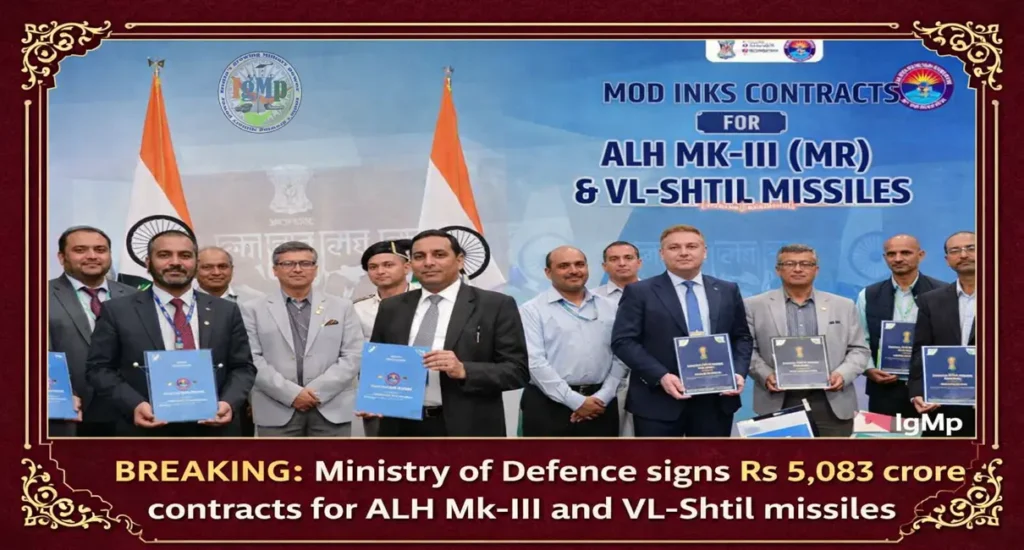
MoD Signs ₹5,083 Crore Contracts for and VL-Shtil Missiles
India’s Ministry of Defence has formalised ₹5,083 crore worth of maritime security contracts covering two very different but strategically linked capabilities: six Advanced Light Helicopters ALH Mk-III (MR) in the maritime role for the Indian Coast Guard and Vertical Launch Shtil (VL-Shtil) surface-to-air missiles for the Indian Navy. Signed in New Delhi in the presence of Defence Secretary Rajesh Kumar Singh, the deals reflect a calibrated mix of indigenous manufacturing and targeted foreign procurement [Source: PIB].
To understand the structure of this package, it is important to break down how the funds are distributed and what operational gaps they address.
Breakdown of the ₹5,083 Crore Maritime Security Contracts (March 2026)
| System | Platform / Developer | Contract Value | Key Operational Role | Procurement Category |
|---|---|---|---|---|
| ALH Mk-III (MR) Maritime | Hindustan Aeronautics Limited (HAL)(Indigenous) | ₹2,901 Crore | Coastal surveillance, SAR, EEZ protection | Buy (Indian-IDDM) |
| VL-Shtil SAM | JSC Rosoboronexport (Russia) | ₹2,182 Crore | Medium-range air defence for frontline warships | Buy (Global) |
The contrast is deliberate. One system reinforces domestic aerospace manufacturing; the other ensures immediate combat readiness at sea.
Strengthening the Shield: The Indian Navy’s VL-Shtil Upgrade
The ₹2,182 crore VL-Shtil contract is operationally significant because it strengthens the medium-range air defence layer on frontline warships. The system, widely known as the navalised Shtil-1 and associated with the 3S90M vertical launch architecture, is designed to intercept aircraft, helicopters, anti-ship missiles and certain precision-guided threats in complex maritime environments.
For the Indian Navy, layered defence is non-negotiable. Long-range sensors detect threats early, close-in weapon systems provide the last line of protection, and medium-range missiles like VL-Shtil form the crucial middle shield. This acquisition is especially relevant for follow-on ships of the Talwar lineage and other platforms where the vertical launch configuration integrates more seamlessly with modern combat management systems.
Why Vertical Launch? The 360-Degree Engagement Advantage
Earlier Shtil variants on some frigates relied on trainable arm launchers, which required the launcher to be physically oriented toward the incoming threat. The 3S90M vertical launch system removes that constraint. Missiles are launched vertically and then rapidly steered toward the target, enabling near 360-degree coverage without mechanical reorientation delays.
In a saturation attack scenario—where multiple threats approach from different bearings—reaction time and engagement flexibility determine survivability. Vertical launch systems reduce launch latency, allow faster ripple firing and simplify deck layout. In high-threat environments, these seconds matter.
The strategic context cannot be ignored. In 2026, amid ongoing Western sanctions on Russia and India’s strong push for indigenisation, signing a major deal with Rosoboronexport sends a clear message of realpolitik. Warships under construction or nearing commissioning cannot remain under-armed while waiting for a fully indigenous equivalent to mature. If a platform is ready to sail, its air defence suite must be ready too. The decision reflects continuity in India-Russia defence cooperation while balancing it with domestic capability building elsewhere.
The Coast Guard’s New Eyes: HAL’s ALH Mk-III (MR) Maritime
The ₹2,901 crore contract for six ALH Mk-III (Maritime Role) helicopters signed with Hindustan Aeronautics Limited (HAL) under the Buy (Indian-IDDM) category reinforces the indigenous pillar of the deal. The ALH family, often referred to as Dhruv, has steadily evolved through multiple variants including the Mk-III already in service with the Coast Guard.
This raises a key technical question: why procure the ALH Mk-III (MR) maritime variant when ALH Mk-III helicopters are operational?
The answer lies in mission optimisation and fleet economics. The ALH Mk-III (MR) maritime configuration can be tailored as a high-availability workhorse optimised for coastal surveillance, search and rescue, and EEZ patrol duties from shore bases. It may not carry the same advanced sensor suite or mission complexity as certain ALH Mk-III (MR) configurations, but it provides a cost-effective, reliable platform for routine maritime security tasks. In fleet planning, not every helicopter needs to be top-tier in sensor density; availability rates and maintenance efficiency are equally important.
Technically, the ALH Mk-III (MR) benefits from the Shakti engine, co-developed with Safran, delivering improved high-temperature performance and power margins. For overwater operations—especially in tropical maritime conditions—engine reliability and power reserve are critical. Combined with modern avionics and maritime-specific equipment, the helicopter enhances the Coast Guard’s ability to monitor offshore installations, respond to distress calls and protect fishermen operating deep in the Exclusive Economic Zone.
India’s coastline of over 7,500 km and expanding offshore energy infrastructure make rotary-wing assets indispensable. Fixed-wing aircraft can patrol large areas, but helicopters provide vertical insertion, winching capability and shipborne flexibility. In that sense, the ALH Mk-III (MR) strengthens the Coast Guard’s “last-mile” response capability.
Economic Impact: Supporting 200 MSMEs and 6.5 Million Man-Hours
Beyond hardware, the ALH order carries structural economic implications. The programme reportedly involves over 200 micro, small and medium enterprises supplying components and subsystems. These firms form the backbone of India’s emerging private aerospace ecosystem.
The ALH production line at HAL’s Bengaluru facility acts as an anchor for this ecosystem. Even a six-helicopter order helps keep the line “warm,” ensuring continuity in skilled labour, vendor contracts and quality control processes. Aerospace manufacturing cannot be switched on and off without cost penalties. Regular orders stabilise the supply chain, sustain specialised tooling and preserve institutional knowledge.
The estimated 6.5 million man-hours generated by this contract are not abstract numbers; they translate into high-skilled engineering jobs, fabrication work, avionics integration and logistics support. In policy terms, this directly aligns with Aatmanirbhar Bharat by embedding value addition within the country rather than exporting it abroad.
Strategic Balance: Indigenization vs. Immediate Operational Readiness
Taken together, the ₹5,083 crore package illustrates a pragmatic doctrine. The government is investing heavily in domestic aerospace capability through Hindustan Aeronautics Limited and its MSME network, while simultaneously ensuring that the Navy’s frontline warships are not left vulnerable due to developmental timelines.
Defence procurement, especially in the maritime domain, rarely allows ideological purity. A warship without adequate air defence is a strategic liability. A domestic aerospace ecosystem without sustained orders is an economic liability. By combining a Buy (Indian-IDDM) helicopter contract with a Buy (Global) missile acquisition, the Ministry of Defence appears to be addressing both imperatives.
For India’s maritime security architecture, the message is clear: strengthen surveillance along the coast, harden air defence at sea, and maintain industrial momentum at home. In a rapidly evolving Indo-Pacific security landscape, that balance may prove more valuable than headline numbers alone.