Synopsis
- Whether “Operation Ghazab Lil Haq” becomes a short, sharp signal or the beginning of a longer conflict will depend on diplomatic backchannels, restraint on both sides, and the willingness to separate domestic politics from regional stability.
Source : IgMp Bulletin
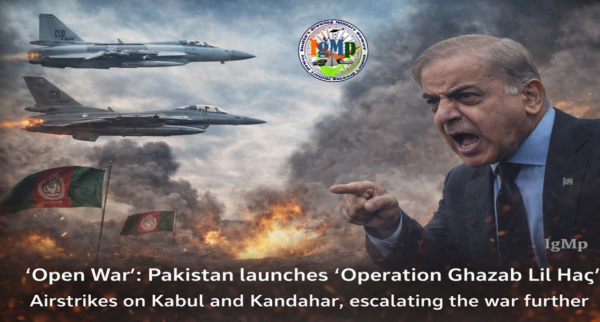
Tensions between Pakistan and Taliban-led Afghanistan have surged dramatically after Islamabad announced the launch of “Operation Ghazab Lil Haq,” a series of overnight airstrikes targeting sites in Kabul and Kandahar. The operation, described by Pakistani officials as a response to what they called unprovoked cross-border attacks, signals one of the most serious escalations between the two neighbours since the Taliban returned to power in 2021.
Residents in Kabul reported hearing fighter jets overhead followed by multiple explosions that echoed across parts of the capital late Thursday night. Similar accounts emerged from Kandahar, the spiritual heartland of the Taliban movement and base of its supreme leader. While Afghan authorities confirmed the strikes, they rejected Pakistan’s claims of heavy militant casualties and insisted that no significant losses had occurred on their side. Islamabad, however, maintained that the operation was “effective,” alleging over a hundred militants were killed in what it described as precision strikes on military facilities.
Pakistan’s Prime Minister Shehbaz Sharif publicly backed the military action, asserting that Pakistan’s armed forces are fully capable of countering aggression. His remarks were echoed by senior officials who framed the air campaign as a defensive response following earlier clashes along the disputed Durand Line, the 2,611-kilometre border that Afghanistan has never formally recognised.
The crisis did not erupt overnight. Relations between Islamabad and Kabul have been steadily deteriorating over accusations that Tehrik-i-Taliban Pakistan (TTP) militants operate from Afghan territory. Pakistan blames cross-border insurgent attacks for a surge in violence inside Khyber Pakhtunkhwa and Balochistan provinces. The Afghan Taliban deny harbouring anti-Pakistan groups, arguing that security within Pakistan is an internal matter.
The Durand Line has long been a flashpoint. Skirmishes, artillery exchanges and temporary border closures have periodically disrupted trade and civilian movement. Key crossings such as Torkham have seen repeated shutdowns, affecting thousands of Afghan returnees and traders. In recent days, reports of civilian injuries near refugee camps have further complicated the humanitarian picture, with local officials describing mortar impacts close to residential areas.
Independent verification of casualty figures from either side remains difficult. Pakistan claims significant militant losses, while Taliban spokespersons counter that civilian areas were hit and that Pakistani troops have also suffered casualties in retaliatory exchanges. The information war unfolding alongside the military confrontation underscores how fragile trust has become.
Regional powers are watching closely. Saudi Arabia previously mediated limited confidence-building measures after earlier border incidents, including the release of detained soldiers. Whether such diplomacy can resume amid intensified hostilities remains uncertain. The broader concern is strategic stability: both nations face internal security pressures, economic strain, and international scrutiny. A prolonged military exchange would deepen instability across South and Central Asia.
For India and other regional stakeholders, developments along the Afghanistan-Pakistan frontier carry long-term implications. An expanded conflict could shift militant dynamics, strain refugee flows, and alter the security architecture of the wider region. Analysts note that neither Islamabad nor Kabul appears eager for full-scale war, yet tit-for-tat retaliation risks miscalculation.
The unfolding confrontation reflects a deeper structural tension rooted in contested borders, militant sanctuaries, and competing narratives of sovereignty. Whether “Operation Ghazab Lil Haq” becomes a short, sharp signal or the beginning of a longer conflict will depend on diplomatic backchannels, restraint on both sides, and the willingness to separate domestic politics from regional stability.